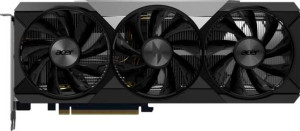
The most telling performance divide between the Acer Nitro RX 9070 OC and the Nvidia GeForce RTX 5080 lies in their shader counts and raw compute output. The RTX 5080 deploys a massive 10,752 shading units alongside 336 TMUs, compared to the RX 9070 OC's 3,584 shaders and 224 TMUs. This directly feeds into the RTX 5080's substantially higher floating-point performance of 56.34 TFLOPS versus 38.71 TFLOPS, and a texture fill rate of 880 GTexels/s vs 604.8 GTexels/s — advantages that translate to noticeably better performance in compute-heavy workloads, complex shader scenes, and high-resolution rendering.
There are a few areas where the RX 9070 OC punches back. Its higher ROP count (128 vs 112) gives it a superior pixel fill rate of 345.6 GPixel/s against the RTX 5080's 293.4 GPixel/s, which can benefit scenarios involving heavy blending or high-resolution output throughput. Additionally, the RX 9070 OC's GPU memory runs at a significantly faster 2,518 MHz versus 1,875 MHz — a meaningful gap that can help sustain memory bandwidth under pressure. On clock speeds, the RX 9070 OC actually edges out a slightly higher turbo ceiling (2,700 MHz vs 2,620 MHz), though this advantage is narrow.
Overall, the RTX 5080 holds a clear performance advantage in this group. Its dominant shader and compute architecture results in a substantially higher TFLOPS figure and texture throughput, which are the primary drivers of GPU performance in most real-world graphics workloads. The RX 9070 OC's leads in pixel rate and memory clock are real but not sufficient to close the gap at this level of compute disparity.