Acer Nitro Radeon RX 9070 OC
PowerColor Hellhound Radeon RX 9070

Acer Nitro Radeon RX 9070 OC PowerColor Hellhound Radeon RX 9070

Overview

When choosing between the Acer Nitro Radeon RX 9070 OC and the PowerColor Hellhound Radeon RX 9070, buyers are faced with two RDNA 4.0 cards built on the same 5 nm foundation yet tuned very differently. This comparison digs into their clock speeds and raw compute throughput, their power consumption, physical dimensions, and feature-set distinctions like DirectX support to help you decide which card fits your build best.

Common Features

  • Both cards share the same GPU memory speed of 2518 MHz.
  • Both cards have 3584 shading units.
  • Both cards have 224 texture mapping units (TMUs).
  • Both cards have 128 render output units (ROPs).
  • Double Precision Floating Point (DPFP) is supported on both cards.
  • Both cards have an effective memory speed of 20000 MHz.
  • Both cards come with 16GB of VRAM.
  • Both cards use GDDR6 memory.
  • Both cards feature a 256-bit memory bus width.
  • ECC memory is supported on both cards.
  • Both cards support OpenGL version 4.6.
  • Both cards support OpenCL version 2.2.
  • Multi-display technology is supported on both cards.
  • Ray tracing is supported on both cards.
  • 3D support is available on both cards.
  • DLSS support is not available on either card.
  • FSR4 is supported on both cards.
  • XeSS (XMX) support is not available on either card.
  • Both cards have one HDMI 2.1b output and three DisplayPort outputs, with no USB-C, DVI, or mini DisplayPort outputs.
  • Both cards are built on the RDNA 4.0 architecture using a 5 nm process with 53900 million transistors, connected via PCIe 5, and use air cooling only.

Main Differences

  • GPU base clock speed is 1440 MHz on Acer Nitro Radeon RX 9070 OC and 1330 MHz on PowerColor Hellhound Radeon RX 9070.
  • GPU turbo clock speed is 2700 MHz on Acer Nitro Radeon RX 9070 OC and 2590 MHz on PowerColor Hellhound Radeon RX 9070.
  • Pixel rate is 345.6 GPixel/s on Acer Nitro Radeon RX 9070 OC and 331.5 GPixel/s on PowerColor Hellhound Radeon RX 9070.
  • Floating-point performance is 38.71 TFLOPS on Acer Nitro Radeon RX 9070 OC and 37.13 TFLOPS on PowerColor Hellhound Radeon RX 9070.
  • Texture rate is 604.8 GTexels/s on Acer Nitro Radeon RX 9070 OC and 580.2 GTexels/s on PowerColor Hellhound Radeon RX 9070.
  • Maximum memory bandwidth is 644 GB/s on Acer Nitro Radeon RX 9070 OC and 644.6 GB/s on PowerColor Hellhound Radeon RX 9070.
  • DirectX 12 Ultimate is supported on Acer Nitro Radeon RX 9070 OC, while PowerColor Hellhound Radeon RX 9070 supports DirectX 12 only.
  • Thermal Design Power (TDP) is 245W on Acer Nitro Radeon RX 9070 OC and 220W on PowerColor Hellhound Radeon RX 9070.
  • Card width is 295 mm on Acer Nitro Radeon RX 9070 OC and 340 mm on PowerColor Hellhound Radeon RX 9070.
  • Card height is 120 mm on Acer Nitro Radeon RX 9070 OC and 142 mm on PowerColor Hellhound Radeon RX 9070.
Specs Comparison
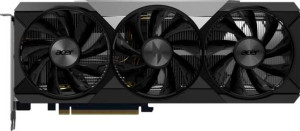
Acer Nitro Radeon RX 9070 OC

Acer Nitro Radeon RX 9070 OC

PowerColor Hellhound Radeon RX 9070

PowerColor Hellhound Radeon RX 9070

Performance:
GPU clock speed 1440 MHz 1330 MHz
GPU turbo 2700 MHz 2590 MHz
pixel rate 345.6 GPixel/s 331.5 GPixel/s
floating-point performance 38.71 TFLOPS 37.13 TFLOPS
texture rate 604.8 GTexels/s 580.2 GTexels/s
GPU memory speed 2518 MHz 2518 MHz
shading units 3584 3584
texture mapping units (TMUs) 224 224
render output units (ROPs) 128 128
Has Double Precision Floating Point (DPFP)

Both cards are built on identical silicon, sharing the same 3584 shading units, 224 TMUs, and 128 ROPs — meaning any performance gap between them comes purely from clock speeds, not architectural differences. This makes the comparison straightforward: the Acer Nitro RX 9070 OC carries a factory overclock that pushes its base clock to 1440 MHz and its boost to 2700 MHz, while the PowerColor Hellhound runs at 1330 MHz base and 2590 MHz boost. That is a roughly 8% clock speed advantage for the Acer at base and around 4% at turbo.

Those clock differences flow directly into every throughput metric. The Acer delivers 38.71 TFLOPS of floating-point performance versus 37.13 TFLOPS on the Hellhound — a gap of about 4.3%. Similarly, texture throughput lands at 604.8 GTexels/s against 580.2 GTexels/s, and pixel fill rate at 345.6 GPixel/s versus 331.5 GPixel/s. In practice, these margins translate to a modest but measurable frame rate advantage in GPU-bound scenarios, particularly at higher resolutions where fill rate and shader throughput become the bottleneck. Memory bandwidth is a non-issue here — both cards run their GDDR6 at an identical 2518 MHz, so there is no differentiation on that front.

The Acer Nitro RX 9070 OC holds a clear edge in this group. It consistently outperforms the Hellhound across every throughput metric solely due to its higher factory overclock. The gap is not dramatic — real-world frame rate differences will likely fall in the low single digits percentagewise — but it is consistent and entirely in the Acer's favor. Buyers who prioritize out-of-the-box peak performance without manual overclocking will find the Acer the stronger choice here.

Memory:
effective memory speed 20000 MHz 20000 MHz
maximum memory bandwidth 644 GB/s 644.6 GB/s
VRAM 16GB 16GB
GDDR version GDDR6 GDDR6
memory bus width 256-bit 256-bit
Supports ECC memory

On paper, the memory configurations of these two cards are virtually indistinguishable. Both feature 16GB of GDDR6 on a 256-bit bus running at an effective 20000 MHz, yielding maximum bandwidth figures of 644 GB/s and 644.6 GB/s respectively — a rounding-level difference of less than 0.1% that will never manifest in any real workload. The 256-bit bus width is a meaningful spec in context: it is wide enough to keep the GPU's shader array fed at 4K and in VRAM-heavy scenarios like high-resolution texture packs or large AI inference tasks, without the added cost and power draw of a 320-bit or 384-bit design.

The 16GB VRAM is the headline figure that matters most to buyers. At this capacity, both cards are well-positioned for demanding workloads in 2025 and beyond — modern AAA titles with ultra texture settings, content creation pipelines, and local AI model inference all benefit significantly from having headroom beyond the 8–12GB range common in lower-tier cards. ECC memory support on both adds a layer of reliability relevant to professional or compute use cases, where silent data corruption is a concern.

This group is a dead heat. Every meaningful memory specification — capacity, bus width, speed, bandwidth, and ECC support — is shared between the Acer Nitro RX 9070 OC and the PowerColor Hellhound RX 9070. Neither card holds any advantage here, and memory configuration should play no role in choosing between them.

Features:
DirectX version DirectX 12 Ultimate DirectX 12
OpenGL version 4.6 4.6
OpenCL version 2.2 2.2
Supports multi-display technology
supports ray tracing
Supports 3D
supports DLSS
has FSR4
has XeSS (XMX)
AMD SAM / Intel Resizable BAR AMD SAM AMD SAM
has LHR
has RGB lighting
supported displays 4 4

The one meaningful differentiator in this group is the DirectX version. The Acer Nitro RX 9070 OC lists DirectX 12 Ultimate, while the PowerColor Hellhound RX 9070 lists only DirectX 12. DirectX 12 Ultimate is Microsoft's feature tier that formally certifies support for hardware ray tracing, mesh shaders, variable rate shading, and sampler feedback — capabilities that game developers can rely on being present without fallback checks. In practice, both cards support ray tracing as a listed feature, but the Ultimate certification on the Acer signals a more complete and formally validated feature set for current and future DX12U titles.

Everything else in this group is shared ground. Both support FSR4 — AMD's latest upscaling generation — which is the most relevant AI-assisted rendering feature for this platform, given that neither card supports DLSS (an Nvidia-exclusive technology). FSR4 can deliver meaningful resolution upscaling and frame generation benefits in supported titles. Both also carry AMD SAM (Smart Access Memory), ray tracing, multi-display output across up to 4 displays, and RGB lighting, leaving no further gaps between them on the feature checklist.

The Acer Nitro RX 9070 OC holds a narrow edge here strictly due to its DirectX 12 Ultimate designation versus the Hellhound's plain DirectX 12 listing. For most users today the gap is unlikely to surface in day-to-day gaming, but for those who prioritize forward compatibility and full access to the DX12U feature tier without ambiguity, the Acer is the safer specification on paper.
Ports:
has an HDMI output
HDMI ports 1 1
HDMI version HDMI 2.1b HDMI 2.1b
DisplayPort outputs 3 3
USB-C ports 0 0
DVI outputs 0 0
mini DisplayPort outputs 0 0

Port selection is identical across both cards: one HDMI 2.1b output and three DisplayPort outputs, totaling four display connections — consistent with the four-display limit noted in the Features group. HDMI 2.1b is the current high-bandwidth revision of the standard, capable of driving 4K at 144Hz or 8K at 60Hz without compression, making it well-suited for modern high-refresh gaming monitors and living room setups alike. The three DisplayPort outputs provide flexibility for multi-monitor productivity or gaming arrangements without requiring adapters.

Neither card offers USB-C, mini DisplayPort, or DVI outputs. The absence of USB-C is worth noting for users with newer monitors that rely on that connection, as an adapter would be required — but this is a shared limitation, not a differentiator between the two.

This group is a complete tie. Every port — type, count, and version — is identical on both the Acer Nitro RX 9070 OC and the PowerColor Hellhound RX 9070. Connectivity should not factor into the decision between these two cards.

General info:
GPU architecture RDNA 4.0 RDNA 4.0
release date March 2025 March 2025
Thermal Design Power (TDP) 245W 220W
PCI Express (PCIe) version 5 5
semiconductor size 5 nm 5 nm
number of transistors 53900 million 53900 million
Has air-water cooling
width 295 mm 340 mm
height 120 mm 142 mm

Sharing the same RDNA 4.0 architecture, 5nm process node, and identical transistor count of 53,900 million, these two cards are cut from exactly the same silicon cloth. The shared PCIe 5.0 interface is also a non-issue — both will perform identically in any current or near-future motherboard. Where this group gets interesting is in the two specs that most directly affect build compatibility and running costs: power consumption and physical size.

The Acer Nitro RX 9070 OC carries a 245W TDP versus the PowerColor Hellhound's 220W — a 25W gap that directly explains the Acer's higher factory overclock seen in the Performance group. That extra power draw requires more headroom from the PSU and contributes additional heat to the case. The size difference is equally notable: the Hellhound is substantially larger at 340 × 142 mm compared to the Acer's more compact 295 × 120 mm footprint. The Hellhound's larger cooler is likely what allows it to manage a higher-clocked card's thermals with less power — except here the roles are reversed, with the bigger card actually drawing less power, suggesting PowerColor prioritized cooling headroom and efficiency over peak clock speed.

Which card has the edge here depends on the use case. The PowerColor Hellhound holds an advantage in power efficiency at 220W TDP, making it the friendlier option for tighter PSU budgets and thermally constrained cases — though its larger physical dimensions may actually create fitment challenges in smaller mid-tower builds. The Acer Nitro, despite its higher power draw, is the more physically compact card at 295mm, which could be the deciding factor for users with case length restrictions.

Comparison Summary & Verdict

Both cards share the same RDNA 4.0 architecture, 16 GB of GDDR6 memory, ray tracing, FSR4, and an identical port layout, so neither has a fundamental feature advantage. The Acer Nitro Radeon RX 9070 OC pulls ahead with a higher turbo clock of 2700 MHz, 38.71 TFLOPS of floating-point performance, and DirectX 12 Ultimate support, making it the stronger pick for enthusiasts who want every last frame and access to advanced DX12 features. However, it draws 245W and has a more compact 295 x 120 mm footprint. The PowerColor Hellhound Radeon RX 9070, by contrast, operates at a cooler 220W TDP, which makes it friendlier to modest PSUs and thermals, though its larger 340 x 142 mm body demands a roomier case. If outright performance and feature completeness are your priority, lean toward the Acer Nitro; if power efficiency and quieter thermals matter more, the Hellhound is the sensible choice.

Acer Nitro Radeon RX 9070 OC
Buy Acer Nitro Radeon RX 9070 OC if...

Buy the Acer Nitro Radeon RX 9070 OC if you want the highest clock speeds, greater floating-point performance, and DirectX 12 Ultimate support, and your system can comfortably handle a 245W power draw.

PowerColor Hellhound Radeon RX 9070
Buy PowerColor Hellhound Radeon RX 9070 if...

Buy the PowerColor Hellhound Radeon RX 9070 if a lower 220W TDP and reduced power consumption are priorities for your build, and you do not specifically require DirectX 12 Ultimate.