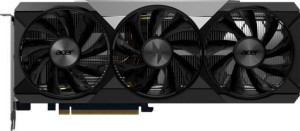
At first glance, the Asus Dual RTX 5070 appears to hold a raw compute advantage with its massive 6,144 shading units versus the 3,584 on the Acer Nitro RX 9070 — nearly 72% more. However, shading unit count alone is an architectural figure that does not translate directly into real-world throughput without context, and the remaining specs tell a very different story.
When examining actual throughput metrics, the RX 9070 pulls decisively ahead across the board. Its floating-point performance of 36.13 TFLOPS outpaces the RTX 5070's 30.87 TFLOPS by roughly 17%, meaning it can execute more shader operations per second in practice. This advantage extends to rasterization workloads: the RX 9070's pixel fill rate of 322.6 GPixel/s is over 60% higher than the RTX 5070's 201 GPixel/s, which directly benefits frame rendering throughput. Similarly, its texture rate of 564.5 GTexels/s edges out the RTX 5070's 482.3 GTexels/s, supported by more TMUs (224 vs. 192) and significantly more ROPs (128 vs. 80) — the latter being critical for high-resolution output and anti-aliasing. The RX 9070 also runs its memory at a notably faster 2518 MHz versus the RTX 5070's 1750 MHz, which reduces memory bandwidth bottlenecks in texture-heavy scenes.
One curiosity is the clock speed dynamic: the RTX 5070 has a much higher base clock (2325 MHz vs. 1330 MHz), yet its turbo ceiling (2512 MHz) is virtually identical to the RX 9070's (2520 MHz). This suggests the RTX 5070 operates in a narrower boost window while the RX 9070 scales more aggressively from base to turbo. Overall, based strictly on the provided performance specs, the Acer Nitro RX 9070 holds a clear edge in real-world throughput metrics — FLOPS, pixel rate, texture rate, and memory speed — making it the stronger performer in this group.