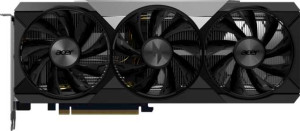
Looking at raw compute throughput, the Acer Nitro RX 9070 XT OC holds a commanding lead across nearly every meaningful metric. Its 50.79 TFLOPS of floating-point performance is more than double the RTX 5060 Ti's 23.69 TFLOPS, and this gap is mirrored in texture throughput — 793.6 GTexels/s versus 370.1 GTexels/s — meaning the 9070 XT can process geometry and shading workloads at roughly twice the rate. In practice, this translates to more headroom for high-resolution rendering, complex shader-heavy scenes, and demanding rasterization workloads.
The pixel rate gap is even more striking: the RX 9070 XT's 396.8 GPixel/s dwarfs the RTX 5060 Ti's 123.4 GPixel/s, a direct consequence of the 9070 XT having 128 ROPs compared to just 48 on the 5060 Ti. ROPs are the final stage of the rendering pipeline, writing completed pixels to the framebuffer, so a nearly 3x advantage here is especially significant for high-resolution or high-refresh-rate gaming where fill rate becomes a bottleneck. The 9070 XT also has a notably higher GPU memory speed (2518 MHz vs 1750 MHz), which supports faster data throughput to feed those extra execution resources. The RTX 5060 Ti does edge ahead in raw shading unit count (4608 vs 4096) and base clock speed, but this advantage is effectively negated by the 9070 XT's substantially higher turbo clock of 3100 MHz versus 2570 MHz.
Both cards support Double Precision Floating Point, so neither has an exclusive advantage for compute or professional workloads on that front. Overall, based strictly on the provided performance specifications, the RX 9070 XT OC has a clear and decisive advantage in this group — it outpaces the RTX 5060 Ti in compute throughput, texture processing, pixel fill rate, and memory speed by significant margins, pointing to a substantially higher performance ceiling in GPU-bound scenarios.