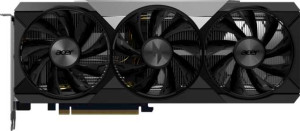
Acer Nitro Radeon RX 9070 XT OC
Nvidia GeForce RTX 5070 Ti

Acer Nitro Radeon RX 9070 XT OC Nvidia GeForce RTX 5070 Ti

Overview

Welcome to our in-depth spec comparison between the Acer Nitro Radeon RX 9070 XT OC and the Nvidia GeForce RTX 5070 Ti — two powerful mid-to-high-end GPUs that take very different paths to performance. From their contrasting GPU architectures to differences in memory technology, shading unit counts, and feature sets, there is plenty to unpack before deciding which card belongs in your build.

Common Features

  • Both GPUs support Double Precision Floating Point (DPFP).
  • Both cards come with 16GB of VRAM.
  • Both use a 256-bit memory bus width.
  • ECC memory is supported on both products.
  • Both GPUs support DirectX 12 Ultimate.
  • Both cards support OpenGL version 4.6.
  • Multi-display technology is supported on both products.
  • Ray tracing is supported on both GPUs.
  • 3D support is available on both cards.
  • XeSS (XMX) support is not available on either product.
  • LHR (Lite Hash Rate) is not present on either GPU.
  • Both cards support up to 4 displays simultaneously.
  • Both GPUs include one HDMI port running HDMI 2.1b.
  • Both cards offer 3 DisplayPort outputs.
  • Neither card includes USB-C ports, DVI outputs, or mini DisplayPort outputs.
  • Both GPUs use PCI Express version 5.
  • Air-water cooling is not available on either product.

Main Differences

  • GPU base clock speed is 1870 MHz on Acer Nitro Radeon RX 9070 XT OC and 2300 MHz on Nvidia GeForce RTX 5070 Ti.
  • GPU turbo clock speed is 3100 MHz on Acer Nitro Radeon RX 9070 XT OC and 2450 MHz on Nvidia GeForce RTX 5070 Ti.
  • Pixel rate is 396.8 GPixel/s on Acer Nitro Radeon RX 9070 XT OC and 235.2 GPixel/s on Nvidia GeForce RTX 5070 Ti.
  • Floating-point performance is 50.79 TFLOPS on Acer Nitro Radeon RX 9070 XT OC and 43.94 TFLOPS on Nvidia GeForce RTX 5070 Ti.
  • Texture rate is 793.6 GTexels/s on Acer Nitro Radeon RX 9070 XT OC and 686.6 GTexels/s on Nvidia GeForce RTX 5070 Ti.
  • GPU memory speed is 2518 MHz on Acer Nitro Radeon RX 9070 XT OC and 1750 MHz on Nvidia GeForce RTX 5070 Ti.
  • Shading units count is 4096 on Acer Nitro Radeon RX 9070 XT OC and 8960 on Nvidia GeForce RTX 5070 Ti.
  • Texture mapping units (TMUs) number 256 on Acer Nitro Radeon RX 9070 XT OC and 280 on Nvidia GeForce RTX 5070 Ti.
  • Render output units (ROPs) total 128 on Acer Nitro Radeon RX 9070 XT OC and 96 on Nvidia GeForce RTX 5070 Ti.
  • Effective memory speed is 20000 MHz on Acer Nitro Radeon RX 9070 XT OC and 28000 MHz on Nvidia GeForce RTX 5070 Ti.
  • Maximum memory bandwidth is 644 GB/s on Acer Nitro Radeon RX 9070 XT OC and 896 GB/s on Nvidia GeForce RTX 5070 Ti.
  • The Acer Nitro Radeon RX 9070 XT OC uses GDDR6 memory, while the Nvidia GeForce RTX 5070 Ti uses GDDR7.
  • OpenCL version is 0 on Acer Nitro Radeon RX 9070 XT OC and 3 on Nvidia GeForce RTX 5070 Ti.
  • DLSS support is present on Nvidia GeForce RTX 5070 Ti but not available on Acer Nitro Radeon RX 9070 XT OC.
  • The Acer Nitro Radeon RX 9070 XT OC features AMD SAM, while the Nvidia GeForce RTX 5070 Ti uses Intel Resizable BAR.
  • RGB lighting is present on Acer Nitro Radeon RX 9070 XT OC but not available on Nvidia GeForce RTX 5070 Ti.
  • GPU architecture is RDNA 4.0 on Acer Nitro Radeon RX 9070 XT OC and Blackwell on Nvidia GeForce RTX 5070 Ti.
  • Thermal Design Power (TDP) is 340W on Acer Nitro Radeon RX 9070 XT OC and 300W on Nvidia GeForce RTX 5070 Ti.
  • Semiconductor size is 4nm on Acer Nitro Radeon RX 9070 XT OC and 5nm on Nvidia GeForce RTX 5070 Ti.
  • Transistor count is 53,900 million on Acer Nitro Radeon RX 9070 XT OC and 45,600 million on Nvidia GeForce RTX 5070 Ti.
  • Card width is 295mm on Acer Nitro Radeon RX 9070 XT OC and 304mm on Nvidia GeForce RTX 5070 Ti.
  • Card height is 120mm on Acer Nitro Radeon RX 9070 XT OC and 137mm on Nvidia GeForce RTX 5070 Ti.
Specs Comparison
Acer Nitro Radeon RX 9070 XT OC

Acer Nitro Radeon RX 9070 XT OC

Nvidia GeForce RTX 5070 Ti

Nvidia GeForce RTX 5070 Ti

Performance:
GPU clock speed 1870 MHz 2300 MHz
GPU turbo 3100 MHz 2450 MHz
pixel rate 396.8 GPixel/s 235.2 GPixel/s
floating-point performance 50.79 TFLOPS 43.94 TFLOPS
texture rate 793.6 GTexels/s 686.6 GTexels/s
GPU memory speed 2518 MHz 1750 MHz
shading units 4096 8960
texture mapping units (TMUs) 256 280
render output units (ROPs) 128 96
Has Double Precision Floating Point (DPFP)

The most striking tension in this comparison is between shading unit count and actual compute throughput. The RTX 5070 Ti fields a massive 8960 shading units — more than double the 4096 on the RX 9070 XT OC — yet the Acer card still leads in floating-point performance at 50.79 TFLOPS versus 43.94 TFLOPS. This apparent contradiction is explained by clock speed architecture: the RX 9070 XT OC reaches a turbo of 3100 MHz, an extraordinarily high boost frequency, while the RTX 5070 Ti tops out at just 2450 MHz. The Acer card essentially compensates for fewer execution units by running each one significantly faster.

On rasterization-focused metrics — the workload that dominates traditional gaming — the RX 9070 XT OC holds a clear lead. Its pixel rate of 396.8 GPixel/s is nearly 69% higher than the RTX 5070 Ti's 235.2 GPixel/s, driven both by its clock advantage and its superior 128 ROPs versus 96. Similarly, its texture rate of 793.6 GTexels/s outpaces the Nvidia card's 686.6 GTexels/s. Memory bandwidth potential also favors the Acer card, with a GPU memory speed of 2518 MHz compared to 1750 MHz — faster memory feeds the GPU pipeline more efficiently, reducing bottlenecks in high-resolution or texture-heavy scenes.

For this spec group, the RX 9070 XT OC holds a meaningful edge across the majority of raw performance indicators: higher TFLOPS, higher pixel and texture fill rates, more ROPs, and faster memory. The RTX 5070 Ti's shading unit advantage does not translate into a compute lead here, though it may contribute to workloads that scale more directly with shader count outside of traditional rasterization. Both cards support Double Precision Floating Point, so that is a non-differentiator.

Memory:
effective memory speed 20000 MHz 28000 MHz
maximum memory bandwidth 644 GB/s 896 GB/s
VRAM 16GB 16GB
GDDR version GDDR6 GDDR7
memory bus width 256-bit 256-bit
Supports ECC memory

The Acer Nitro Radeon RX 9070 XT OC and Nvidia GeForce RTX 5070 Ti share some similarities in their memory specifications but differ in key areas. Both cards feature 16GB of VRAM and use a 256-bit memory bus width, ensuring ample bandwidth for high-performance tasks. Additionally, both products support ECC memory, which helps maintain data integrity during heavy computational loads.

However, the two cards differ significantly in their memory speeds and bandwidth. The RX 9070 XT OC has an effective memory speed of 20000 MHz and a maximum memory bandwidth of 644 GB/s. In contrast, the RTX 5070 Ti benefits from a faster memory setup, with an effective memory speed of 28000 MHz and a maximum memory bandwidth of 896 GB/s.

Another distinction lies in the GDDR version: the RX 9070 XT OC uses GDDR6 memory, while the RTX 5070 Ti features the newer GDDR7 memory. This difference in memory technology may influence overall performance, with GDDR7 offering potential advantages in data transfer rates and efficiency.

Features:
DirectX version DirectX 12 Ultimate DirectX 12 Ultimate
OpenGL version 4.6 4.6
OpenCL version 0 3
Supports multi-display technology
supports ray tracing
Supports 3D
supports DLSS
has XeSS (XMX)
AMD SAM / Intel Resizable BAR AMD SAM Intel Resizable BAR
has LHR
has RGB lighting
supported displays 4 4

The Acer Nitro Radeon RX 9070 XT OC and Nvidia GeForce RTX 5070 Ti offer similar features in several areas, but there are some differences in specific capabilities. Both cards support DirectX 12 Ultimate, OpenGL 4.6, multi-display technology, ray tracing, and 3D support, ensuring robust performance for modern gaming and multimedia applications.

When it comes to OpenCL support, the RX 9070 XT OC does not offer any OpenCL version, while the RTX 5070 Ti supports OpenCL version 3. Another distinction is in the support for DLSS, where the RTX 5070 Ti has this feature, but the RX 9070 XT OC does not. Additionally, the RX 9070 XT OC supports AMD SAM, while the RTX 5070 Ti uses Intel Resizable BAR for system optimizations.

On the aesthetic front, the RX 9070 XT OC includes RGB lighting, while the RTX 5070 Ti does not. Both cards support up to four displays, and neither has LHR (Lite Hash Rate) limitations. Both products also lack support for XeSS (XMX), a feature related to Intel’s AI-powered scaling technology.

Ports:
has an HDMI output
HDMI ports 1 1
HDMI version HDMI 2.1b HDMI 2.1b
DisplayPort outputs 3 3
USB-C ports 0 0
DVI outputs 0 0
mini DisplayPort outputs 0 0

The Acer Nitro Radeon RX 9070 XT OC and Nvidia GeForce RTX 5070 Ti are quite similar when it comes to their port configurations. Both cards feature one HDMI output, with an HDMI version of 2.1b, ensuring support for high-quality video and audio output. They also offer three DisplayPort outputs, providing additional options for connecting multiple displays.

Neither card includes USB-C ports, DVI outputs, or mini DisplayPort outputs, so users looking for those specific types of connectivity will need to explore other options. Overall, the port configurations of both cards are identical in terms of HDMI, DisplayPort, and lack of other ports.

General info:
GPU architecture RDNA 4.0 Blackwell
release date March 2025 January 2025
Thermal Design Power (TDP) 340W 300W
PCI Express (PCIe) version 5 5
semiconductor size 4 nm 5 nm
number of transistors 53900 million 45600 million
Has air-water cooling
width 295 mm 304 mm
height 120 mm 137 mm

The Acer Nitro Radeon RX 9070 XT OC and Nvidia GeForce RTX 5070 Ti feature different GPU architectures and physical characteristics. The RX 9070 XT OC is based on the RDNA 4.0 architecture, while the RTX 5070 Ti uses the Blackwell architecture.

In terms of power consumption, the RX 9070 XT OC has a higher Thermal Design Power (TDP) of 340W, compared to the RTX 5070 Ti's 300W. Both products utilize PCI Express 5.0, ensuring fast data transfer speeds. The RX 9070 XT OC is built on a 4 nm semiconductor size, while the RTX 5070 Ti uses a slightly larger 5 nm semiconductor.

The RX 9070 XT OC contains 53.9 billion transistors, surpassing the RTX 5070 Ti's 45.6 billion transistors. Neither card includes air-water cooling. In terms of size, the RX 9070 XT OC is 295 mm wide and 120 mm high, while the RTX 5070 Ti is slightly larger at 304 mm wide and 137 mm high.

Comparison Summary & Verdict

After examining all available specifications, both GPUs are compelling but serve slightly different audiences. The Acer Nitro Radeon RX 9070 XT OC stands out with a higher GPU turbo clock of 3100 MHz, superior floating-point performance at 50.79 TFLOPS, a better pixel and texture rate, and a more advanced 4nm manufacturing process — making it an excellent choice for raw rasterization workloads. It also includes RGB lighting and AMD SAM support. On the other hand, the Nvidia GeForce RTX 5070 Ti counters with a significantly higher shading unit count of 8960, faster GDDR7 memory delivering up to 896 GB/s of bandwidth, DLSS support, and a lower 300W TDP — advantages that matter greatly for AI-accelerated rendering and memory-intensive workloads. Neither card is a universal winner; your ideal choice depends entirely on your software ecosystem and workload priorities.

Acer Nitro Radeon RX 9070 XT OC
Buy Acer Nitro Radeon RX 9070 XT OC if...

Buy the Acer Nitro Radeon RX 9070 XT OC if you want higher raw rasterization performance, a faster GPU turbo clock, and superior floating-point throughput, especially within an AMD ecosystem that benefits from SAM support.

Nvidia GeForce RTX 5070 Ti
Buy Nvidia GeForce RTX 5070 Ti if...

Buy the Nvidia GeForce RTX 5070 Ti if you prioritize faster GDDR7 memory bandwidth, a much higher shading unit count, DLSS support, and a lower power draw for a more efficient, AI-accelerated gaming experience.