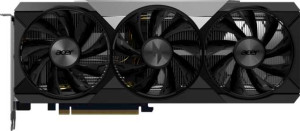
Acer Nitro Radeon RX 9070 XT OC
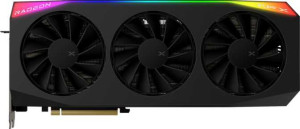
XFX Mercury Radeon RX 9070 XT OC Gaming Edition

Acer Nitro Radeon RX 9070 XT OC XFX Mercury Radeon RX 9070 XT OC Gaming Edition

Overview

Welcome to our in-depth spec comparison between the Acer Nitro Radeon RX 9070 XT OC and the XFX Mercury Radeon RX 9070 XT OC Gaming Edition. Both cards are built on AMD’s cutting-edge RDNA 4.0 architecture with identical core clocks, VRAM, and port configurations — but they diverge in key areas like power consumption, physical dimensions, and OpenCL support that could matter depending on your build and workflow.

Common Features

  • Both cards have a base GPU clock speed of 1870 MHz.
  • Both cards have a GPU turbo clock of 3100 MHz.
  • Both cards deliver a pixel rate of 396.8 GPixel/s.
  • Both cards offer a floating-point performance of 50.79 TFLOPS.
  • Both cards have a texture rate of 793.6 GTexels/s.
  • Both cards have a GPU memory speed of 2518 MHz.
  • Both cards feature 4096 shading units.
  • Both cards have 256 texture mapping units (TMUs).
  • Both cards have an effective memory speed of 20000 MHz.
  • Both cards come with 16GB of VRAM.
  • Both cards use GDDR6 memory.
  • Both cards have a 256-bit memory bus width.
  • ECC memory support is available on both cards.
  • Both cards support DirectX 12 Ultimate.
  • Both cards support OpenGL version 4.6.
  • Multi-display technology support is available on both cards.
  • Ray tracing support is available on both cards.
  • 3D support is available on both cards.
  • DLSS support is not available on either card.
  • FSR4 support is available on both cards.
  • XeSS (XMX) support is not available on either card.
  • Both cards include one HDMI 2.1b output.
  • Both cards feature three DisplayPort outputs.
  • Neither card has any USB-C or DVI outputs.
  • Both cards are built on the RDNA 4.0 GPU architecture.
  • Both cards use a PCIe 5 interface.
  • Both cards are manufactured using a 4 nm semiconductor process.
  • Both cards contain 53900 million transistors.
  • Neither card uses air-water cooling.

Main Differences

  • Maximum memory bandwidth is 644 GB/s on Acer Nitro Radeon RX 9070 XT OC and 640 GB/s on XFX Mercury Radeon RX 9070 XT OC Gaming Edition.
  • OpenCL support is not present on Acer Nitro Radeon RX 9070 XT OC, while XFX Mercury Radeon RX 9070 XT OC Gaming Edition supports OpenCL version 2.2.
  • Thermal Design Power (TDP) is 340W on Acer Nitro Radeon RX 9070 XT OC and 304W on XFX Mercury Radeon RX 9070 XT OC Gaming Edition.
  • Card width is 295 mm on Acer Nitro Radeon RX 9070 XT OC and 360 mm on XFX Mercury Radeon RX 9070 XT OC Gaming Edition.
  • Card height is 120 mm on Acer Nitro Radeon RX 9070 XT OC and 155 mm on XFX Mercury Radeon RX 9070 XT OC Gaming Edition.
Specs Comparison
Acer Nitro Radeon RX 9070 XT OC

Acer Nitro Radeon RX 9070 XT OC

XFX Mercury Radeon RX 9070 XT OC Gaming Edition

XFX Mercury Radeon RX 9070 XT OC Gaming Edition

Performance:
GPU clock speed 1870 MHz 1870 MHz
GPU turbo 3100 MHz 3100 MHz
pixel rate 396.8 GPixel/s 396.8 GPixel/s
floating-point performance 50.79 TFLOPS 50.79 TFLOPS
texture rate 793.6 GTexels/s 793.6 GTexels/s
GPU memory speed 2518 MHz 2518 MHz
shading units 4096 4096
texture mapping units (TMUs) 256 256
render output units (ROPs) 128 128
Has Double Precision Floating Point (DPFP)

When comparing the performance specs of the Acer Nitro RX 9070 XT OC and the XFX Mercury RX 9070 XT OC Gaming Edition, the result is a perfect tie across every single metric. Both cards share an identical base clock of 1870 MHz and a turbo clock of 3100 MHz, meaning neither will boost higher or sustain frequencies longer than the other under equivalent thermal conditions — at least on paper.

At the compute level, both deliver 50.79 TFLOPS of floating-point performance, backed by the same 4096 shading units, 256 TMUs, and 128 ROPs. This translates to identical theoretical throughput in rasterization workloads, with a texture fill rate of 793.6 GTexels/s and a pixel rate of 396.8 GPixel/s — figures that place both cards firmly in the high-end tier for 1440p and capable 4K gaming. Memory bandwidth is also matched, with both running at 2518 MHz on the GPU memory side. Both also support Double Precision Floating Point, which is relevant for compute and professional workloads beyond gaming.

In this performance group, there is no measurable advantage for either card. Any real-world difference in performance will come down to factors outside this spec group — such as cooling solution quality, power delivery, or factory overclocking headroom — rather than these core GPU compute figures, which are essentially determined by the shared Radeon RX 9070 XT silicon underneath.

Memory:
effective memory speed 20000 MHz 20000 MHz
maximum memory bandwidth 644 GB/s 640 GB/s
VRAM 16GB 16GB
GDDR version GDDR6 GDDR6
memory bus width 256-bit 256-bit
Supports ECC memory

The memory configurations of the Acer Nitro RX 9070 XT OC and the XFX Mercury RX 9070 XT OC Gaming Edition are nearly identical, sharing 16GB of GDDR6 across a 256-bit bus at an effective speed of 20000 MHz. That capacity is a meaningful advantage for high-resolution gaming and content creation workflows — 16GB comfortably handles large texture packs at 4K and leaves headroom for VRAM-hungry titles that increasingly push past the 12GB ceiling of previous-generation cards.

The one measurable difference surfaces in maximum memory bandwidth: the Acer Nitro edges ahead at 644 GB/s versus the XFX Mercury′s 640 GB/s — a gap of just 4 GB/s, or roughly 0.6%. In practice, this difference is imperceptible in any gaming or compute scenario; bandwidth at this level is more than sufficient to keep the GPU′s shader array fed without bottlenecking. Both cards also support ECC memory, which adds a layer of error-correction relevant to professional compute and machine learning workloads, though it is rarely a deciding factor for gaming buyers.

Overall, this group is effectively a tie. The Acer Nitro′s bandwidth lead exists on paper but carries no real-world significance at this margin. Buyers should weigh other spec groups — cooling, power, and features — rather than treating this 4 GB/s delta as a differentiator.

Features:
DirectX version DirectX 12 Ultimate DirectX 12 Ultimate
OpenGL version 4.6 4.6
OpenCL version 0 2.2
Supports multi-display technology
supports ray tracing
Supports 3D
supports DLSS
has FSR4
has XeSS (XMX)
AMD SAM / Intel Resizable BAR AMD SAM AMD SAM
has LHR
has RGB lighting
supported displays 4 4

Feature parity is the dominant story here, with both the Acer Nitro RX 9070 XT OC and the XFX Mercury RX 9070 XT OC Gaming Edition supporting DirectX 12 Ultimate, ray tracing, FSR4, and AMD SAM across the board. DirectX 12 Ultimate is the current standard for modern gaming, and ray tracing support ensures both cards are future-proofed for lighting-intensive titles. FSR4 — AMD′s latest upscaling generation — is a meaningful addition, offering quality-per-frame improvements that help sustain high framerates at 1440p and 4K. Neither card supports DLSS, which is expected given these are AMD GPUs, and the absence of XeSS (XMX) is similarly unsurprising.

The one spec where these two cards diverge is OpenCL: the XFX Mercury lists OpenCL 2.2 support, while the Acer Nitro shows no OpenCL version. OpenCL is a compute API used in GPU-accelerated professional applications — video processing, simulation, and certain machine learning tools. For pure gamers this distinction is irrelevant, but users running GPU compute workloads alongside gaming may find the XFX Mercury′s explicit OpenCL support a practical advantage.

On balance, the XFX Mercury holds a narrow edge in this group solely due to its OpenCL 2.2 listing. For gaming-only buyers the two cards remain functionally equivalent in features, but for anyone with mixed gaming and compute use cases, the XFX Mercury is the more versatile option based strictly on the data provided.
Ports:
has an HDMI output
HDMI ports 1 1
HDMI version HDMI 2.1b HDMI 2.1b
DisplayPort outputs 3 3
USB-C ports 0 0
DVI outputs 0 0
mini DisplayPort outputs 0 0

Port selection is identical on both the Acer Nitro RX 9070 XT OC and the XFX Mercury RX 9070 XT OC Gaming Edition: each offers three DisplayPort outputs and one HDMI 2.1b port, totaling four simultaneous display connections — which aligns with the four-display limit noted in their feature specs. This is a well-balanced layout for a high-end card, giving users the flexibility to mix and match monitor types without adapters in most common setups.

The HDMI 2.1b implementation is worth noting — it supports up to 4K at high refresh rates and 8K output, making both cards suitable for modern high-bandwidth displays and living-room gaming scenarios. The three DisplayPort outputs are equally capable for high-refresh 1440p or 4K monitors in a multi-display workstation or gaming rig. Neither card includes USB-C, mini DisplayPort, or DVI, which reflects current market trends — legacy DVI has been effectively retired, and USB-C on GPUs remains uncommon outside workstation-class products.

This group is a complete tie. Every port, version, and count is mirrored exactly between the two cards. Buyers with specific connectivity requirements — such as needing USB-C for a particular display — will find neither card meets that need, but for standard monitor configurations, both offer a practical and modern output selection.

General info:
GPU architecture RDNA 4.0 RDNA 4.0
release date March 2025 March 2025
Thermal Design Power (TDP) 340W 304W
PCI Express (PCIe) version 5 5
semiconductor size 4 nm 4 nm
number of transistors 53900 million 53900 million
Has air-water cooling
width 295 mm 360 mm
height 120 mm 155 mm

Both cards are built on the same RDNA 4.0 architecture using a 4nm process node with an identical 53.9 billion transistors, so the silicon foundation is the same. Where this group gets interesting is in how each manufacturer has chosen to implement that silicon — and the tradeoffs those choices create. The Acer Nitro RX 9070 XT OC has a TDP of 340W, while the XFX Mercury RX 9070 XT OC Gaming Edition comes in at a notably lower 304W — a 36W difference on identical GPU hardware. That gap suggests the XFX Mercury operates at a more conservative power target, which typically translates to lower heat output and quieter fan behavior under sustained load, at the potential cost of some thermal headroom for boosting.

Physical size tells the opposite story. The Acer Nitro is the more compact card at 295 × 120 mm, whereas the XFX Mercury is considerably larger at 360 × 155 mm. The XFX′s extra bulk is almost certainly dedicated to a more expansive cooling solution — larger heatsink surface area and bigger fans — which is likely how it manages to achieve that lower TDP figure while keeping thermals in check. The Acer Nitro′s smaller footprint makes it the better fit for tighter cases or builds where GPU clearance is a concern, though its higher power draw means case airflow planning becomes more important.

Neither card is strictly superior here — the choice depends on the buyer′s priorities. The XFX Mercury has the edge for system builders prioritizing power efficiency and quieter operation, while the Acer Nitro wins on physical compatibility with compact or mid-tower cases. Both share the same PCIe 5.0 interface, ensuring neither is constrained by bandwidth on any current platform.

Comparison Summary & Verdict

After examining the full spec sheets, both cards deliver the same core GPU experience: identical clocks, 16GB of GDDR6 memory, ray tracing, FSR4, and a robust port selection. The real differences lie in the details. The Acer Nitro Radeon RX 9070 XT OC is notably more compact at 295 mm wide and 120 mm tall, making it the better fit for smaller chassis or builds with tight clearance. It also edges ahead with a marginally higher maximum memory bandwidth of 644 GB/s. The XFX Mercury Radeon RX 9070 XT OC Gaming Edition, on the other hand, operates at a lower 304W TDP versus 340W, which is a meaningful advantage for power efficiency and thermals in sustained workloads. It also adds OpenCL 2.2 support, making it the stronger choice for compute or creative software tasks. Choose based on your case size and workload priorities.

Acer Nitro Radeon RX 9070 XT OC
Buy Acer Nitro Radeon RX 9070 XT OC if...

Buy the Acer Nitro Radeon RX 9070 XT OC if you have a compact case that demands a smaller card, or if you want a marginally higher maximum memory bandwidth of 644 GB/s.

XFX Mercury Radeon RX 9070 XT OC Gaming Edition
Buy XFX Mercury Radeon RX 9070 XT OC Gaming Edition if...

Buy the XFX Mercury Radeon RX 9070 XT OC Gaming Edition if you prioritize lower power consumption at 304W TDP or need OpenCL 2.2 support for compute and creative applications.