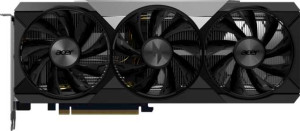
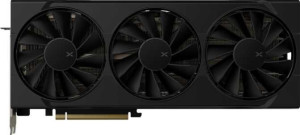
Both cards share identical silicon foundations — 4096 shading units, 256 TMUs, and 128 ROPs — meaning the underlying GPU die is the same. The real differentiator lies entirely in clock speeds. The Acer Nitro boosts to 3100 MHz at turbo, compared to 2970 MHz on the XFX Swift, a roughly 4.4% gap. At base, the difference is even larger: 1870 MHz versus 1660 MHz, suggesting the Acer Nitro is tuned more aggressively out of the box, likely backed by a more robust power delivery or cooling solution.
That clock speed advantage translates directly into every throughput metric. The Acer Nitro delivers 50.79 TFLOPS of floating-point performance against the XFX Swift's 48.66 TFLOPS, and leads in texture rate (793.6 GTexels/s vs 760.3) and pixel fill rate (396.8 vs 380.2 GPixel/s). In practice, these differences map to slightly higher average framerates and better headroom in compute-heavy scenarios like ray tracing or upscaling workloads. The gap is real but modest — roughly 4–5% across the board — so it won't be transformative, but it is consistent. Memory speed is identical at 2518 MHz on both cards, so bandwidth is a non-factor in distinguishing them.
The Acer Nitro RX 9070 XT OC holds a clear, if narrow, performance edge in this group purely on the strength of its higher factory overclock. For users who prioritize peak throughput without manual tuning, it is the stronger choice here. The XFX Swift is competitive but trails across every computed performance metric, with no offsetting advantage visible in these specs.