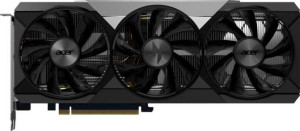
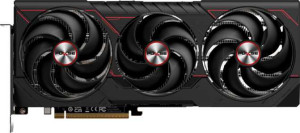
When comparing the Performance specifications of the Acer Nitro and Sapphire Pulse Radeon RX 9070 XT, the most striking finding is that every single metric is identical across both cards. Both share a base GPU clock of 1660 MHz and a turbo clock of 2970 MHz, meaning neither card has been factory overclocked relative to the other — they run at the same reference-level frequencies out of the box.
The compute and throughput figures follow naturally from those shared clocks. Both deliver 48.66 TFLOPS of floating-point performance, a texture rate of 760.3 GTexels/s, and a pixel rate of 380.2 GPixel/s — numbers that reflect the same underlying silicon configuration: 4096 shading units, 256 TMUs, and 128 ROPs. Memory bandwidth potential is equally matched, with both running GPU memory at 2518 MHz. Both cards also support Double Precision Floating Point (DPFP), which matters for compute workloads like scientific simulations or GPU-accelerated data processing, though it is less relevant for pure gaming.
In terms of raw performance, this matchup is a complete tie. Neither the Acer Nitro nor the Sapphire Pulse holds any advantage based on these specs alone — they are effectively the same GPU running at the same speeds with identical shader and render resources. A buyer choosing between the two on performance grounds should look elsewhere in the spec sheet — factors like cooling design, power delivery, or price — since neither card will outperform the other in this category.