Acer Nitro V 16 AI (2025) 16"
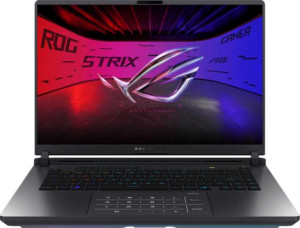
Asus ROG Strix G16 (2025) G615 16" (Core i9-14900HX / RTX 5070 Laptop / 32GB RAM / 2TB)

Acer Nitro V 16 AI (2025) 16" Asus ROG Strix G16 (2025) G615 16" (Core i9-14900HX / RTX 5070 Laptop / 32GB RAM / 2TB)

Common Features

  • Both products are gaming laptops.
  • Neither product uses a fanless design.
  • Both products have a backlit keyboard.
  • Neither product is weather-sealed.
  • Neither product has a rugged build.
  • Both products feature an LCD, LED-backlit, IPS display.
  • Both products have a 16″ screen size.
  • Neither product has a touch screen.
  • Neither product has an anti-reflection coating.
  • Both products support up to four displays.
  • Both products have 32GB of RAM.
  • Both products use flash storage.
  • Both products feature an 8GB VRAM.
  • Both products support DLSS.
  • Both products support ray tracing.
  • Both products have stereo speakers.
  • Both products have a socket for a 3.5 mm audio jack.
  • Both products support multi-display technology.
  • Both products have Wi-Fi support.
  • Both products have a front camera.

Main Differences

  • Acer Nitro V 16 AI (2025) 16″ weighs 2440 g while Asus ROG Strix G16 (2025) G615 16″ weighs 2730 g.
  • Acer Nitro V 16 AI (2025) 16″ has a volume of 2384.64 cm³ while Asus ROG Strix G16 (2025) G615 16″ has a volume of 2087.184 cm³.
  • Acer Nitro V 16 AI (2025) 16″ has a width of 360 mm while Asus ROG Strix G16 (2025) G615 16″ has a width of 354 mm.
  • Acer Nitro V 16 AI (2025) 16″ has a height of 276 mm while Asus ROG Strix G16 (2025) G615 16″ has a height of 268 mm.
  • Acer Nitro V 16 AI (2025) 16″ has a thickness of 24 mm while Asus ROG Strix G16 (2025) G615 16″ has a thickness of 22 mm.
  • Acer Nitro V 16 AI (2025) 16″ has a resolution of 1920 x 1200 px while Asus ROG Strix G16 (2025) G615 16″ has a resolution of 2560 x 1600 px.
  • Acer Nitro V 16 AI (2025) 16″ has a pixel density of 141 ppi while Asus ROG Strix G16 (2025) G615 16″ has a pixel density of 188 ppi.
  • Acer Nitro V 16 AI (2025) 16″ has a refresh rate of 180Hz while Asus ROG Strix G16 (2025) G615 16″ has a refresh rate of 240Hz.
  • Acer Nitro V 16 AI (2025) 16″ has 1024GB of internal storage while Asus ROG Strix G16 (2025) G615 16″ has 2048GB of internal storage.
  • Acer Nitro V 16 AI (2025) 16″ has a CPU speed of 10 x 2 GHz while Asus ROG Strix G16 (2025) G615 16″ has a CPU speed of 8 x 2.2 & 16 x 1.6 GHz.
  • Acer Nitro V 16 AI (2025) 16″ has 20 CPU threads while Asus ROG Strix G16 (2025) G615 16″ has 32 CPU threads.
  • Acer Nitro V 16 AI (2025) 16″ has a maximum memory amount of 256GB while Asus ROG Strix G16 (2025) G615 16″ has a maximum memory amount of 64GB.
  • Acer Nitro V 16 AI (2025) 16″ has a turbo clock speed of 5GHz while Asus ROG Strix G16 (2025) G615 16″ has a turbo clock speed of 5.8GHz.
  • Acer Nitro V 16 AI (2025) 16″ has a Geekbench 6 multi-core score of 12581 while Asus ROG Strix G16 (2025) G615 16″ has a Geekbench 6 multi-core score of 15655.
  • Acer Nitro V 16 AI (2025) 16″ has a Geekbench 6 single-core score of 2533 while Asus ROG Strix G16 (2025) G615 16″ has a Geekbench 6 single-core score of 2680.
  • Acer Nitro V 16 AI (2025) 16″ has a PassMark result of 29482 while Asus ROG Strix G16 (2025) G615 16″ has a PassMark result of 45332.
  • Acer Nitro V 16 AI (2025) 16″ has 3 USB 3.2 Gen 1 ports (USB-A) while Asus ROG Strix G16 (2025) G615 16″ has 0 USB 3.2 Gen 1 ports (USB-A).
  • Acer Nitro V 16 AI (2025) 16″ has 1 USB 3.2 Gen 1 port (USB-C) while Asus ROG Strix G16 (2025) G615 16″ has 0 USB 3.2 Gen 1 ports (USB-C).
  • Acer Nitro V 16 AI (2025) 16″ has 0 USB 4 40Gbps ports while Asus ROG Strix G16 (2025) G615 16″ has 2 USB 4 40Gbps ports.
  • Acer Nitro V 16 AI (2025) 16″ supports Wi-Fi 6E (802.11ax) while Asus ROG Strix G16 (2025) G615 16″ supports Wi-Fi 7 (802.11be).
  • Acer Nitro V 16 AI (2025) 16″ has an external memory slot while Asus ROG Strix G16 (2025) G615 16″ does not have an external memory slot.
  • Acer Nitro V 16 AI (2025) 16″ has Bluetooth version 5.3 while Asus ROG Strix G16 (2025) G615 16″ has Bluetooth version 5.4.
  • Acer Nitro V 16 AI (2025) 16″ has a battery size of 76 Wh while Asus ROG Strix G16 (2025) G615 16″ has a battery size of 90 Wh.
  • Acer Nitro V 16 AI (2025) 16″ has 1 microphone while Asus ROG Strix G16 (2025) G615 16″ has 2 microphones.
  • Acer Nitro V 16 AI (2025) 16″ does not use big.LITTLE technology while Asus ROG Strix G16 (2025) G615 16″ uses big.LITTLE technology.
  • Acer Nitro V 16 AI (2025) 16″ has an unlocked multiplier while Asus ROG Strix G16 (2025) G615 16″ does not have an unlocked multiplier.
  • Acer Nitro V 16 AI (2025) 16″ has a GPU with 12 execution units while Asus ROG Strix G16 (2025) G615 16″ has a GPU with 32 execution units.
  • Acer Nitro V 16 AI (2025) 16″ has a Radeon 780M GPU while Asus ROG Strix G16 (2025) G615 16″ has a UHD Graphics 770 GPU.
  • Acer Nitro V 16 AI (2025) 16″ has a RAM speed of 7500 MHz while Asus ROG Strix G16 (2025) G615 16″ has a RAM speed of 5600 MHz.
  • Acer Nitro V 16 AI (2025) 16″ has a L3 cache of 24 MB while Asus ROG Strix G16 (2025) G615 16″ has a L3 cache of 36 MB.
  • Acer Nitro V 16 AI (2025) 16″ has a L2 cache of 10 MB while Asus ROG Strix G16 (2025) G615 16″ has a L2 cache of 40 MB.
Specs Comparison
Acer Nitro V 16 AI (2025) 16"

Acer Nitro V 16 AI (2025) 16"

Asus ROG Strix G16 (2025) G615 16" (Core i9-14900HX / RTX 5070 Laptop / 32GB RAM / 2TB)

Asus ROG Strix G16 (2025) G615 16" (Core i9-14900HX / RTX 5070 Laptop / 32GB RAM / 2TB)

Design:
Type Gaming Gaming
weight 2440 g 2730 g
Uses a fanless design
Has a backlit keyboard
volume 2384.64 cm³ 2087.184 cm³
width 360 mm 354 mm
height 276 mm 268 mm
thickness 24 mm 22 mm
is weather-sealed (splashproof)
has a rugged build

The Acer Nitro V 16 AI (2025) 16″ and Asus ROG Strix G16 (2025) G615 16″ both fall under the gaming laptop category, offering similar design traits, but with a few key differences. The Acer Nitro V 16 AI weighs 2440 g, while the Asus ROG Strix G16 is heavier at 2730 g. In terms of overall volume, the Nitro V has a slightly larger footprint with 2384.64 cm³ compared to the ROG Strix's 2087.184 cm³.

Both laptops feature backlit keyboards, making them suitable for low-light environments. Neither uses a fanless design, and neither is weather-sealed or has a rugged build, which means both are likely intended for typical indoor use in controlled conditions.

As for the dimensions, the Acer Nitro V is 360 mm wide, 276 mm high, and 24 mm thick, while the Asus ROG Strix is slightly smaller in width at 354 mm, height at 268 mm, and thickness at 22 mm, making the ROG Strix marginally more compact.

Display:
screen size 16" 16"
resolution 1920 x 1200 px 2560 x 1600 px
pixel density 141 ppi 188 ppi
Display type LCD, LED-backlit, IPS LCD, LED-backlit, IPS
has a touch screen
refresh rate 180Hz 240Hz
has anti-reflection coating
supported displays 4 4

The Acer Nitro V 16 AI (2025) 16″ and Asus ROG Strix G16 (2025) G615 16″ feature similar display characteristics but with some notable differences. Both have a 16″ screen size and an LCD, LED-backlit, IPS display type, providing vibrant colors and wide viewing angles. However, the resolution differs: the Nitro V has a 1920 x 1200 px resolution, while the ROG Strix offers a higher 2560 x 1600 px resolution, providing more detail and clarity on screen.

In terms of pixel density, the Nitro V's 141 ppi is lower than the ROG Strix's 188 ppi, which means the Strix's display will appear sharper with more pixels packed into each inch. Additionally, the refresh rate on the Nitro V is 180Hz, while the ROG Strix supports a faster 240Hz refresh rate, which could offer smoother visuals during high-speed gaming.

Neither laptop features a touchscreen or has an anti-reflection coating, and both support up to 4 displays. Despite the differences, both devices are set up for excellent visual experiences, but the Asus ROG Strix stands out with its higher resolution and faster refresh rate.

Performance:
RAM 32GB 32GB
Uses flash storage
internal storage 1024GB 2048GB
CPU speed 10 x 2 GHz 8 x 2.2 & 16 x 1.6 GHz
CPU threads 20 threads 32 threads
VRAM 8GB 8GB
floating-point performance 23.22 TFLOPS 23.22 TFLOPS
GDDR version GDDR7 GDDR7
texture rate 362.9 GTexels/s 362.9 GTexels/s
pixel rate 121 GPixel/s 121 GPixel/s
Is an NVMe SSD
DirectX version DirectX 12 Ultimate DirectX 12 Ultimate
GPU clock speed 2235 MHz 2235 MHz
uses multithreading
maximum memory amount 256GB 64GB
DDR memory version 5 5
turbo clock speed 5GHz 5.8GHz
GPU turbo 2520 MHz 2520 MHz
PCI Express (PCIe) version 4 4
semiconductor size 4 nm 4 nm
has XeSS (XMX)
Supports 64-bit

The Acer Nitro V 16 AI (2025) 16″ and Asus ROG Strix G16 (2025) G615 16″ offer similar high-end performance specs but with a few distinctions. Both laptops feature 32GB of RAM, use flash storage, and have an NVMe SSD. The Nitro V comes with 1024GB of internal storage, while the ROG Strix offers double that at 2048GB. The CPU configurations are also different: the Nitro V has a 10-core CPU running at 2 GHz and 20 threads, while the ROG Strix has an 8-core CPU running at 2.2 GHz (with 16 cores at 1.6 GHz) and 32 threads, providing a higher thread count for multitasking and parallel processing.

Both laptops share the same GPU specs, with 8GB of VRAM, GDDR7 memory, and identical GPU clock speeds of 2235 MHz and GPU turbo speeds of 2520 MHz. The floating-point performance is the same for both at 23.22 TFLOPS, and both laptops support DirectX 12 Ultimate, texture rates of 362.9 GTexels/s, and pixel rates of 121 GPixel/s. They also both support multithreading and 64-bit computing.

Other differences include the Nitro V’s maximum memory support of 256GB, while the ROG Strix can handle up to 64GB of RAM. The Nitro V has a turbo clock speed of 5GHz, while the ROG Strix achieves a higher turbo clock speed of 5.8GHz. Both laptops use the same PCIe version (4) and have a 4 nm semiconductor size, but the ROG Strix includes an additional 16 threads, potentially providing better overall processing power for highly threaded tasks.

Benchmarks:
Geekbench 6 result (multi) 12581 15655
Geekbench 6 result (single) 2533 2680
PassMark (G3D) result 19987 19987
PassMark result 29482 45332
PassMark result (single) 3841 4245

In terms of benchmark results, the Acer Nitro V 16 AI (2025) 16″ and the Asus ROG Strix G16 (2025) G615 16″ show clear differences. The Nitro V scores 12581 in the Geekbench 6 multi-core test and 2533 in the single-core test, while the ROG Strix performs slightly better with 15655 in multi-core and 2680 in single-core. The difference in multi-core performance suggests that the ROG Strix may be better equipped for demanding multi-threaded tasks.

Both laptops share the same PassMark (G3D) result of 19987, indicating equal performance in graphics-related tasks. However, in overall PassMark results, the Nitro V scores 29482, while the ROG Strix outperforms it with 45332. The single-core PassMark result also favors the ROG Strix, with a score of 4245 compared to the Nitro V's 3841, suggesting a performance edge in single-threaded applications for the Asus model.

Overall, the Asus ROG Strix G16 tends to outperform the Acer Nitro V in most benchmark tests, particularly in multi-core performance and overall system performance, though both laptops show comparable results in graphics performance.

Connectivity:
USB 3.2 Gen 2 ports (USB-C) 0 0
USB 3.2 Gen 2 ports (USB-A) 0 3
USB 4 20Gbps ports 0 0
USB 4 40Gbps ports 0 2
Thunderbolt 4 ports 0 0
USB 3.2 Gen 1 ports (USB-C) 1 0
USB 3.2 Gen 1 ports (USB-A) 3 0
Thunderbolt 3 ports 0 0
has an HDMI output
Has USB Type-C
supports Wi-Fi
Wi-Fi version Wi-Fi 6E (802.11ax), Wi-Fi 6 (802.11ax), Wi-Fi 5 (802.11ac), Wi-Fi 4 (802.11n) Wi-Fi 7 (802.11be), Wi-Fi 6E (802.11ax), Wi-Fi 6 (802.11ax), Wi-Fi 5 (802.11ac), Wi-Fi 4 (802.11n)
has an external memory slot
Bluetooth version 5.3 5.4
RJ45 ports 1 1
HDMI ports 1 1
DisplayPort outputs 0 0
has AirPlay
mini DisplayPort outputs 0 0
has a VGA connector

The Acer Nitro V 16 AI (2025) 16″ and the Asus ROG Strix G16 (2025) G615 16″ offer several similarities and differences in terms of connectivity. Both laptops feature HDMI outputs, USB Type-C ports, and support Wi-Fi. The Nitro V has one USB 3.2 Gen 1 (USB-C) port and three USB 3.2 Gen 1 (USB-A) ports, while the ROG Strix has no USB 3.2 Gen 1 (USB-C) ports but includes two USB 4 40Gbps ports and three USB 3.2 Gen 2 (USB-A) ports. This gives the ROG Strix more options for high-speed data transfer with its USB 4 40Gbps ports.

In terms of wireless connectivity, the Nitro V supports Wi-Fi 6E (802.11ax), Wi-Fi 6 (802.11ax), Wi-Fi 5 (802.11ac), and Wi-Fi 4 (802.11n), while the ROG Strix supports the newer Wi-Fi 7 (802.11be) along with Wi-Fi 6E, Wi-Fi 6, Wi-Fi 5, and Wi-Fi 4, offering a potentially faster wireless experience. The Nitro V comes with Bluetooth 5.3, while the ROG Strix features the slightly newer Bluetooth 5.4.

Both laptops feature one RJ45 port, support AirPlay, and lack mini DisplayPort or VGA connectors. Additionally, the Nitro V has an external memory slot, while the ROG Strix does not provide this feature.

Battery:
battery size 76 Wh 90 Wh
Has sleep-and-charge USB ports
Has a MagSafe power adapter

The Acer Nitro V 16 AI (2025) 16″ and the Asus ROG Strix G16 (2025) G615 16″ both offer similar battery features with some differences. The Acer Nitro V is equipped with a 76 Wh battery, while the Asus ROG Strix comes with a larger 90 Wh battery, offering potentially longer battery life depending on usage. Both laptops feature sleep-and-charge USB ports, allowing users to charge devices even when the laptop is in sleep mode.

Neither laptop includes a MagSafe power adapter, so both rely on standard charging solutions.

Features:
release date October 2025 January 2025
has stereo speakers
has a socket for a 3.5 mm audio jack
supports ray tracing
supports DLSS
has Dolby Atmos
Stylus included
Has a fingerprint scanner
number of microphones 1 2
Uses 3D facial recognition
has voice commands
has a front camera
Has S/PDIF Out port
has a gyroscope
has GPS
has an accelerometer
has a compass
Has an optical disc drive

The Acer Nitro V 16 AI (2025) 16″ and the Asus ROG Strix G16 (2025) G615 16″ come with a number of similar features, but with some differences. Both laptops have stereo speakers, a 3.5 mm audio jack, support ray tracing, and support DLSS. However, the Nitro V lacks Dolby Atmos, while the ROG Strix includes it, providing a more immersive sound experience. The Nitro V has one microphone, while the ROG Strix has two microphones, which could result in better sound capture for communication and recording.

Both laptops feature front cameras, but only the ROG Strix uses 3D facial recognition for added security, whereas the Nitro V does not. The Nitro V also has voice command functionality, while the ROG Strix does not support this feature. Neither laptop includes a fingerprint scanner, S/PDIF Out port, gyroscope, GPS, accelerometer, compass, or an optical disc drive.

Overall, the ROG Strix stands out with Dolby Atmos audio, facial recognition, and a higher number of microphones, while the Nitro V offers voice commands and a simpler feature set.

Miscellaneous:
clock multiplier 20 22
AMD SAM / Intel Resizable BAR Intel Resizable BAR Intel Resizable BAR
GPU architecture Blackwell Blackwell
has LHR
Thermal Design Power (TDP) 50W 50W
Supports 3D
Supports multi-display technology
OpenCL version 3 3
OpenGL version 4.6 4.6
Supports ECC memory
memory bus width 128-bit 128-bit
effective memory speed 25400 MHz 25400 MHz
maximum memory bandwidth 405.8 GB/s 405.8 GB/s
render output units (ROPs) 48 48
texture mapping units (TMUs) 144 144
shading units 4608 4608
Has Double Precision Floating Point (DPFP)
GPU memory speed 2000 MHz 2000 MHz
Type Laptop, Desktop Laptop
Uses big.LITTLE technology
Has an unlocked multiplier
instruction sets MMX, F16C, FMA3, AES, AVX, AVX2, SSE 4.1, SSE 4.2 MMX, F16C, FMA3, AES, AVX2, AVX, SSE 4.1, SSE 4.2
GPU execution units 12 32
GPU name Radeon 780M UHD Graphics 770
Has integrated graphics
memory channels 2 2
RAM speed (max) 7500 MHz 5600 MHz
L3 cache 24 MB 36 MB
L2 cache 10 MB 40 MB
CPU temperature 100 °C 100 °C
Has NX bit

The Acer Nitro V 16 AI (2025) 16″ and the Asus ROG Strix G16 (2025) G615 16″ have similar specifications in several key areas, but there are some notable differences. Both devices use the Blackwell GPU architecture and support 3D and multi-display technology. The GPU memory speed is identical for both at 2000 MHz, with the same maximum memory bandwidth of 405.8 GB/s and effective memory speed of 25400 MHz. They both have 128-bit memory bus width, 48 render output units (ROPs), 144 texture mapping units (TMUs), and 4608 shading units. The GPUs are also equipped with Double Precision Floating Point (DPFP) support and integrated graphics.

In terms of CPU specifications, the Acer Nitro V has a clock multiplier of 20, while the Asus ROG Strix features a higher clock multiplier of 22. The Nitro V’s CPU has an unlocked multiplier, while the ROG Strix does not. The Nitro V also features an AMD SAM / Intel Resizable BAR, as does the ROG Strix. The RAM speed on the Nitro V is slightly faster, maxing out at 7500 MHz, compared to the ROG Strix's 5600 MHz. Additionally, the Nitro V's CPU has a 24 MB L3 cache and 10 MB L2 cache, while the ROG Strix has a larger 36 MB L3 cache and 40 MB L2 cache.

Both laptops share a thermal design power (TDP) of 50W and a maximum CPU temperature of 100 °C. They both have memory channels supporting dual-channel RAM, and both include the NX bit for enhanced security. The Acer Nitro V does not use big.LITTLE technology, while the Asus ROG Strix does. Additionally, the Nitro V uses an integrated Radeon 780M GPU, whereas the ROG Strix uses an integrated UHD Graphics 770 GPU, though both offer integrated graphics functionality.

Comparison Summary

This is a specification comparison between the Acer Nitro V 16 AI (2025) 16″ and the Asus ROG Strix G16 (2025) G615 16″ (Core i9-14900HX / RTX 5070 Laptop / 32GB RAM / 2TB). Both products share a 16″ LCD, LED-backlit, IPS display and 32GB of RAM. Additionally, both laptops support ray tracing and DLSS. However, the Acer Nitro V 16 AI (2025) 16″ has a lower resolution of 1920 x 1200 px compared to the Asus ROG Strix G16 (2025) G615 16″ with a higher 2560 x 1600 px resolution. The Acer model also has a smaller internal storage of 1024GB, while the Asus has 2048GB. Furthermore, the Acer Nitro V 16 AI (2025) 16″ features a turbo clock speed of 5GHz, while the Asus ROG Strix G16 (2025) G615 16″ offers a slightly higher 5.8GHz. The Acer laptop has a battery size of 76 Wh, while the Asus version has a 90 Wh battery.