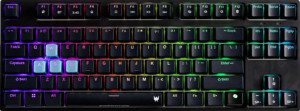
Acer Predator Aethon 550 TKL
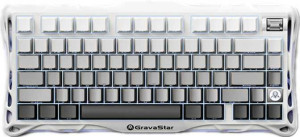
GravaStar Mercury K1

Acer Predator Aethon 550 TKL GravaStar Mercury K1

Overview

Welcome to our in-depth spec comparison between the Acer Predator Aethon 550 TKL and the GravaStar Mercury K1 — two wireless mechanical gaming keyboards that share a surprising amount of common ground while diverging sharply in areas that matter most to different types of users. Both offer hot-swappable linear switches, tri-mode connectivity, and RGB backlighting, yet they take notably different approaches to form factor, battery endurance, and overall build quality. Read on to see how they stack up across every key specification.

Common Features

  • Both keyboards are gaming mechanical keyboards with a standard profile.
  • Both support wireless and wired connectivity, including Bluetooth, 2.4GHz wireless, and USB.
  • Both have a polling rate of 1000 Hz.
  • Neither keyboard is designed for Mac.
  • Both keyboards have a detachable cable.
  • Both feature Bluetooth version 5.
  • Both keyboards have RGB lighting.
  • Both keyboards have a backlit keyboard.
  • Both keyboards have adjustable feet.
  • Both keyboards use mechanical switches with a linear feel.
  • Hot-swappable switches are supported on both keyboards.
  • Neither keyboard has analog input.
  • Neither keyboard has rapid trigger.
  • Neither keyboard has dual actuation.
  • Neither keyboard has adjustable actuation.
  • Both keyboards have NKRO support.
  • Neither keyboard has a display.
  • Neither keyboard has QMK support.
  • Neither keyboard has ZMK support.
  • Both keyboards use an ANSI (United States) layout with PBT double-shot keycaps, a standard key layout, media keys via Fn key, and a rotary dial.

Main Differences

  • Keyboard layout size is Tenkeyless (80%) on Acer Predator Aethon 550 TKL and Compact (75%) on GravaStar Mercury K1.
  • Battery life is 150 hours on Acer Predator Aethon 550 TKL and 470 hours on GravaStar Mercury K1.
  • Height is 130 mm on Acer Predator Aethon 550 TKL and 156 mm on GravaStar Mercury K1.
  • Width is 440 mm on Acer Predator Aethon 550 TKL and 343 mm on GravaStar Mercury K1.
  • Thickness is 40 mm on Acer Predator Aethon 550 TKL and 46 mm on GravaStar Mercury K1.
  • Weight is 1760 g on Acer Predator Aethon 550 TKL and 1060 g on GravaStar Mercury K1.
  • Warranty period is 2 years on Acer Predator Aethon 550 TKL and 1 year on GravaStar Mercury K1.
  • Case material is plastic on Acer Predator Aethon 550 TKL and a combination of plastic and aluminum on GravaStar Mercury K1.
  • Case colors available are black only on Acer Predator Aethon 550 TKL, while GravaStar Mercury K1 is available in black, white, pink, and gray.
  • A wrist rest is included with GravaStar Mercury K1 but not with Acer Predator Aethon 550 TKL.
  • The switch used is the Acer Red Switch on Acer Predator Aethon 550 TKL and the GravaStar x Kailh Cherry Pink linear on GravaStar Mercury K1.
  • USB passthrough is present on GravaStar Mercury K1 but not available on Acer Predator Aethon 550 TKL.
  • Keycap profile is OEM on Acer Predator Aethon 550 TKL and Cherry on GravaStar Mercury K1.
Specs Comparison
Acer Predator Aethon 550 TKL

Acer Predator Aethon 550 TKL

GravaStar Mercury K1

GravaStar Mercury K1

General info:
Keyboard type Gaming, Mechanical Gaming, Mechanical
Keyboard layout size Tenkeyless (80%) Compact (75%)
Profile Standard Standard
connectivity Wireless & wired Wireless & wired
connection type Bluetooth, 2.4GHz wireless, USB Bluetooth, 2.4GHz wireless, USB
polling rate 1000 Hz 1000 Hz
Battery life 150 hours 470 hours
designed for Mac
has a detachable cable
height 130 mm 156 mm
width 440 mm 343 mm
thickness 40 mm 46 mm
weight 1760 g 1060 g
Bluetooth version 5 5
release date September 2025 April 2025
warranty period 2 years 1 years

Both the Acer Predator Aethon 550 TKL and the GravaStar Mercury K1 are wireless mechanical gaming keyboards sharing the same connectivity trio — Bluetooth 5, 2.4GHz wireless, and USB — along with identical 1000 Hz polling rates and detachable cables. For a user scanning the basics, they look nearly equivalent. But dig into the details and meaningful differences emerge.

The most striking gap is battery life: the Mercury K1 claims an extraordinary 470 hours versus the Aethon 550 TKL's 150 hours. In practice, this means the K1 could go weeks between charges under typical use, while the Aethon still offers a competitive runtime but will need attention more frequently. Equally notable is the weight difference — the Aethon tips the scales at 1,760 g compared to the K1's 1,060 g. That 700 g gap is substantial; the Aethon is nearly 66% heavier, which matters for portability and desk feel. Part of this is explained by form factor: the Aethon uses a tenkeyless (80%) layout, while the K1 adopts a more compressed 75% layout, making it physically smaller and lighter by design. The Aethon does counter with a 2-year warranty versus the K1's single year, offering longer manufacturer-backed peace of mind.

Overall, the GravaStar Mercury K1 holds a clear edge in this category for users who prioritize portability and minimal maintenance — its lighter build and vastly superior battery life are hard to overlook. The Aethon 550 TKL is the better fit for those who prefer a larger layout and value a longer warranty, but it concedes on the two most practically impactful specs here.

Design:
has RGB lighting
Has a backlit keyboard
Case material Plastic Plastic, Aluminum
Case colors Black Black, White, Pink, Gray
has adjustable feet
includes a wrist rest

On the surface, these two keyboards share a familiar design foundation: both feature RGB backlighting, adjustable feet, and an all-plastic case in black. For users who just want a lit-up gaming board with some tilt adjustment, either will deliver the basics. The real divergence, however, lies in what the Mercury K1 layers on top of that baseline.

The most significant material difference is the K1's plastic and aluminum hybrid construction versus the Aethon 550 TKL's all-plastic chassis. Aluminum elements typically add structural rigidity and a premium feel — less flex, less rattle, and a more solid typing experience overall. Alongside that, the Mercury K1 ships in four color options (Black, White, Pink, and Gray), making it a far more versatile pick for users who care about desk aesthetics, while the Aethon is limited to a single black finish. The K1 also bundles in an included wrist rest, an accessory that would otherwise cost extra and meaningfully improves comfort during long sessions.

The GravaStar Mercury K1 takes a clear edge in design. It offers more material quality, broader personalization through color variety, and added ergonomic value with the wrist rest — none of which the Aethon 550 TKL matches. For buyers who treat their keyboard as part of their overall setup aesthetic, or who simply want more out of the box, the K1 is the stronger choice here.

Switches:
Switch type Mechanical Mechanical
Switch feel Linear Linear
Hot-swappable switches
Switch name Acer Red Switch GravaStar x Kailh Cherry Pink linear

Switch-wise, these two keyboards are strikingly aligned: both use mechanical linear switches and both support hot-swappable sockets. That last point is practically significant — hot-swap means users can pull and replace switches without soldering, making it easy to experiment with different switch feels down the line without voiding the board or requiring technical skill.

Where they diverge is in switch provenance. The Aethon 550 TKL ships with Acer Red Switches, an in-house branded linear, while the Mercury K1 uses the GravaStar x Kailh Cherry Pink linear — a co-developed switch with Kailh, a manufacturer widely recognized in the mechanical keyboard community. The Kailh collaboration signals a more transparent supply chain for the switch itself, which some enthusiasts find reassuring when evaluating feel and longevity expectations.

Given that hot-swap is present on both, neither board locks you into its stock switches permanently — so the gap here is narrower than it might first appear. Still, the Mercury K1 earns a slight edge for pairing its linear switches with a named, co-branded partner rather than a fully proprietary solution, giving buyers a clearer reference point for what they are getting out of the box.

Features:
has analog input
has rapid trigger
has dual actuation
has adjustable actuation
has NKRO
has USB passthrough
Has a display
has QMK support
has ZMK support
has VIA support

Across the feature set, these two keyboards are largely identical — and notably restrained. Neither offers the advanced input technologies increasingly common in competitive gaming boards, such as rapid trigger, adjustable actuation, or analog input. Enthusiasts chasing cutting-edge performance tuning will find both boards similarly limited in this regard. Equally, neither supports open firmware ecosystems like QMK, ZMK, or VIA, which means customization is confined to whatever the manufacturer's own software provides — a meaningful constraint for users who want deep, portable key remapping without vendor lock-in.

Both do include NKRO (N-Key Rollover), ensuring that every simultaneous keypress is registered independently — a practical baseline for gaming that prevents missed inputs during complex key combinations. The sole hardware differentiator is the USB passthrough port present on the Mercury K1 but absent on the Aethon 550 TKL. In a compact or tenkeyless setup where desk real estate is at a premium, having an extra USB port directly on the keyboard to plug in a mouse, dongle, or other peripheral is a genuinely useful convenience.

The GravaStar Mercury K1 takes a narrow edge here purely on the strength of its USB passthrough — it is the only differentiating feature in an otherwise tied category. Neither board stands out for feature depth, but the K1 offers slightly more practical utility at the desk level.

Keys & layout:
Keyboard layout ANSI (United States) ANSI (United States)
Keycap type PBT, Double-shot PBT, Double-shot
Keycap profile OEM Cherry
uses a standard key layout
Media keys Via Fn key Via Fn key
has a rotary dial

This is one of the closest spec groups in the entire comparison. Both keyboards use ANSI layout, PBT double-shot keycaps, standard key layouts, Fn-layer media controls, and a rotary dial — a notably high degree of alignment. PBT double-shot is a quality baseline worth highlighting: PBT plastic resists shine and wear better than ABS, and double-shot molding means legends are formed from a second layer of plastic rather than printed, so they will not fade with extended use. Both boards get this right.

The single differentiator here is keycap profile. The Aethon 550 TKL uses OEM profile keycaps, while the Mercury K1 uses Cherry profile. In practical terms, Cherry profile keycaps sit lower and have a subtler sculpt than OEM, which many typists find more comfortable over long sessions and which tends to be preferred in the enthusiast community for its flatter, more consistent feel. OEM profile is taller and more widely found on mainstream boards — familiar to most users but less refined by enthusiast standards.

This category is close to a tie, but the Mercury K1 earns a marginal edge for its Cherry profile keycaps, which carry a stronger reputation for ergonomic comfort and are generally more sought after among keyboard enthusiasts. Both boards otherwise offer identical and commendably durable keycap construction.

Comparison Summary & Verdict

After examining every spec, both keyboards prove to be capable wireless gaming peripherals with hot-swappable linear switches, NKRO support, and versatile tri-mode connectivity. However, their strengths point to different audiences. The Acer Predator Aethon 550 TKL suits users who prefer a larger tenkeyless layout, a longer 2-year warranty, and a lighter upfront investment in a no-frills gaming keyboard. On the other side, the GravaStar Mercury K1 stands out with its exceptional 470-hour battery life, lighter 1060 g frame, premium aluminum and plastic construction, included wrist rest, USB passthrough, and a wider choice of colorways — making it the stronger pick for users who value portability, desk aesthetics, and long-term wireless freedom. Choose the Acer for a classic, spacious layout; choose the GravaStar for a feature-rich, compact powerhouse.

Acer Predator Aethon 550 TKL
Buy Acer Predator Aethon 550 TKL if...

Buy the Acer Predator Aethon 550 TKL if you prefer a larger tenkeyless layout with a 2-year warranty and do not need extras like a wrist rest or USB passthrough.

GravaStar Mercury K1
Buy GravaStar Mercury K1 if...

Buy the GravaStar Mercury K1 if you want an exceptionally long 470-hour battery life, a lighter and more compact build, an included wrist rest, USB passthrough, and premium aluminum construction.