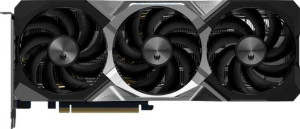
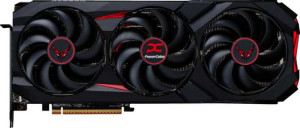
Both cards share the same fundamental compute architecture — identical 4096 shading units, 256 TMUs, and 128 ROPs — meaning any performance gap between them comes down entirely to clock speeds, not silicon differences. This is a factory overclock story. The Acer Predator BiFrost ships with a notably higher base clock of 1870 MHz versus the PowerColor Red Devil's 1660 MHz, a 210 MHz advantage that reflects Acer's more aggressive out-of-box tuning. At boost, the gap narrows but persists: 3100 MHz versus 3060 MHz. In practice, base clock matters most under sustained workloads like long gaming sessions or GPU compute tasks, while boost clock governs peak burst performance.
Those clock differences cascade predictably into every derived throughput metric. The Acer edges ahead in floating-point performance (50.79 vs. 50.14 TFLOPS), texture rate (793.6 vs. 783.4 GTexels/s), and pixel fill rate (396.8 vs. 391.7 GPixel/s). The deltas are in the 1–2% range — too small to be perceptible as a frame-rate difference in gaming, but they confirm the Acer is the faster card on paper. Memory subsystem is a wash: both run at 2518 MHz GPU memory speed, so bandwidth is identical and neither card has an advantage in memory-bound scenarios. Both also support Double Precision Floating Point, relevant for compute and professional workloads.
For pure performance, the Acer Predator BiFrost holds a narrow but consistent edge across every throughput metric, driven solely by its higher factory overclock. In real-world gaming at high resolutions, the difference will be negligible, but buyers who want the fastest RX 9070 XT between these two without manual overclocking should lean toward the Acer. The PowerColor Red Devil is effectively tied in architecture and memory performance — its slightly lower clocks make it the marginally slower option in this head-to-head, though both cards are extremely close in capability.