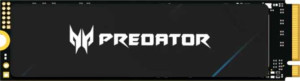
Acer Predator GM9000 2TB
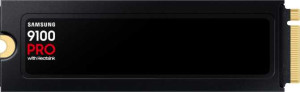
Samsung 9100 Pro 2TB (With Heatsink)

Acer Predator GM9000 2TB Samsung 9100 Pro 2TB (With Heatsink)

Overview

When choosing between two flagship PCIe 5.0 NVMe drives, the details matter. This page puts the Acer Predator GM9000 2TB and the Samsung 9100 Pro 2TB (With Heatsink) side by side, examining how these M2 TLC powerhouses differ across sequential and random throughput, endurance ratings, thermal solutions, and security features. Both drives share a strong common foundation, yet their individual strengths point toward different ideal buyers.

Common Features

  • Both drives use the M2 form factor.
  • Both drives feature a DRAM cache.
  • Both drives are NVMe SSDs.
  • Both drives support NVMe version 2.
  • Both drives offer 2000GB of internal storage.
  • Both drives use TLC NAND flash storage.
  • Both drives use PCI Express version 5.
  • Both drives have 8 controller channels.

Main Differences

  • Sequential read speed is 14000 MB/s on Acer Predator GM9000 2TB and 14700 MB/s on Samsung 9100 Pro 2TB (With Heatsink).
  • Random read speed is 2000000 IOPS on Acer Predator GM9000 2TB and 1850000 IOPS on Samsung 9100 Pro 2TB (With Heatsink).
  • Sequential write speed is 13000 MB/s on Acer Predator GM9000 2TB and 13400 MB/s on Samsung 9100 Pro 2TB (With Heatsink).
  • Random write speed is 1600000 IOPS on Acer Predator GM9000 2TB and 2600000 IOPS on Samsung 9100 Pro 2TB (With Heatsink).
  • The controller is the Silicon Motion SM2508 on Acer Predator GM9000 2TB and the Samsung Presto (S4LY027) on Samsung 9100 Pro 2TB (With Heatsink).
  • Terabytes Written (TBW) is 1800 on Acer Predator GM9000 2TB and 1200 on Samsung 9100 Pro 2TB (With Heatsink).
  • An integrated heatsink is present on Samsung 9100 Pro 2TB (With Heatsink) but not available on Acer Predator GM9000 2TB.
  • Hardware encryption support is available on Samsung 9100 Pro 2TB (With Heatsink) at 256 bits, while Acer Predator GM9000 2TB does not support hardware encryption.
Specs Comparison
Acer Predator GM9000 2TB

Acer Predator GM9000 2TB

Samsung 9100 Pro 2TB (With Heatsink)

Samsung 9100 Pro 2TB (With Heatsink)

Read speed:
sequential read speed 14000 MB/s 14700 MB/s
random read speed 2000000 IOPS 1850000 IOPS

Both drives operate at the very top of consumer NVMe performance, but they prioritize read workloads differently. The Samsung 9100 Pro holds the edge in sequential reads at 14700 MB/s versus the Acer Predator GM9000's 14000 MB/s — a roughly 5% advantage that translates to faster large-file transfers: think game installs, 4K video exports, or moving multi-gigabyte archives. In everyday use, both drives will feel virtually identical for these tasks, but the Samsung pulls ahead when sustained throughput is the bottleneck.

The dynamic flips for random reads, where the GM9000 takes the lead with 2,000,000 IOPS compared to the 9100 Pro's 1,850,000 IOPS — an 8% advantage. Random read IOPS govern how quickly a drive handles the flood of small, scattered requests typical of OS boot sequences, application launches, and database queries. A higher IOPS ceiling means snappier responsiveness under mixed, real-world workloads rather than clean sequential benchmarks.

In summary, neither drive has a sweep here: the Samsung 9100 Pro has the edge for large sequential transfers, while the Acer Predator GM9000 leads in random read throughput. Users prioritizing raw transfer speed for large files should lean toward the Samsung, while those focused on system responsiveness and multitasking agility will benefit more from the GM9000's IOPS advantage.

Write speed:
sequential write speed 13000 MB/s 13400 MB/s
random write speed 1600000 IOPS 2600000 IOPS

Sequential write performance is close between these two drives, with the Samsung 9100 Pro reaching 13400 MB/s against the Acer Predator GM9000's 13000 MB/s — a gap of roughly 3%. For sequential writes, this margin is slim enough that most users would never perceive a difference during typical workloads like saving large video files or writing game data to disk.

Where the 9100 Pro asserts a much more meaningful advantage is random write IOPS: 2,600,000 IOPS versus the GM9000's 1,600,000 IOPS — a 63% lead. This is the standout differentiator of this spec group. Random write performance directly impacts how a drive handles simultaneous small write operations, which are common in content creation pipelines, virtual machine storage, and any scenario where the OS is writing multiple files concurrently. A gap of this magnitude is not just a benchmark number; it can translate into noticeably smoother performance under sustained, write-heavy multitasking.

The Samsung 9100 Pro takes a clear overall edge in write performance. While the sequential gap is negligible in practice, its commanding random write lead makes it the stronger choice for users who regularly push drives with demanding, mixed write workloads rather than simple large-file transfers.

General info:
type M2 M2
SSD cache DRAM cache DRAM cache
Is an NVMe SSD
NVMe version 2 2
internal storage 2000GB 2000GB
release date March 2025 February 2025
controller Silicon Motion SM2508 Samsung Presto (S4LY027)
SSD storage type TLC TLC
PCI Express (PCIe) version 5 5
Controller channels 8 8
Terabytes Written (TBW) 1800 1200
MTBF 1.5million hours 1.5million hours
warranty period 5 years 5 years
Has an integrated heatsink
bits of encryption supported 0 256
has RGB lighting

At the foundational level, these two drives share an identical platform: both are M.2 PCIe 5.0 NVMe 2.0 SSDs with 2TB of TLC NAND, DRAM cache, and 8 controller channels — meaning neither has a structural architecture advantage over the other. The meaningful differences emerge in the details. The Acer Predator GM9000 uses a Silicon Motion SM2508 controller, while the Samsung 9100 Pro relies on Samsung's proprietary Presto (S4LY027) — a fully in-house design that allows Samsung tighter integration between controller and NAND.

On endurance, the GM9000 holds a significant lead with a 1800 TBW rating versus the 9100 Pro's 1200 TBW — a 50% advantage. TBW dictates how much data can be written to the drive over its lifetime before wear becomes a concern, making this particularly relevant for content creators, prosumers, or anyone running write-intensive workloads daily. Both drives share the same 1.5 million hour MTBF and 5-year warranty, so reliability assurances are equal on paper. The 9100 Pro counters with two practical extras: an integrated heatsink for thermal management out of the box, and 256-bit hardware encryption — the GM9000 offers neither.

This group does not produce a clean overall winner — it comes down to use case. The GM9000's superior TBW makes it the more durable long-term choice for heavy writers, while the 9100 Pro's heatsink and encryption support add real value for users in thermally constrained builds or environments where data security is a requirement.

Comparison Summary & Verdict

Both drives are high-end PCIe 5.0 NVMe SSDs built on a shared foundation of M2 form factor, DRAM cache, TLC NAND, and 8 controller channels, making either a serious performer. The Acer Predator GM9000 2TB stands out with a notably higher TBW rating of 1800 versus 1200, giving it a clear edge in long-term write endurance, and it also leads in random read speed at 2,000,000 IOPS. The Samsung 9100 Pro 2TB, on the other hand, pulls ahead in sequential read and write throughput, dominates in random write performance at 2,600,000 IOPS, includes a built-in heatsink for out-of-the-box thermal management, and adds 256-bit hardware encryption. Choose the Acer for maximum longevity and random read workloads; choose the Samsung for peak sequential speeds, heavy random writes, thermal convenience, and data security.

Acer Predator GM9000 2TB
Buy Acer Predator GM9000 2TB if...

Buy the Acer Predator GM9000 2TB if long-term drive endurance is a priority, as its 1800 TBW rating significantly outpaces the competition, and you also value class-leading random read performance.

Samsung 9100 Pro 2TB (With Heatsink)
Buy Samsung 9100 Pro 2TB (With Heatsink) if...

Buy the Samsung 9100 Pro 2TB (With Heatsink) if you need superior sequential throughput, dominant random write speeds, a built-in heatsink for hassle-free thermal management, and hardware-level 256-bit encryption.