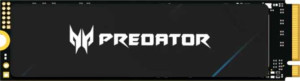
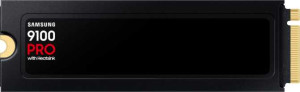
At a foundational level, these two drives share the same architecture: M.2 form factor, PCIe 5.0 interface, NVMe 2.0 protocol, TLC NAND, DRAM cache, and an 8-channel controller. That common foundation explains why their raw performance figures are in the same ballpark — but the controller choice is where their engineering philosophies diverge. The Acer GM9000 2TB uses a Silicon Motion SM2508, a capable third-party controller, while the Samsung 9100 Pro 4TB runs Samsung's in-house Presto (S4LY027) — a vertically integrated solution where Samsung controls the NAND, controller, and firmware simultaneously.
Endurance is a meaningful differentiator for long-term buyers. The Samsung's 2400 TBW rating comfortably outpaces the Acer's 1800 TBW — a 33% advantage that reflects both the larger capacity and potentially more resilient NAND binning. For a drive used in write-heavy professional environments, that gap compounds over years of use. Both carry identical 1.5 million hour MTBF ratings and 5-year warranties, so reliability promises on paper are even.
The single sharpest qualitative difference is hardware encryption: the Samsung supports 256-bit encryption, while the Acer offers none. For enterprise users, security-conscious professionals, or anyone storing sensitive data, this alone could be decisive. Combined with its larger capacity and higher TBW, the Samsung 9100 Pro 4TB holds a clear overall advantage in this group — the Acer is competitive on shared fundamentals, but trails on endurance, encryption, and the integration benefits of Samsung's proprietary controller stack.