Acer Predator Helios 18 AI (2025) 18"
Asus ROG Strix G16 (2025) G614FR 16" AMD Ryzen 9 9955HX3D 2.5GHz / Nvidia GeForce RTX 5070 Ti Laptop / 32GB RAM / 2TB SSD

Acer Predator Helios 18 AI (2025) 18" Asus ROG Strix G16 (2025) G614FR 16" AMD Ryzen 9 9955HX3D 2.5GHz / Nvidia GeForce RTX 5070 Ti Laptop / 32GB RAM / 2TB SSD

Common Features

  • Both products are designed for gaming.
  • Both products use a backlit keyboard.
  • Both products do not have a rugged build.
  • Both products support anti-reflection coating on the display.
  • Both products support up to four displays.
  • Both products have stereo speakers.
  • Both products have a socket for a 3.5 mm audio jack.
  • Both products support ray tracing.
  • Both products support DLSS.
  • Both products have stereo speakers.
  • Both products have a USB Type-C port.
  • Both products have HDMI output.
  • Both products support Wi-Fi.
  • Both products have one RJ45 port.
  • Both products have sleep-and-charge USB ports.
  • Both products do not include a stylus.
  • Both products support multi-display technology.
  • Both products have Dolby Atmos support absent.
  • Both products use Intel Resizable BAR.
Specs Comparison
Acer Predator Helios 18 AI (2025) 18"

Acer Predator Helios 18 AI (2025) 18"

Asus ROG Strix G16 (2025) G614FR 16" AMD Ryzen 9 9955HX3D 2.5GHz / Nvidia GeForce RTX 5070 Ti Laptop / 32GB RAM / 2TB SSD

Asus ROG Strix G16 (2025) G614FR 16" AMD Ryzen 9 9955HX3D 2.5GHz / Nvidia GeForce RTX 5070 Ti Laptop / 32GB RAM / 2TB SSD

Design:
Type Gaming Gaming
weight 3500 g 2500 g
Uses a fanless design
Has a backlit keyboard
volume 3570.103 cm³ 2056.032 cm³
width 401 mm 354 mm
height 307 mm 264 mm
thickness 29 mm 22 mm
is weather-sealed (splashproof)
has a rugged build

Both laptops are purpose-built gaming machines sharing the same foundational design DNA: active cooling (no fanless design), backlit keyboards, and no weather-sealing or rugged certification. These shared traits set expectations — these are performance-first devices, not built for the outdoors or silent operation.

Where they diverge sharply is in physical footprint and mass. The Acer Predator Helios 18 is a large-format machine at 401 × 307 × 29 mm and a substantial 3,500 g, resulting in a volume of roughly 3,570 cm³. The Asus ROG Strix G16, by contrast, measures 354 × 264 × 22 mm and weighs only 2,500 g — a volume of just 2,056 cm³. That translates to the ROG being 43% more compact by volume and a full kilogram lighter. In practical terms, carrying the Helios 18 daily in a backpack is a noticeably different commitment than carrying the Strix G16.

On design portability, the Asus ROG Strix G16 holds a clear edge. Its 7mm thinner profile, significantly smaller chassis, and 1 kg weight advantage make it meaningfully easier to transport without sacrificing the gaming form factor. The Helios 18′s larger frame is a trade-off that may suit a desk-bound setup better than a mobile lifestyle.

Display:
screen size 18" 16"
resolution 3840 x 2400 px 2560 x 1600 px
pixel density 251 ppi 188 ppi
Display type IPS, LCD, LED-backlit LCD, LED-backlit, IPS
has a touch screen
refresh rate 120Hz 240Hz
has anti-reflection coating
supported displays 4 4

These two displays represent a classic gaming laptop trade-off: resolution versus refresh rate. The Acer Predator Helios 18 packs a 3840 × 2400 panel at 251 ppi — a near-4K resolution on an 18″ screen that delivers exceptional image sharpness, making it compelling for content creation, video editing, or simply appreciating highly detailed game environments. The Asus ROG Strix G16 counters with a 2560 × 1600 resolution at 188 ppi, which is still a sharp QHD+ panel, but noticeably less dense.

Where the ROG Strix G16 reclaims ground is in its 240Hz refresh rate versus the Helios 18′s 120Hz. For competitive gaming — fast-paced shooters, fighting games, or any genre where motion clarity and input responsiveness matter — 240Hz produces significantly smoother animation and reduces perceived motion blur. At 120Hz, the Helios 18 is perfectly capable for most gaming scenarios, but it simply cannot match the fluidity the Strix G16 delivers. Both screens share anti-reflection coatings and IPS LCD technology, keeping glare manageable and color viewing angles consistent.

The verdict depends entirely on use case. For a gamer who prioritizes competitive performance and smoothness, the ROG Strix G16′s 240Hz refresh rate is a meaningful and practical advantage. For someone who also uses their laptop for creative work or values raw visual fidelity, the Helios 18′s near-4K panel and higher pixel density are harder to give up. Neither is universally superior — but for pure gaming-centric use, the Strix G16 holds the edge here.

Performance:
RAM 64GB 32GB
Uses flash storage
internal storage 2048GB 2048GB
CPU speed 8 x 2.7 & 16 x 2.1 GHz 16 x 2.5 GHz
CPU threads 24 threads 32 threads
VRAM 24GB 12GB
floating-point performance 31.8 TFLOPS 17.04 TFLOPS
GDDR version GDDR7 GDDR7
texture rate 496.9 GTexels/s 266.2 GTexels/s
pixel rate 193.9 GPixel/s 115.8 GPixel/s
Is an NVMe SSD
DirectX version DirectX 12 Ultimate DirectX 12 Ultimate
GPU clock speed 990 MHz 847 MHz
uses multithreading
maximum memory amount 192GB 32GB
DDR memory version 5 5
turbo clock speed 5.4GHz 5.4GHz
GPU turbo 1515 MHz 1447 MHz
PCI Express (PCIe) version 5 4
semiconductor size 4 nm 4 nm
has XeSS (XMX)
Supports 64-bit

GPU performance is where the gap between these two machines becomes impossible to ignore. The Acer Predator Helios 18 delivers 31.8 TFLOPS of floating-point performance, nearly double the ROG Strix G16′s 17.04 TFLOPS. That advantage carries through to texture throughput (496.9 GTexels/s vs 266.2) and pixel fill rate (193.9 GPixel/s vs 115.8), meaning the Helios 18 can push substantially more graphical complexity per frame. Its 24GB VRAM versus the Strix G16′s 12GB further widens the gap for high-resolution textures, AI workloads, and future game titles that are increasingly VRAM-hungry. The Helios 18 also benefits from a PCIe 5 interface versus PCIe 4 on the Strix G16, offering greater headroom for storage and GPU bandwidth.

The CPU story is more nuanced. Both machines reach the same 5.4GHz peak turbo frequency and use 4nm silicon, but the Strix G16′s processor offers 32 threads versus the Helios 18′s 24. For heavily multi-threaded workloads — video encoding, 3D rendering, or large compilation tasks — that thread count advantage gives the Strix G16 a meaningful foothold. On the memory side, however, the Helios 18 ships with 64GB of DDR5 RAM and supports up to 192GB, dwarfing the Strix G16′s 32GB installed and 32GB maximum — a ceiling that could become restrictive for power users over time.

Taken together, the Helios 18 holds a decisive performance edge in this group. Its GPU advantage is substantial by any measure, its VRAM headroom is considerably larger, and its memory expandability is in a different league. The Strix G16′s higher thread count is a genuine plus for CPU-bound tasks, but it is not enough to shift the overall balance. Users who prioritize raw GPU horsepower and long-term memory scalability will find the Helios 18 the stronger performer here.

Benchmarks:
PassMark result 56426 61356
PassMark result (single) 4723 4491

The PassMark results reveal an interesting split that adds real-world validation to the spec differences discussed in performance. The Asus ROG Strix G16 scores 61,356 in the multi-threaded benchmark, outpacing the Helios 18′s 56,426 by roughly 8.7%. This aligns directly with its higher thread count — more cores working in parallel translate into a tangible advantage when PassMark saturates all available threads, confirming the Strix G16′s CPU is genuinely stronger in sustained multi-threaded workloads like rendering or batch processing.

Flip to single-core performance, and the lead reverses. The Helios 18 scores 4,723 against the Strix G16′s 4,491 — a roughly 5% advantage that matters for tasks relying on one fast core: everyday responsiveness, lightly-threaded applications, and many games that still depend heavily on single-thread CPU speed. It is a modest but consistent edge in scenarios that represent a large portion of day-to-day use.

Across both benchmarks combined, neither machine dominates cleanly — they trade leads depending on workload type. The Strix G16 edges ahead for parallel workloads, while the Helios 18 holds a slight single-core advantage. Users whose workflows are predominantly multi-threaded will find the Strix G16′s CPU benchmark result more meaningful; for general use and gaming, the Helios 18′s single-core lead is arguably the more practically relevant figure. This group is best called a narrow split, with no decisive overall winner.

Connectivity:
USB 3.2 Gen 2 ports (USB-C) 2 0
USB 3.2 Gen 2 ports (USB-A) 2 2
USB 4 20Gbps ports 0 0
USB 4 40Gbps ports 0 2
Thunderbolt 4 ports 0 2
USB 3.2 Gen 1 ports (USB-C) 0 0
USB 3.2 Gen 1 ports (USB-A) 1 0
Thunderbolt 3 ports 0 0
has an HDMI output
Has USB Type-C
supports Wi-Fi
Wi-Fi version Wi-Fi 7 (802.11be), Wi-Fi 6E (802.11ax), Wi-Fi 6 (802.11ax), Wi-Fi 5 (802.11ac), Wi-Fi 4 (802.11n) Wi-Fi 6E (802.11ax), Wi-Fi 6 (802.11ax), Wi-Fi 5 (802.11ac), Wi-Fi 4 (802.11n)
has an external memory slot
Bluetooth version 5.4 5.3
RJ45 ports 1 1
HDMI ports 1 1
DisplayPort outputs 0 0
has AirPlay
mini DisplayPort outputs 0 0
has a VGA connector

The Acer Predator Helios 18 AI (2025) and the Asus ROG Strix G16 (2025) both offer a variety of connectivity options, but there are key differences. The Acer model provides two USB 3.2 Gen 2 USB-C ports, two USB 3.2 Gen 2 USB-A ports, and one USB 3.2 Gen 1 USB-A port. The Asus model, in comparison, has no USB 3.2 Gen 2 USB-C ports but offers two USB 3.2 Gen 2 USB-A ports and two USB 4 40Gbps ports, as well as two Thunderbolt 4 ports, which the Acer does not have.

Both laptops include HDMI outputs, support Wi-Fi 6E (802.11ax), Wi-Fi 6 (802.11ax), Wi-Fi 5 (802.11ac), and Wi-Fi 4 (802.11n), and offer Bluetooth connectivity (Bluetooth version 5.4 for the Acer and 5.3 for the Asus). The Acer has an external memory slot, while the Asus does not. Both models have one RJ45 Ethernet port and support AirPlay, but neither has a VGA connector or mini DisplayPort outputs.

Overall, while both laptops provide strong connectivity options, the Acer offers more USB 3.2 Gen 2 and USB-A ports, while the Asus provides faster USB 4 40Gbps and Thunderbolt 4 support.

Battery:
battery size 99 Wh 90 Wh
Has sleep-and-charge USB ports
Has a MagSafe power adapter

The Acer Predator Helios 18 AI (2025) and the Asus ROG Strix G16 (2025) have similar battery features, with only slight differences. The Acer model is equipped with a 99 Wh battery, while the Asus comes with a slightly smaller 90 Wh battery. Both laptops have sleep-and-charge USB ports, allowing for charging of devices even when the laptop is in sleep mode. Neither model includes a MagSafe power adapter, indicating they both rely on standard power adapters.

Overall, the battery sizes are close, with the Acer offering a marginally larger capacity. Both laptops feature similar charging capabilities, with sleep-and-charge USB ports and no MagSafe support.

Features:
release date January 2025 January 2025
has stereo speakers
has a socket for a 3.5 mm audio jack
supports ray tracing
supports DLSS
has Dolby Atmos
Stylus included
Has a fingerprint scanner
number of microphones 1 2
Uses 3D facial recognition
has voice commands
has a front camera
Has S/PDIF Out port
has a gyroscope
has GPS
has an accelerometer
has a compass
Has an optical disc drive

The Acer Predator Helios 18 AI (2025) and the Asus ROG Strix G16 (2025) share several similar features, particularly in audio and gaming-related technologies. Both laptops are equipped with stereo speakers, a 3.5 mm audio jack, support ray tracing, and support DLSS. Neither model features Dolby Atmos or a stylus, and both lack a fingerprint scanner. Both also have a front camera but do not support 3D facial recognition, voice commands, or an S/PDIF Out port.

In terms of audio, the Acer has one microphone, while the Asus has two microphones. Neither laptop includes a gyroscope, GPS, accelerometer, compass, or an optical disc drive.

While both laptops offer similar core features, the Asus model includes an additional microphone for audio capture, which may be useful for recording or communication purposes.

Miscellaneous:
clock multiplier 27 25
AMD SAM / Intel Resizable BAR Intel Resizable BAR Intel Resizable BAR
GPU architecture Blackwell Blackwell
has LHR
Thermal Design Power (TDP) 95W 60W
Supports 3D
Supports multi-display technology
OpenCL version 3 3
OpenGL version 4.6 4.6
Supports ECC memory
memory bus width 256-bit 192-bit
effective memory speed 25400 MHz 25400 MHz
maximum memory bandwidth 811.5 GB/s 608.6 GB/s
render output units (ROPs) 128 80
texture mapping units (TMUs) 328 184
shading units 10496 5888
Has Double Precision Floating Point (DPFP)
GPU memory speed 2000 MHz 1750 MHz
Type Laptop Desktop, Laptop
instruction sets MMX, F16C, FMA3, AES, AVX, AVX2, SSE 4.1, SSE 4.2 MMX, F16C, FMA3, AES, AVX, AVX2, SSE 4.1, SSE 4.2
Has an unlocked multiplier
L3 cache 36 MB 128 MB
L2 cache 40 MB 16 MB
Has NX bit
CPU temperature 105 °C 100 °C
Has integrated graphics
memory channels 2 2
RAM speed (max) 6400 MHz 5600 MHz
Uses big.LITTLE technology

The Acer Predator Helios 18 AI (2025) and the Asus ROG Strix G16 (2025) share similar core specifications but have some distinct differences. Both laptops use Intel Resizable BAR, support 3D, and multi-display technology, and have Blackwell GPU architecture. The Acer model has a higher clock multiplier of 27, compared to the Asus's 25. This is likely indicative of the Acer's more powerful CPU, but both devices are unlocked for overclocking. The Acer also features a higher Thermal Design Power (TDP) of 95W, while the Asus has a lower TDP of 60W.

Both laptops support ECC memory, have integrated graphics, and utilize a 2-channel memory configuration. The Acer has a wider memory bus width of 256-bit, offering a higher maximum memory bandwidth of 811.5 GB/s, compared to the Asus's 192-bit and 608.6 GB/s. The Acer also benefits from a higher RAM speed (max 6400 MHz) compared to the Asus's 5600 MHz. However, the Acer's shading units (10496) and texture mapping units (328) significantly surpass the Asus's shading units (5888) and texture mapping units (184).

Additional differences include the L3 cache, where the Acer has 36 MB and the Asus has 128 MB, although the Acer’s L2 cache is larger at 40 MB compared to the Asus’s 16 MB. Both laptops support Double Precision Floating Point (DPFP), but the Acer's higher GPU memory speed of 2000 MHz outpaces the Asus's 1750 MHz. Lastly, the Acer uses big.LITTLE technology, which the Asus does not.

Comparison Summary & Verdict

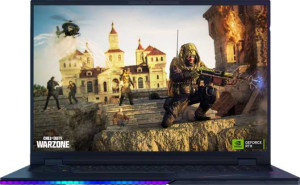
This is a specification comparison between Acer Predator Helios 18 AI (2025) 18″ and Asus ROG Strix G16 (2025) G614FR 16″ AMD Ryzen 9 9955HX3D 2.5GHz / Nvidia GeForce RTX 5070 Ti Laptop / 32GB RAM / 2TB SSD. Both laptops are designed for gaming and feature a backlit keyboard, stereo speakers, and support ray tracing and DLSS. However, the Acer model has a larger 18″ display with a higher 3840 x 2400 px resolution, while the Asus model is smaller at 16″ with a 2560 x 1600 px resolution. The Acer laptop also has more RAM (64GB compared to 32GB) and a more powerful GPU, providing significantly higher floating-point performance, texture rate, and pixel rate. Additionally, the Acer Predator has more USB-C ports and supports Wi-Fi 7, while the Asus ROG Strix supports Wi-Fi 6E and has additional USB 4 ports.