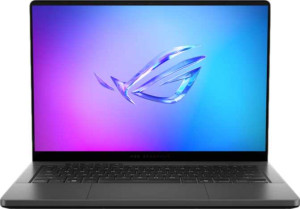
The GPU gap between these two laptops is substantial. The Zephyrus G14's graphics hardware delivers 17.04 TFLOPS of floating-point performance against the Swift X 14's 9.684 TFLOPS — nearly double the throughput. This carries through to texture and pixel fill rates as well, where the G14 leads by similarly wide margins. For gaming, 3D rendering, or AI-accelerated workloads, this difference is not marginal; it translates directly into higher frame rates, faster render times, and more headroom at demanding resolutions. The G14 also holds an advantage in VRAM — 12GB versus 8GB — which matters increasingly for large AI models and modern games with high-resolution texture packs. Interestingly, the Swift X 14 has a higher base GPU clock at 952 MHz versus 847 MHz, but with near-identical turbo clocks and a far wider execution pipeline, the G14's raw throughput advantage is not eroded by this.
On the CPU side, the G14 again pulls ahead with 24 threads across 12 cores compared to the Swift X 14's 16 threads across 8 cores. Turbo speeds are nearly identical at around 5 GHz, so the G14's advantage in heavily threaded workloads — video encoding, compilation, simulation — comes from core count rather than clock speed. It also ships with 64GB of DDR5 RAM versus 32GB, making it more capable out of the box for memory-intensive tasks like large dataset processing or running multiple virtual machines. One footnote in favor of the Swift X 14: its architecture supports a maximum of 256GB RAM, versus the G14's cap of 64GB, which could matter in specialized professional upgrade scenarios.
The Asus ROG Zephyrus G14 (2025) wins the performance category decisively. Across CPU threading, GPU compute, VRAM, system RAM, and even DirectX feature level (DirectX 12 Ultimate versus DirectX 12), it outpaces the Swift X 14 by a consistent and meaningful margin. The Swift X 14's higher memory ceiling is a niche advantage that does not offset the G14's across-the-board lead in raw and practical performance.