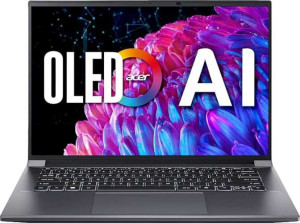
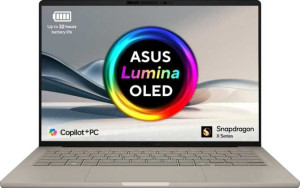
Both laptops use an OLED/AMOLED panel, which means both benefit from the technology's hallmark traits: perfect blacks, high contrast, and vivid color reproduction. On that front, they are evenly matched. Where they diverge sharply, however, is resolution. The Acer Swift X 14 AI ships with a 2880 × 1800 panel on a 14.5″ screen, while the ZenBook A14 offers 1920 × 1080 on a 14″ display. That is a dramatic difference in pixel density — the Swift X 14 AI packs nearly 2.7 times as many pixels, resulting in noticeably crisper text, finer detail in images, and a more refined visual experience overall.
For creative professionals, content consumers, or anyone spending long hours reading on-screen, this resolution gap is consequential. At 1080p on a 14″ screen, individual pixels become discernible at typical viewing distances to users with sharp eyesight, whereas the Swift X 14 AI's panel renders UI elements and fonts with a smoothness that approaches print-like clarity. The slightly larger 14.5″ canvas on the Acer also provides a bit more working area without a significant footprint penalty.
The Acer also supports 4 external displays versus 3 for the ZenBook — a minor but real advantage for power users running elaborate multi-monitor setups. Shared limitations include no touch input and no anti-reflection coating on either device. Overall, the Swift X 14 AI holds a clear display edge, driven almost entirely by its substantially higher resolution panel.