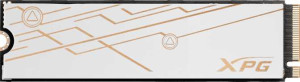
Adata XPG Mars 980 Blade 1TB
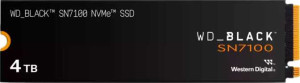
Western Digital WD Black SN7100 4TB

Adata XPG Mars 980 Blade 1TB Western Digital WD Black SN7100 4TB

Overview

Welcome to our in-depth comparison of the Adata XPG Mars 980 Blade 1TB and the Western Digital WD Black SN7100 4TB, two high-performance M.2 NVMe SSDs targeting different ends of the enthusiast storage market. We examine their key battlegrounds — including sequential and random speeds, PCIe generation, cache architecture, and long-term endurance — to help you determine which drive best fits your specific needs.

Common Features

  • Both products use the M2 form factor.
  • Both products are NVMe SSDs.
  • Both products use TLC NAND flash storage.
  • Both products come with a 5-year warranty.
  • Neither product has an integrated heatsink.
  • Neither product supports hardware encryption.
  • Neither product features RGB lighting.

Main Differences

  • Sequential read speed is 14000 MB/s on Adata XPG Mars 980 Blade 1TB and 7250 MB/s on Western Digital WD Black SN7100 4TB.
  • Random read speed is 1600000 IOPS on Adata XPG Mars 980 Blade 1TB and 900000 IOPS on Western Digital WD Black SN7100 4TB.
  • Sequential write speed is 10000 MB/s on Adata XPG Mars 980 Blade 1TB and 6900 MB/s on Western Digital WD Black SN7100 4TB.
  • Random write speed is 1650000 IOPS on Adata XPG Mars 980 Blade 1TB and 1350000 IOPS on Western Digital WD Black SN7100 4TB.
  • The cache type is a dedicated DRAM cache on Adata XPG Mars 980 Blade 1TB, while Western Digital WD Black SN7100 4TB uses HMB (Host Memory Buffer).
  • NVMe version is 2 on Adata XPG Mars 980 Blade 1TB and 1.4 on Western Digital WD Black SN7100 4TB.
  • Internal storage capacity is 1000GB on Adata XPG Mars 980 Blade 1TB and 4000GB on Western Digital WD Black SN7100 4TB.
  • The controller is Silicon Motion SM2508 on Adata XPG Mars 980 Blade 1TB and Polaris 3 A101-000172-A1 on Western Digital WD Black SN7100 4TB.
  • PCIe version is 5 on Adata XPG Mars 980 Blade 1TB and 4 on Western Digital WD Black SN7100 4TB.
  • Controller channels number 8 on Adata XPG Mars 980 Blade 1TB and 4 on Western Digital WD Black SN7100 4TB.
  • Terabytes Written (TBW) endurance rating is 740 TBW on Adata XPG Mars 980 Blade 1TB and 2400 TBW on Western Digital WD Black SN7100 4TB.
Specs Comparison
Adata XPG Mars 980 Blade 1TB

Adata XPG Mars 980 Blade 1TB

Western Digital WD Black SN7100 4TB

Western Digital WD Black SN7100 4TB

Read speed:
sequential read speed 14000 MB/s 7250 MB/s
random read speed 1600000 IOPS 900000 IOPS

Read speed is where these two drives diverge most dramatically. The Adata XPG Mars 980 Blade 1TB posts a sequential read of 14,000 MB/s against the Western Digital WD Black SN7100 4TB's 7,250 MB/s — nearly double the throughput. In practical terms, this gap matters most when moving very large files: transferring a 100 GB dataset, for instance, would complete in roughly half the time on the Adata drive.

The random read advantage follows the same pattern: 1,600,000 IOPS versus 900,000 IOPS. Random read performance governs how snappy a system feels during everyday use — loading applications, booting an OS, or handling database queries with many small, scattered file accesses. The Adata's roughly 78% higher IOPS count translates to noticeably more responsive behavior under these mixed, real-world workloads.

The read speed edge belongs unambiguously to the Adata XPG Mars 980 Blade across both sequential and random metrics. The WD Black SN7100 is by no means slow — 7,250 MB/s sequential is firmly high-end — but if raw read throughput and system responsiveness are the priority, the Adata is the clear winner in this category.

Write speed:
sequential write speed 10000 MB/s 6900 MB/s
random write speed 1650000 IOPS 1350000 IOPS

Write performance tells a similar story to read speed, with the Adata XPG Mars 980 Blade 1TB maintaining a commanding lead. Its sequential write of 10,000 MB/s outpaces the WD Black SN7100 4TB's 6,900 MB/s by around 45% — a gap that becomes very tangible when ingesting large volumes of data, such as capturing high-bitrate video footage, cloning drives, or writing large backups.

On the random write side, the margin narrows somewhat but remains meaningful: 1,650,000 IOPS for the Adata versus 1,350,000 IOPS for the WD Black — roughly a 22% difference. Random write IOPS governs performance under workloads that scatter small writes across the drive simultaneously, such as compiling code, running virtual machines, or operating a write-heavy database. The WD Black holds its own more credibly here than in sequential writes, but the Adata still has the upper hand.

Across both write metrics, the Adata XPG Mars 980 Blade takes the clear edge. That said, the WD Black SN7100's figures are genuinely strong in absolute terms — users whose workloads lean toward sustained sequential writes will feel the gap most acutely, while those doing lighter mixed writes may find the WD Black's numbers more than sufficient.

General info:
type M2 M2
SSD cache DRAM cache HMB (Host Memory Buffer)
Is an NVMe SSD
NVMe version 2 1.4
internal storage 1000GB 4000GB
release date June 2025 March 2025
controller Silicon Motion SM2508 Polaris 3 A101-000172-A1
SSD storage type TLC TLC
PCI Express (PCIe) version 5 4
Controller channels 8 4
Terabytes Written (TBW) 740 2400
warranty period 5 years 5 years
Has an integrated heatsink
bits of encryption supported 0 0
has RGB lighting

The architectural gap between these drives explains everything seen in their performance numbers. The Adata XPG Mars 980 Blade runs on PCIe 5.0 with NVMe 2.0 and a dedicated DRAM cache, backed by 8 controller channels — a top-tier configuration that doubles the interface bandwidth ceiling and gives the controller more parallelism to work with. The WD Black SN7100, by contrast, operates on PCIe 4.0 with NVMe 1.4 and relies on HMB (Host Memory Buffer), which borrows system RAM rather than carrying dedicated onboard cache. Under sustained or random-heavy workloads, HMB can introduce latency spikes that dedicated DRAM avoids entirely.

Capacity and endurance tell a different story, however. The WD Black ships at 4TB versus the Adata's 1TB, making it a fundamentally different proposition for storage-hungry users. More striking is the TBW gap: 2,400 TBW for the WD Black against 740 TBW for the Adata. This means the WD Black is rated to absorb more than three times the total write volume over its lifetime — highly relevant for workloads involving constant large writes, such as video editing archives or server logging. Both carry a 5-year warranty and use TLC NAND, so neither has a structural edge on longevity guarantees or cell-type efficiency.

There is no single winner here — the two drives are optimized for different priorities. The Adata's platform advantages make it the performance-first choice for users who can work within 1TB. The WD Black trades raw speed for vastly more capacity and endurance, positioning it as the more practical pick for high-volume storage over the long haul.

Comparison Summary & Verdict

Both drives share a solid foundation: M.2 NVMe TLC flash, a 5-year warranty, and no hardware encryption or RGB. However, their strengths diverge sharply. The Adata XPG Mars 980 Blade 1TB is the clear speed champion, leveraging PCIe 5.0, NVMe 2.0, an 8-channel controller with dedicated DRAM cache, and blistering sequential reads of 14000 MB/s — making it ideal for power users, content creators, and enthusiasts who demand the absolute fastest transfer speeds available. The Western Digital WD Black SN7100 4TB, on the other hand, offers four times the storage capacity, a significantly higher 2400 TBW endurance rating, and more predictable longevity at scale, making it the smarter choice for users who prioritize high-capacity, long-lasting storage over peak throughput.

Adata XPG Mars 980 Blade 1TB
Buy Adata XPG Mars 980 Blade 1TB if...

Buy the Adata XPG Mars 980 Blade 1TB if you need the fastest possible transfer speeds and have a PCIe 5.0 motherboard to take full advantage of its 14000 MB/s sequential reads and dedicated DRAM cache.

Western Digital WD Black SN7100 4TB
Buy Western Digital WD Black SN7100 4TB if...

Buy the Western Digital WD Black SN7100 4TB if you need a high-capacity drive with superior long-term endurance, offering four times the storage and a 2400 TBW rating for sustained, heavy workloads.