Alcatel V3 Classic 5G
CMF Phone 2 Pro

Alcatel V3 Classic 5G CMF Phone 2 Pro

Overview

Welcome to our in-depth specs comparison between the Alcatel V3 Classic 5G and the CMF Phone 2 Pro. These two budget-friendly 5G smartphones share a few notable similarities — including their Android 15 software and IP54 water resistance — but diverge sharply when it comes to display technology, camera versatility, and overall processing power. Read on to see how they stack up across every major specification category.

Common Features

  • Both phones are water resistant with an IP54 ingress protection rating.
  • Neither phone has a rugged build.
  • Neither phone can be folded.
  • Both displays support a 120Hz refresh rate.
  • Neither phone supports Dolby Vision.
  • Neither phone has a secondary screen.
  • Both phones have a touchscreen.
  • Both phones support 64-bit processing.
  • Both phones use big.LITTLE technology with 8 CPU threads and HMP support.
  • Both phones have integrated LTE and integrated graphics.
  • Both phones support DirectX 12.
  • Both cameras use a CMOS sensor without a BSI sensor.
  • Both phones support continuous autofocus when recording movies.
  • Both phones have phase-detection autofocus for photos.
  • Both phones support slow-motion video recording and have a built-in HDR mode.
  • Both phones run Android 15 and share the same privacy features including clipboard warnings, location privacy options, and camera/microphone privacy options.
  • Neither phone supports wireless charging, but both support fast charging.
  • Neither phone has a removable battery, and both have a rechargeable battery with a battery level indicator.
  • Neither phone supports aptX, LDAC, aptX HD, aptX Adaptive, aptX Lossless.
  • Both phones support 5G, have dual SIM slots, an external memory slot, USB Type-C, NFC, and a fingerprint scanner.
  • Neither phone has emergency SOS via satellite or crash detection.
  • Both phones have a video light, no sapphire glass display, and no curved display.

Main Differences

  • Weight is 187 g on Alcatel V3 Classic 5G and 185 g on CMF Phone 2 Pro.
  • Thickness is 8.2 mm on Alcatel V3 Classic 5G and 7.8 mm on CMF Phone 2 Pro.
  • Width is 76.2 mm on Alcatel V3 Classic 5G and 78 mm on CMF Phone 2 Pro.
  • Height is 165.6 mm on Alcatel V3 Classic 5G and 164 mm on CMF Phone 2 Pro.
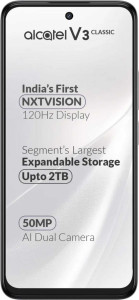
  • Display type is LCD IPS on Alcatel V3 Classic 5G and OLED/AMOLED on CMF Phone 2 Pro.
  • Screen size is 6.67″ on Alcatel V3 Classic 5G and 6.77″ on CMF Phone 2 Pro.
  • Pixel density is 262 ppi on Alcatel V3 Classic 5G and 388 ppi on CMF Phone 2 Pro.
  • Resolution is 720 x 1600 px on Alcatel V3 Classic 5G and 1080 x 2392 px on CMF Phone 2 Pro.
  • Damage-resistant glass is present on CMF Phone 2 Pro but not available on Alcatel V3 Classic 5G.
  • HDR10 and HDR10+ support is present on CMF Phone 2 Pro but not available on Alcatel V3 Classic 5G.
  • Always-On Display is available on CMF Phone 2 Pro but not on Alcatel V3 Classic 5G.
  • Internal storage is 128GB on Alcatel V3 Classic 5G and 256GB on CMF Phone 2 Pro.
  • RAM is 6GB on Alcatel V3 Classic 5G and 8GB on CMF Phone 2 Pro.
  • Chipset is MediaTek Dimensity 6300 on Alcatel V3 Classic 5G and MediaTek Dimensity 7300 on CMF Phone 2 Pro.
  • Geekbench 6 multi-core score is 2012 on Alcatel V3 Classic 5G and 2874 on CMF Phone 2 Pro.
  • Geekbench 6 single-core score is 782 on Alcatel V3 Classic 5G and 1007 on CMF Phone 2 Pro.
  • RAM speed is 2133 MHz (DDR4) on Alcatel V3 Classic 5G and 6400 MHz (DDR5) on CMF Phone 2 Pro.
  • Semiconductor size is 6 nm on Alcatel V3 Classic 5G and 4 nm on CMF Phone 2 Pro.
  • The main camera is a single lens on Alcatel V3 Classic 5G, while CMF Phone 2 Pro has a multi-lens setup with 50 MP, 50 MP, and 8 MP sensors.
  • Optical image stabilization is present on CMF Phone 2 Pro but not available on Alcatel V3 Classic 5G.
  • Front camera is 8 MP on Alcatel V3 Classic 5G and 16 MP on CMF Phone 2 Pro.
  • Video recording on the main camera is 1080p at 30 fps on Alcatel V3 Classic 5G and 2160p at 30 fps on CMF Phone 2 Pro.
  • Optical zoom is 0x on Alcatel V3 Classic 5G and 2x on CMF Phone 2 Pro.
  • Battery capacity is 5200 mAh on Alcatel V3 Classic 5G and 5000 mAh on CMF Phone 2 Pro.
  • Charging speed is 18W on Alcatel V3 Classic 5G and 33W on CMF Phone 2 Pro.
  • A charger is included with Alcatel V3 Classic 5G but not with CMF Phone 2 Pro.
  • A 3.5 mm audio jack is present on Alcatel V3 Classic 5G but not on CMF Phone 2 Pro.
  • Stereo speakers are available on Alcatel V3 Classic 5G but not on CMF Phone 2 Pro.
  • A built-in radio is present on Alcatel V3 Classic 5G but not on CMF Phone 2 Pro.
  • Wi-Fi 6 (802.11ax) support is present on CMF Phone 2 Pro but not on Alcatel V3 Classic 5G.
  • Bluetooth version is 5.4 on Alcatel V3 Classic 5G and 5.3 on CMF Phone 2 Pro.
  • A barometer is present on Alcatel V3 Classic 5G but not on CMF Phone 2 Pro.
  • A stylus is included with Alcatel V3 Classic 5G but not with CMF Phone 2 Pro.
  • An e-paper display is present on Alcatel V3 Classic 5G but not on CMF Phone 2 Pro.
Specs Comparison
Alcatel V3 Classic 5G

Alcatel V3 Classic 5G

CMF Phone 2 Pro

CMF Phone 2 Pro

Design:
water resistance Water resistant Water resistant
weight 187 g 185 g
thickness 8.2 mm 7.8 mm
width 76.2 mm 78 mm
height 165.6 mm 164 mm
volume 103.473504 cm³ 99.7776 cm³
Ingress Protection (IP) rating IP54 IP54
has a rugged build
can be folded

Both the Alcatel V3 Classic 5G and the CMF Phone 2 Pro share the same IP54 water resistance rating, meaning neither is rugged nor foldable, and both offer comparable splash and dust protection. This puts them on equal footing for everyday resilience against light rain or accidental spills, though neither is suited for submersion.

Where subtle differences emerge is in their physical dimensions. The Alcatel is marginally taller (165.6 mm vs 164 mm) and narrower (76.2 mm vs 78 mm), while the CMF is noticeably slimmer at 7.8 mm thick compared to 8.2 mm. That 0.4 mm difference in thickness may sound trivial, but combined with a slightly smaller overall volume (99.8 cm³ vs 103.5 cm³), the CMF Phone 2 Pro feels more compact and pocket-friendly in practice. The weight difference is negligible — 185 g vs 187 g — so neither has a meaningful advantage there.

Overall, the CMF Phone 2 Pro holds a modest design edge: it is slimmer and more compact by volume, which translates to a slightly sleeker in-hand feel. The Alcatel's narrower width could appeal to users who prefer a less wide grip, but on balance, the CMF's slimmer profile gives it the design advantage in this category.

Display:
Display type LCD, IPS OLED/AMOLED
screen size 6.67" 6.77"
pixel density 262 ppi 388 ppi
resolution 720 x 1600 px 1080 x 2392 px
refresh rate 120Hz 120Hz
has branded damage-resistant glass
supports HDR10
supports HDR10+
Always-On Display
supports Dolby Vision
Has a secondary screen
has a touch screen

The display category is where these two phones diverge most dramatically. The CMF Phone 2 Pro uses an OLED/AMOLED panel, while the Alcatel V3 Classic 5G relies on an LCD IPS screen — a fundamental technology gap that affects contrast, color vibrancy, and black levels. OLED pixels emit their own light and can switch off individually, producing true blacks and punchier colors that LCD simply cannot replicate, making the CMF's screen noticeably more engaging for media consumption and everyday use.

The resolution gap compounds this advantage. The CMF's 1080 x 2392 px resolution yields a pixel density of 388 ppi, versus the Alcatel's 720 x 1600 px at just 262 ppi. That 48% density advantage means sharper text, crisper images, and finer detail — differences that are clearly visible to the naked eye at typical viewing distances. Both phones match on 120Hz refresh rate, so scrolling smoothness is equally fluid. However, the CMF also adds HDR10+ support and an Always-On Display, features entirely absent on the Alcatel, further widening the gap for content creators and users who rely on glanceable notifications.

The CMF Phone 2 Pro wins this category decisively. Its OLED panel, full-HD+ resolution, HDR10+ support, and branded damage-resistant glass collectively represent a display experience that is in a different league from the Alcatel's entry-level LCD screen. For any user who values screen quality — whether for streaming, browsing, or daily readability — the CMF holds a clear and significant advantage.

Performance:
internal storage 128GB 256GB
RAM 6GB 8GB
Chipset (SoC) name MediaTek Dimensity 6300 MediaTek Dimensity 7300
GPU name Arm Mali-G57 MC2 Mali G615 MC2
CPU speed 2 x 2.4 & 6 x 2 GHz 4 x 2.5 & 4 x 2 GHz
Geekbench 6 result (multi) 2012 2874
Geekbench 6 result (single) 782 1007
GPU clock speed 950 MHz 1047 MHz
Has integrated LTE
RAM speed 2133 MHz 6400 MHz
semiconductor size 6 nm 4 nm
Supports 64-bit
DirectX version DirectX 12 DirectX 12
Has integrated graphics
Uses big.LITTLE technology
CPU threads 8 threads 8 threads
Uses HMP
maximum memory amount 12GB 16GB
DDR memory version 4 5

At the heart of this comparison lies a generational chipset gap. The Alcatel V3 Classic 5G runs on the MediaTek Dimensity 6300 built on a 6 nm process, while the CMF Phone 2 Pro is powered by the MediaTek Dimensity 7300 on a more advanced 4 nm node. A smaller manufacturing process generally means greater power efficiency and more transistor density — the CMF's chip can do more work while generating less heat. The Geekbench 6 scores reflect this clearly: the CMF leads in both single-core (1007 vs 782) and multi-core (2874 vs 2012) results, translating to snappier app launches, smoother multitasking, and better sustained performance under load.

Memory tells a similarly one-sided story. The CMF ships with 8 GB of DDR5 RAM running at 6400 MHz, compared to the Alcatel's 6 GB of DDR4 at 2133 MHz — a nearly 3x bandwidth advantage. Faster RAM means the system can feed the CPU data more quickly, reducing bottlenecks in demanding apps and games. The CMF also doubles the base storage at 256 GB vs 128 GB, which matters for users who store large media libraries or many apps locally. The GPU clock advantage (1047 MHz vs 950 MHz) further reinforces the CMF's edge in graphics-intensive tasks.

The CMF Phone 2 Pro wins the performance category comprehensively. Across every meaningful metric — chipset efficiency, CPU benchmark scores, RAM speed and capacity, and storage — it outpaces the Alcatel by a consistent and meaningful margin. Users who run demanding apps, game regularly, or simply want a phone that stays fast over time will find the CMF the clearly stronger choice here.

Cameras:
megapixels (main camera) 50 MP 50 & 50 & 8 MP
wide aperture (main camera) 1.8f 1.9 & 1.9 & 2.2f
Has a dual-lens (or multi-lens) main camera
megapixels (front camera) 8MP 16MP
has built-in optical image stabilization
video recording (main camera) 1080 x 30 fps 2160 x 30 fps
Has a dual-tone LED flash
number of flash LEDs 1 1
has a BSI sensor
has a CMOS sensor
has continuous autofocus when recording movies
Has phase-detection autofocus for photos
supports slow-motion video recording
has a built-in HDR mode
has manual exposure
has a flash
optical zoom 0x 2x
has manual ISO
has a serial shot mode
has manual focus
has a front camera
Has laser autofocus
Shoots 360° panorama
has manual white balance
shoots raw
has touch autofocus
has manual shutter speed
can create panoramas in-camera
wide aperture (front camera) 2f 2f
Has timelapse function
Has a front-facing LED flash
has a dual-lens (or multi-lens) front camera
supports HDR10 recording
supports Dolby Vision recording
has a front-facing camera under the display
Has a RGB LED flash
has 3D photo/video recording capabilities

The camera systems reveal another substantial gap between these two phones. The Alcatel V3 Classic 5G relies on a single 50 MP rear lens with no optical image stabilization and a video ceiling of 1080p at 30 fps. The CMF Phone 2 Pro counters with a triple-camera array — a 50 MP main, a 50 MP secondary, and an 8 MP lens — plus optical image stabilization (OIS) and 4K at 30 fps video recording. OIS alone is a significant real-world differentiator: it reduces blur from hand tremor in photos and produces far smoother video footage, particularly in low light or while moving.

Versatility is another area where the CMF pulls ahead. Its multi-lens setup combined with 2x optical zoom allows for genuine zoom shots without the quality degradation that comes from digital cropping — something the Alcatel cannot offer at all with its 0x optical zoom. On the selfie side, the CMF's 16 MP front camera outresolves the Alcatel's 8 MP unit, which matters for video calls and self-portraits. Both phones share a solid common feature set — phase-detection autofocus, HDR mode, slow-motion, and manual controls — so the Alcatel is not without capability, but it lacks the hardware to compete on range or video quality.

The CMF Phone 2 Pro takes a clear win in cameras. The combination of a triple-lens system, OIS, 4K video, optical zoom, and a higher-resolution front camera gives it meaningfully greater flexibility and output quality across virtually every shooting scenario the provided specs address.

Operating system:
Android version Android 15 Android 15
has clipboard warnings
has location privacy options
has camera/microphone privacy options
has Mail Privacy Protection
has theme customization
can block app tracking
blocks cross-site tracking
has on-device machine learning
has notification permissions
has media picker
Can play games while they download
has dark mode
has Wi-Fi password sharing
has battery health check
has an extra dim mode
has focus modes
has dynamic theming
can offload apps
Has customizable notifications
has Live Text
has full-page screenshots
supports split screen
gets direct OS updates
has PiP
Can be used as a PC
Has sharing intents
has a child lock
Supports widgets
Is free and open source
Has offline voice recognition
has voice commands
Tracks the current position of a mobile device
is a multi-user system
has Quick Start

On the software front, this is a rare instance of a complete tie. Both the Alcatel V3 Classic 5G and the CMF Phone 2 Pro run Android 15 and share an identical feature set across every single spec provided — from privacy controls like camera/microphone permissions and app tracking blocks, to usability features like dark mode, dynamic theming, split-screen, and Picture-in-Picture. There are no differentiators to analyze here because, based strictly on the provided data, none exist.

The shared privacy toolkit is worth noting for both devices: location privacy options, clipboard warnings, and on-device machine learning are present on each, reflecting the broader Android 15 baseline rather than any manufacturer-specific advantage. Neither phone offers direct OS updates, which means both will depend on their respective manufacturers for software patches — a consideration equally applicable to both.

This category is a complete draw. Users should not factor the operating system into their decision between these two phones, as every listed capability is identical. The choice ultimately rests on the hardware differences covered in other categories.

Battery:
battery power 5200 mAh 5000 mAh
has wireless charging
Supports fast charging
charging speed 18W 33W
comes with a charger
has a removable battery
has a battery level indicator
has a rechargeable battery

Battery capacity is one of the few hardware areas where the Alcatel V3 Classic 5G holds an advantage. Its 5200 mAh cell edges out the CMF Phone 2 Pro's 5000 mAh pack — a 4% difference that, in isolation, would suggest marginally longer time between charges. However, this advantage is complicated by context: the Alcatel's less demanding LCD display and less powerful chipset consume less power, while the CMF's OLED panel and faster processor have different efficiency profiles. Based strictly on the capacity figure provided, the Alcatel has a nominal lead, though it is not dramatic.

Where the CMF strikes back is charging speed. Its 33W fast charging is nearly double the Alcatel's 18W, meaning the CMF can replenish its battery significantly faster when plugged in — a practical advantage for users with busy schedules who can't afford long charging windows. One trade-off worth flagging: the CMF does not include a charger in the box, while the Alcatel does. For users who don't already own a compatible fast charger, this is an added out-of-pocket cost to factor in. Neither phone supports wireless charging.

This category ends in a narrow split. The Alcatel wins on raw capacity, but the margin is small enough to be largely inconsequential in daily use. The CMF's substantially faster 33W charging is the more impactful real-world differentiator — though the missing in-box charger partially offsets that convenience. Users who prioritize topping up quickly will lean toward the CMF; those who want to go longer between charges with no accessories needed may prefer the Alcatel.

Audio:
has a socket for a 3.5 mm audio jack
has stereo speakers
has aptX
has LDAC
has aptX HD
has aptX Adaptive
has aptX Lossless
Has a radio

Audio is a category where the Alcatel V3 Classic 5G punches above its weight — and where the CMF Phone 2 Pro makes notable omissions. The Alcatel offers both a 3.5 mm headphone jack and stereo speakers, while the CMF lacks both. Stereo speakers create a wider, more immersive soundstage for media playback, gaming, and calls — a single-speaker setup sounds comparatively flat and one-directional. The headphone jack, increasingly rare in modern smartphones, adds genuine value for users with wired headphones or earbuds, eliminating the need for an adapter or Bluetooth entirely.

The Alcatel also includes an FM radio tuner, which the CMF omits. While radio is a niche feature for many users, it carries real utility in areas with limited connectivity or during emergencies when streaming isn't an option. Neither phone supports high-resolution Bluetooth audio codecs such as aptX, LDAC, or their variants, so wireless audio quality is on equal footing — and equally limited — on both devices.

The Alcatel V3 Classic 5G wins the audio category clearly. Its combination of stereo speakers, a headphone jack, and FM radio represents a meaningfully richer audio hardware package than the CMF can offer. For users who care about speaker quality, wired listening, or offline radio access, the Alcatel holds a practical and unambiguous advantage here.

Connectivity & Features:
release date May 2025 April 2025
has 5G support
Wi-Fi version Wi-Fi 5 (802.11ac), Wi-Fi 4 (802.11n) Wi-Fi 4 (802.11n), Wi-Fi 6 (802.11ax), Wi-Fi 5 (802.11ac)
SIM cards 2 SIM 2 SIM
Bluetooth version 5.4 5.3
has an external memory slot
Has USB Type-C
has NFC
download speed 3300 MBits/s 3270 MBits/s
Has a fingerprint scanner
has emergency SOS via satellite
has crash detection
is DLNA-certified
has a gyroscope
supports ANT+
Has a heart rate monitor
has GPS
has a compass
supports Wi-Fi
Has an infrared sensor
has an accelerometer
has a cellular module
Has a barometer
has an HDMI output
Uses 3D facial recognition
Has an iris scanner
Stylus included
supports Galileo
Has motion tracking
Has optical tracking
Has a built-in projector

Across the broad connectivity checklist — 5G, NFC, dual SIM, USB-C, expandable storage, GPS, and Galileo — these two phones are evenly matched. The most meaningful divergence is in Wi-Fi generation: the CMF Phone 2 Pro supports Wi-Fi 6 (802.11ax), while the Alcatel V3 Classic 5G tops out at Wi-Fi 5 (802.11ac). Wi-Fi 6 delivers higher throughput, lower latency, and better performance in congested environments with many connected devices — a tangible upgrade for users on modern routers or in dense urban settings. The Alcatel counters with a marginally newer Bluetooth 5.4 versus the CMF's 5.3, though the practical difference between these adjacent versions is negligible for most users.

Two exclusive features on the Alcatel stand out beyond wireless specs. It includes a barometer — useful for weather tracking, altitude measurement, and certain fitness or navigation applications — which the CMF entirely omits. More unusually, the Alcatel also ships with a stylus, adding a precision input option that the CMF cannot match. A stylus enables handwriting, annotation, and fine-detail interaction that finger touch cannot replicate, which may matter for note-takers or creative users.

This category ends in a split verdict. The CMF's Wi-Fi 6 support is the stronger future-facing connectivity upgrade, but the Alcatel's bundled stylus and barometer are distinctive hardware extras that serve specific real-world needs. Users who prioritize wireless performance lean toward the CMF; those who value the stylus or sensor breadth will find the Alcatel's package more compelling.
Miscellaneous:
has a video light
Has sapphire glass display
Has a curved display
Has an e-paper display

Most of the specs in this group are shared — both phones have a video light, neither features sapphire glass nor a curved display. The one meaningful differentiator is the Alcatel V3 Classic 5G's e-paper display, a feature entirely absent on the CMF Phone 2 Pro. E-paper panels — typically used as secondary displays on the rear or edge of a device — consume virtually no power when showing static content and remain readable in direct sunlight without any backlight, making them practical for at-a-glance information like notifications, time, or battery status.

For users who appreciate persistent, low-power information display without waking the main screen, this is a genuinely useful addition. It differentiates the Alcatel in a niche but tangible way, particularly for battery-conscious users or those who frequently glance at their phone for quick status checks without needing to interact with it fully.

The Alcatel V3 Classic 5G takes this category by virtue of its sole differentiator: the e-paper display. It is a niche feature that will not matter to every buyer, but for those it appeals to, the CMF Phone 2 Pro simply has no equivalent to offer.

Comparison Summary & Verdict

After a thorough side-by-side review, it is clear that both phones serve different types of users. The CMF Phone 2 Pro stands out for those who prioritize visual quality and performance, thanks to its OLED display with HDR10+ support, significantly higher pixel density of 388 ppi, the more powerful Dimensity 7300 chipset, a multi-lens camera system with optical image stabilization and 4K video recording, and faster 33W charging. Meanwhile, the Alcatel V3 Classic 5G appeals to users who value a complete multimedia package out of the box, offering stereo speakers, a 3.5 mm headphone jack, a built-in FM radio, a bundled charger, a stylus, an e-paper display, and a slightly larger 5200 mAh battery. Your choice ultimately comes down to whether you want a richer screen and camera experience or a more feature-packed, self-contained device.

Alcatel V3 Classic 5G
Buy Alcatel V3 Classic 5G if...

Buy the Alcatel V3 Classic 5G if you want a complete multimedia experience with stereo speakers, a headphone jack, FM radio, a stylus, and a charger included in the box.

CMF Phone 2 Pro
Buy CMF Phone 2 Pro if...

Buy the CMF Phone 2 Pro if you prioritize a sharper OLED display, stronger processing performance, a versatile multi-lens camera with optical image stabilization, and faster 33W charging.