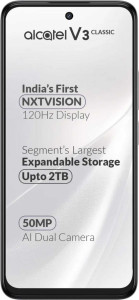
Core connectivity is a mirror image across both phones. Dual SIM, 5G, Wi-Fi, USB Type-C 2.0, expandable storage, fingerprint scanner, GPS with Galileo support, and a 3300 Mbits/s peak download speed — all present on both. For everyday use, this means neither phone has a networking or biometric advantage over the other, and both are equally capable of leveraging 5G where available.
Two exclusive features tip the scales toward the Alcatel V3 Classic 5G. First, it includes a barometer, a sensor the Itel lacks entirely. While niche, a barometer enables more accurate altitude readings and can enhance weather apps and outdoor navigation tools. Second — and more strikingly for this price tier — the Alcatel ships with a stylus. A bundled stylus opens up note-taking, sketching, and precision input that simply isn't possible on the Itel without an accessory purchase. This is an uncommon inclusion in the budget segment and adds tangible utility for productivity-oriented users.
The Alcatel V3 Classic 5G takes a clear edge here. The stylus in particular is an unexpected value-add that elevates the device beyond a straight spec comparison, and the barometer, while secondary, further pads the Alcatel's advantage. Users who have no use for either feature will find the connectivity foundations identical, but for anyone who might benefit from pen input or environmental sensing, the Alcatel is the more capable package.