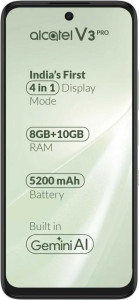
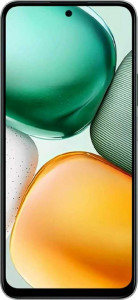
Alcatel V3 Pro 5G
Honor X7c 5G

Alcatel V3 Pro 5G Honor X7c 5G

Overview

Welcome to our detailed spec comparison between the Alcatel V3 Pro 5G and the Honor X7c 5G — two mid-range 5G smartphones that share a surprising amount of common ground while diverging sharply in key areas. From display sharpness and chipset architecture to camera versatility and everyday connectivity extras, each device takes a distinct approach to the budget-to-mid-range segment. Read on to discover how these two contenders truly stack up against each other.

Common Features

  • Both phones are water resistant.
  • Neither phone has a rugged build.
  • Neither phone can be folded.
  • Both phones feature an LCD IPS display with a 120Hz refresh rate.
  • Neither phone has branded damage-resistant glass.
  • Neither phone supports HDR10, HDR10+, or Dolby Vision.
  • Neither phone has an Always-On Display or a secondary screen.
  • Both phones come with 256GB of internal storage and 8GB of RAM.
  • Both phones support 5G, LTE, and 64-bit processing.
  • Both phones use big.LITTLE technology with 8 CPU threads.
  • Both phones support DirectX 12 and have integrated graphics.
  • Both main cameras feature a dual-lens setup at 50 MP for the primary sensor.
  • Neither phone has built-in optical image stabilization.
  • Both phones record main camera video at 1080p 30fps.
  • Both phones support continuous autofocus and phase-detection autofocus.
  • Both phones support slow-motion video recording.
  • Both phones run Android with clipboard warnings, location privacy options, and camera/microphone privacy options.
  • Neither phone has Mail Privacy Protection or blocks cross-site tracking.
  • Both phones support fast charging but lack wireless charging and have a non-removable battery.
  • Both phones feature stereo speakers but lack aptX, LDAC, aptX HD, aptX Adaptive, aptX Adaptive, and aptX Lossless support.
  • Both phones support 5G, dual SIM, USB Type-C (USB 2.0), NFC, and have a fingerprint scanner.
  • Neither phone has emergency SOS via satellite or crash detection.
  • Both phones have a video light, no sapphire glass display, and no curved display.

Main Differences

  • Weight is 190g on Alcatel V3 Pro 5G and 196g on Honor X7c 5G.
  • Thickness is 8.2mm on Alcatel V3 Pro 5G and 8.1mm on Honor X7c 5G.
  • Ingress Protection rating is IP54 on Alcatel V3 Pro 5G and IP64 on Honor X7c 5G.
  • Screen size is 6.67″ on Alcatel V3 Pro 5G and 6.8″ on Honor X7c 5G.
  • Pixel density is 263 ppi on Alcatel V3 Pro 5G and 389 ppi on Honor X7c 5G.
  • Resolution is 720x1600px on Alcatel V3 Pro 5G and 1080x2412px on Honor X7c 5G.
  • The chipset is MediaTek Dimensity 6300 on Alcatel V3 Pro 5G and Qualcomm Snapdragon 4 Gen 2 on Honor X7c 5G.
  • The GPU is Arm Mali-G57 MC2 on Alcatel V3 Pro 5G and Adreno 613 on Honor X7c 5G.
  • Semiconductor size is 6nm on Alcatel V3 Pro 5G and 4nm on Honor X7c 5G.
  • RAM speed is 2133 MHz on Alcatel V3 Pro 5G and 3200 MHz on Honor X7c 5G.
  • DDR memory version is DDR4 on Alcatel V3 Pro 5G and DDR5 on Honor X7c 5G.
  • Maximum memory support is 12GB on Alcatel V3 Pro 5G and 16GB on Honor X7c 5G.
  • The secondary main camera is 5MP on Alcatel V3 Pro 5G and 2MP on Honor X7c 5G.
  • Front camera resolution is 8MP on Alcatel V3 Pro 5G and 5MP on Honor X7c 5G.
  • A rear flash is present on Alcatel V3 Pro 5G but not available on Honor X7c 5G.
  • Android version is Android 15 on Alcatel V3 Pro 5G and Android 14 on Honor X7c 5G.
  • App offloading is supported on Alcatel V3 Pro 5G but not available on Honor X7c 5G.
  • Battery capacity is 5200 mAh on Alcatel V3 Pro 5G and 5100 mAh on Honor X7c 5G.
  • Charging speed is 18W on Alcatel V3 Pro 5G and 35W on Honor X7c 5G.
  • A 3.5mm audio jack is present on Alcatel V3 Pro 5G but not available on Honor X7c 5G.
  • FM radio is available on Alcatel V3 Pro 5G but not present on Honor X7c 5G.
  • Bluetooth version is 5.4 on Alcatel V3 Pro 5G and 5.0 on Honor X7c 5G.
  • Download speed is 3300 Mbit/s on Alcatel V3 Pro 5G and 2500 Mbit/s on Honor X7c 5G.
  • A gyroscope is present on Alcatel V3 Pro 5G but not available on Honor X7c 5G.
  • A barometer is present on Alcatel V3 Pro 5G but not available on Honor X7c 5G.
  • A stylus is included with Alcatel V3 Pro 5G but not with Honor X7c 5G.
  • An e-paper display is present on Alcatel V3 Pro 5G but not available on Honor X7c 5G.
Specs Comparison
Alcatel V3 Pro 5G

Alcatel V3 Pro 5G

Honor X7c 5G

Honor X7c 5G

Design:
water resistance Water resistant Water resistant
weight 190 g 196 g
thickness 8.2 mm 8.1 mm
width 76.2 mm 76.8 mm
height 165.6 mm 166.9 mm
volume 103.473504 cm³ 103.825152 cm³
Ingress Protection (IP) rating IP54 IP64
has a rugged build
can be folded

In terms of physical dimensions, these two phones are remarkably close. The Alcatel V3 Pro 5G measures 165.6 × 76.2 × 8.2 mm against the Honor X7c 5G at 166.9 × 76.8 × 8.1 mm, resulting in nearly identical volumes of roughly 103.5 cm³ versus 103.8 cm³. In practice, a user switching between them blindfolded would struggle to notice the difference in hand feel. The Alcatel is marginally lighter at 190 g compared to the Honor's 196 g — a 6 g gap that, while technically measurable, is unlikely to be perceptible during everyday use.

The more meaningful differentiator here is the IP rating. Both phones are rated as water resistant, but the Honor X7c 5G carries an IP64 certification while the Alcatel V3 Pro 5G holds an IP54. The first digit — dust protection — is where the gap lies: IP5x means partial dust resistance (some ingress permitted), whereas IP6x means the device is fully dust-tight. For users in dusty environments, construction sites, or sandy outdoor settings, this distinction is genuinely significant and not just a spec-sheet detail.

Neither device features a rugged build or a foldable form factor, so both target the same mainstream, slim-slab audience. Overall, the Honor X7c 5G holds a clear edge in this category thanks to its superior dust protection, while the two phones are effectively tied on every other dimension of design.

Display:
Display type LCD, IPS LCD, IPS
screen size 6.67" 6.8"
pixel density 263 ppi 389 ppi
resolution 720 x 1600 px 1080 x 2412 px
refresh rate 120Hz 120Hz
has branded damage-resistant glass
supports HDR10
supports HDR10+
Always-On Display
supports Dolby Vision
Has a secondary screen
has a touch screen

Both phones use an LCD IPS panel with a 120Hz refresh rate, which means smooth scrolling and responsive touch input are on the table for both — a welcome feature at this price tier. The screen sizes are also comparable, with the Honor X7c 5G edging out at 6.8″ versus the Alcatel V3 Pro 5G's 6.67″, a difference too small to be a deciding factor on its own.

Where the two screens genuinely diverge is sharpness. The Alcatel ships with a 720 x 1600 px resolution yielding just 263 ppi, while the Honor steps up to a 1080 x 2412 px panel at 389 ppi — nearly 50% more pixels per inch. That gap is clearly visible in everyday use: text appears crisper, fine UI details render more cleanly, and images look noticeably more refined on the Honor. At typical phone viewing distances, 263 ppi is passable but individual pixels can become discernible, especially when reading small text or viewing photos up close.

Neither display supports HDR10, Dolby Vision, or damage-resistant glass, so those factors don't separate the two. The Honor X7c 5G holds a decisive advantage in this category purely on the strength of its full HD+ resolution — it is the more capable display for media consumption, reading, and general daily use.

Performance:
internal storage 256GB 256GB
RAM 8GB 8GB
Chipset (SoC) name MediaTek Dimensity 6300 Qualcomm Snapdragon 4 Gen 2
GPU name Arm Mali-G57 MC2 Adreno 613
CPU speed 2 x 2.4 & 6 x 2 GHz 2 x 2.3 & 6 x 2 GHz
GPU clock speed 950 MHz 955 MHz
Has integrated LTE
RAM speed 2133 MHz 3200 MHz
semiconductor size 6 nm 4 nm
Supports 64-bit
DirectX version DirectX 12 DirectX 12
Has integrated graphics
Uses big.LITTLE technology
CPU threads 8 threads 8 threads
maximum memory amount 12GB 16GB
DDR memory version 4 5

On the surface, these two phones look evenly matched: both pack 8GB of RAM, 256GB of storage, an 8-thread big.LITTLE CPU layout, and near-identical clock speeds. But the silicon underneath tells a more nuanced story. The Alcatel V3 Pro 5G runs on a MediaTek Dimensity 6300 built on a 6 nm process, while the Honor X7c 5G uses a Qualcomm Snapdragon 4 Gen 2 on a 4 nm node. A smaller fabrication process generally means better power efficiency and more thermal headroom — the Honor's chip can do more work per watt, which translates to cooler sustained performance and less battery drain under load.

The memory architecture further separates the two. The Honor pairs its chipset with DDR5 RAM running at 3200 MHz, compared to the Alcatel's DDR4 at 2133 MHz — roughly 50% more memory bandwidth. Faster RAM means quicker data handoffs between the CPU and memory, which benefits multitasking, app load times, and anything that shuffles large amounts of data. The Honor also supports a higher maximum memory ceiling of 16GB versus 12GB on the Alcatel, useful if either device offers virtual RAM expansion features. GPU clock speeds are virtually tied at 955 vs 950 MHz, so raw graphics throughput is not a meaningful differentiator here.

Taken together, the Honor X7c 5G holds a clear performance advantage in this category. While neither phone will struggle with everyday tasks, the Snapdragon 4 Gen 2's more advanced process node and faster memory architecture give the Honor a meaningful edge in efficiency and sustained responsiveness — advantages that become more apparent under heavier workloads.

Cameras:
megapixels (main camera) 50 & 5 MP 50 & 2 MP
wide aperture (main camera) 2.2 & 1.8f 2.4 & 1.8f
Has a dual-lens (or multi-lens) main camera
megapixels (front camera) 8MP 5MP
has built-in optical image stabilization
video recording (main camera) 1080 x 30 fps 1080 x 30 fps
Has a dual-tone LED flash
number of flash LEDs 1 1
has continuous autofocus when recording movies
Has phase-detection autofocus for photos
supports slow-motion video recording
has a built-in HDR mode
has manual exposure
has a flash
optical zoom 0x 0x
has manual ISO
has a serial shot mode
has manual focus
has a front camera
Has laser autofocus
Shoots 360° panorama
has manual white balance
shoots raw
has touch autofocus
has manual shutter speed
can create panoramas in-camera
wide aperture (front camera) 2f 2.2f
Has timelapse function
Has a front-facing LED flash
has a dual-lens (or multi-lens) front camera
supports HDR10 recording
supports Dolby Vision recording
has a front-facing camera under the display
Has a RGB LED flash
has 3D photo/video recording capabilities

The main camera setup shares a 50MP primary sensor on both phones, and the feature set is broadly identical — phase-detection autofocus, slow-motion, HDR, timelapse, panorama, and a solid range of manual controls. Video is capped at 1080p at 30fps on both, with no OIS on either. At this level, the cameras are built for similar audiences. The real differences emerge in the secondary lens and the front-facing setup.

The Alcatel V3 Pro 5G pairs its main sensor with a 5MP secondary camera, compared to just 2MP on the Honor X7c 5G. A 2MP secondary is typically only capable of basic depth sensing for portrait mode, while 5MP can deliver more usable detail. The Alcatel's main lens also has a marginally wider aperture at f/2.2 versus the Honor's f/2.4, allowing slightly more light in — a modest but real advantage in low-light conditions. For selfies, the Alcatel pulls further ahead with an 8MP front camera at f/2.0 compared to the Honor's 5MP at f/2.2, offering both higher resolution and better light gathering.

The most decisive gap, however, is that the Honor X7c 5G lacks a rear flash entirely, while the Alcatel includes one. Shooting in dark environments without a flash is a significant practical limitation. Combined with its stronger secondary lens and front camera, the Alcatel V3 Pro 5G holds a clear overall advantage in the camera category.

Operating system:
Android version Android 15 Android 14
has clipboard warnings
has location privacy options
has camera/microphone privacy options
has Mail Privacy Protection
has theme customization
can block app tracking
blocks cross-site tracking
has on-device machine learning
has notification permissions
has media picker
Can play games while they download
has dark mode
has Wi-Fi password sharing
has battery health check
has an extra dim mode
has focus modes
has dynamic theming
can offload apps
Has customizable notifications
has Live Text
has full-page screenshots
supports split screen
gets direct OS updates
has PiP
Can be used as a PC
Has sharing intents
has a child lock
Supports widgets
Is free and open source
Has offline voice recognition
has voice commands
Tracks the current position of a mobile device
is a multi-user system
has Quick Start

The software comparison here is largely a story of near-identical feature sets separated by one meaningful version gap. The Alcatel V3 Pro 5G ships with Android 15, while the Honor X7c 5G launches on Android 14. A newer Android version brings the latest security patches, privacy improvements, and platform optimizations out of the box — and since neither device receives direct OS updates, the version each ships with is likely to define its long-term software baseline.

Across privacy tools, productivity features, and customization options — dark mode, dynamic theming, split-screen, Picture-in-Picture, widgets, on-device machine learning, and granular notification controls — the two phones are functionally identical. One additional practical differentiator is app offloading: the Alcatel supports it, the Honor does not. Offloading allows rarely used apps to be temporarily removed to free up storage while preserving their data, a handy feature on devices where internal space can fill up over time.

The Alcatel V3 Pro 5G holds the edge in this category, driven by its newer Android version and app offloading support. Neither advantage is dramatic enough to be a dealbreaker on its own, but for users who prioritize having the most current software foundation, the Alcatel starts from a more future-proof position.

Battery:
battery power 5200 mAh 5100 mAh
has wireless charging
Supports fast charging
charging speed 18W 35W
has a removable battery
has a battery level indicator
has a rechargeable battery

Raw capacity is effectively a wash here: the Alcatel V3 Pro 5G carries a 5200 mAh battery against the Honor X7c 5G's 5100 mAh — a 100 mAh difference that will not produce any meaningful real-world gap in screen-on time. Both cells are non-removable and non-wireless, so the specs that actually matter for day-to-day battery experience come down to a single factor: charging speed.

That gap is substantial. The Honor X7c 5G supports 35W fast charging, nearly double the Alcatel's 18W. In practical terms, 35W can replenish a significant portion of a 5100 mAh battery in under an hour, while 18W charging on a similarly sized cell will take considerably longer to reach the same point. For users who rely on quick top-ups between activities — or who frequently find themselves charging on the go — this difference is felt daily, not just on paper.

The Honor X7c 5G wins this category, and it is not particularly close. The Alcatel's marginal capacity lead is too small to offset the Honor's significantly faster replenishment speed, making the Honor the more convenient device for users where charging time is a priority.

Audio:
has a socket for a 3.5 mm audio jack
has stereo speakers
has aptX
has LDAC
has aptX HD
has aptX Adaptive
has aptX Lossless
Has a radio

Stereo speakers are present on both phones, putting them on equal footing for loudspeaker listening. Neither device supports high-resolution Bluetooth audio codecs such as aptX or LDAC, so wireless audio quality is limited to standard Bluetooth transmission on both — no advantage to either side there.

The divergence comes in two features the Alcatel V3 Pro 5G has and the Honor X7c 5G simply does not: a 3.5mm headphone jack and an FM radio. The headphone jack remains practically significant for users who own wired headphones or earphones, listen in situations where Bluetooth is inconvenient, or want to avoid the latency and battery drain of wireless audio. The FM radio, while a niche feature for many, is genuinely valued by users in areas with strong terrestrial broadcasts or during emergencies when data connectivity is unavailable.

The Alcatel V3 Pro 5G wins this category outright. The Honor offers no compensating audio advantage, and losing both the headphone jack and FM radio represents a meaningful reduction in audio versatility for users who rely on either.

Connectivity & Features:
release date May 2025 January 2025
has 5G support
Wi-Fi version Wi-Fi 5 (802.11ac), Wi-Fi 4 (802.11n) Wi-Fi 4 (802.11n), Wi-Fi 5 (802.11ac)
SIM cards 2 SIM 2 SIM
Bluetooth version 5.4 5
Has USB Type-C
USB version 2 2
has NFC
download speed 3300 MBits/s 2500 MBits/s
Has a fingerprint scanner
has emergency SOS via satellite
has crash detection
is DLNA-certified
has a gyroscope
supports ANT+
Has a heart rate monitor
has GPS
has a compass
supports Wi-Fi
Has an infrared sensor
has an accelerometer
has a cellular module
Has a barometer
has an HDMI output
Uses 3D facial recognition
Has an iris scanner
Stylus included
supports Galileo
Has motion tracking
Has optical tracking
Has a built-in projector

The connectivity foundations are shared: both phones offer 5G, dual SIM, Wi-Fi 5, USB Type-C 2.0, NFC, GPS with Galileo support, and a fingerprint scanner. For most users, this common ground covers the essentials. The Alcatel V3 Pro 5G does pull ahead on Bluetooth, offering version 5.4 versus the Honor X7c 5G's 5.0 — a newer revision that brings improvements in connection stability and energy efficiency. The Alcatel also supports a higher peak download speed of 3300 Mbps compared to the Honor's 2500 Mbps, a gap that matters mainly in congested networks or when transferring large files over cellular.

The sensor loadout is where the Alcatel distinguishes itself more meaningfully. It includes a gyroscope and a barometer, both absent on the Honor. A gyroscope enables accurate motion-based features — from augmented reality apps to more responsive gaming controls — while a barometer allows altitude readings and can improve GPS accuracy. The Alcatel also ships with a stylus, an unusual inclusion at this tier that adds a note-taking and precision input option the Honor simply cannot match.

The Alcatel V3 Pro 5G wins this category convincingly. Across Bluetooth version, cellular throughput, sensor complement, and the bonus of an included stylus, it offers a noticeably broader and more capable feature set than the Honor X7c 5G.

Miscellaneous:
has a video light
Has sapphire glass display
Has a curved display
Has an e-paper display

Most of the miscellaneous specs here are shared — both phones include a video light and neither features sapphire glass or a curved display. The only differentiator in this group, but a genuinely distinctive one, is that the Alcatel V3 Pro 5G includes an e-paper display while the Honor X7c 5G does not.

An e-paper screen is typically a secondary display that uses virtually no power when showing static content, making it ideal for glanceable information — notifications, time, or status updates — without waking the main panel. For users who want to conserve battery or simply check information at a glance in bright sunlight, where e-ink excels over backlit LCDs, this is a practical and uncommon feature at this price point.

The Alcatel V3 Pro 5G takes this category by virtue of its e-paper display, a niche but tangible feature that adds everyday utility the Honor cannot offer. Whether it is a priority will depend on the user, but as a differentiator it clearly favors the Alcatel.

Comparison Summary & Verdict

After examining every specification, both phones serve different types of users. The Alcatel V3 Pro 5G stands out for its richer feature set, offering a 3.5mm audio jack, FM radio, gyroscope, barometer, stylus, e-paper display, Android 15, and a higher IP54-rated build with broader sensor support — making it the better choice for users who value versatility and extras. The Honor X7c 5G, on the other hand, wins decisively on display quality with its Full HD+ 389 ppi screen, benefits from a more modern 4nm Snapdragon chipset with DDR5 RAM, a superior IP64 dust-and-water rating, and significantly faster 35W charging. If raw visual experience and performance efficiency matter most, the Honor X7c 5G is the sharper pick — but if you need a feature-packed, sensor-rich daily driver, the Alcatel V3 Pro 5G delivers more tools out of the box.

Alcatel V3 Pro 5G
Buy Alcatel V3 Pro 5G if...

Buy the Alcatel V3 Pro 5G if you want a feature-rich device with a stylus, 3.5mm audio jack, FM radio, gyroscope, barometer, and a newer Android 15 experience.

Honor X7c 5G
Buy Honor X7c 5G if...

Buy the Honor X7c 5G if you prioritize a sharper Full HD+ display, a more efficient 4nm chipset with DDR5 RAM, a better IP64 rating, and significantly faster 35W charging.