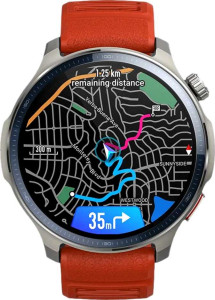
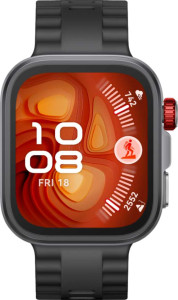
Both watches share a strong design foundation: OLED/AMOLED displays, sapphire glass protection, Always-On Display, replaceable bands, and IP68 certification. However, the form factor differences are substantial. The Huawei Watch Fit 4 Pro is dramatically slimmer at 9.3 mm thick versus 12.3 mm for the Amazfit Balance 2, and weighs only 30.4 g compared to 43 g — a nearly 30% reduction. Combined with a smaller footprint (44.5 × 40 mm vs 47.4 × 47.4 mm), the Fit 4 Pro sits far more discreetly on the wrist, which matters for all-day and sleep tracking comfort.
Interestingly, the Fit 4 Pro pairs its compact chassis with a larger 1.82″ screen versus the Balance 2's 1.5″ panel, and achieves this through a more rectangular form that maximizes screen real estate within a smaller case. Its pixel density is also slightly higher at 347 ppi vs 323 ppi, meaning text and graphics will appear marginally sharper. The trade-off is the 20 mm band width on the Fit 4 Pro versus 22 mm on the Balance 2, giving the latter a slightly more substantial, sport-watch feel on the wrist.
On water resistance, the picture is nuanced: the Balance 2 carries a higher 10 ATM pressure rating, which translates to greater theoretical resilience during high-velocity water activities like swimming laps or water sports, while the Fit 4 Pro is rated 5 ATM despite a slightly deeper static depth rating of 50 m. Overall, the Huawei Watch Fit 4 Pro holds a clear design edge for users who prioritize a lighter, slimmer, more everyday-wearable form factor with a bigger screen; the Amazfit Balance 2 is the better pick for those who prefer a chunkier, more robust feel and stronger water-pressure resistance.