Amazfit Bip 6
CMF Watch 3 Pro

Amazfit Bip 6 CMF Watch 3 Pro

Overview

Welcome to our in-depth spec comparison between the Amazfit Bip 6 and the CMF Watch 3 Pro — two budget-friendly smartwatches that share a surprising amount of common ground while diverging sharply in key areas. Both sport AMOLED displays, GPS, heart rate monitoring, and broad smartphone compatibility, yet they take very different approaches to design philosophy, battery endurance, and software features. Read on to find out which one is the better fit for your lifestyle.

Common Features

  • Both watches feature an OLED/AMOLED display type.
  • Both watches carry a 5 ATM water resistance rating.
  • Both watches have an IP68 ingress protection rating.
  • Always-On Display is available on both watches.
  • The watch band is replaceable on both watches.
  • Branded damage-resistant glass is not featured on either watch.
  • A touchscreen display is present on both watches.
  • Blood oxygen level monitoring is available on both watches.
  • A heart rate monitor is included in both watches.
  • GPS is present on both watches.
  • An accelerometer is included in both watches.
  • A temperature sensor is not available on either watch.
  • A compass is present on both watches.
  • A barometer is not available on either watch.
  • A gyroscope is included in both watches.
  • Sleep tracking is available on both watches.
  • Both watches track distance, steps taken, and measure pace.
  • Automatic activity detection is available on both watches.
  • Route tracking is available on both watches.
  • Elevation tracking is available on both watches.
  • Sleep reports are provided by both watches.
  • Neither watch has a cellular module.
  • Both watches are compatible with iOS and Android.
  • Neither watch supports Wi-Fi, ANT+, or NFC.
  • Galileo satellite system support is available on both watches.
  • Neither watch supports wireless charging.
  • Both watches have a rechargeable battery.
  • A solar power battery is not featured on either watch.
  • The battery is not removable on either watch.
  • HRV tracking is available on both watches.
  • VO2 max measurement is available on both watches.
  • Resting heart rate measurement is available on both watches.
  • Fast and slow heart rate notifications are available on both watches.
  • Both watches can be used to answer calls and have call control.
  • Phone-finding functionality is available on both watches.
  • Both watches support notifications.
  • Activity reports are provided by both watches.
  • Inactivity alerts are available on both watches.
  • Calorie burn counting is available on both watches.
  • Goal setting and achievements are available on both watches.
  • The companion app is free and ad-free on both watches.
  • An exercise diary is available on both watches.
  • A battery level indicator is present on both watches.
  • Neither watch is compatible with Windows or Mac OS X.
  • Neither watch has an external memory slot or a 3.5 mm audio jack socket.

Main Differences

  • Screen size is 1.97″ on Amazfit Bip 6 and 1.43″ on CMF Watch 3 Pro.
  • Water resistance is rated as water resistant on Amazfit Bip 6 but only sweat resistant on CMF Watch 3 Pro.
  • Pixel density is 302 ppi on Amazfit Bip 6 and 326 ppi on CMF Watch 3 Pro.
  • Resolution is 390 x 450 px on Amazfit Bip 6 and 466 x 466 px on CMF Watch 3 Pro.
  • Thickness is 10.45 mm on Amazfit Bip 6 and 14.4 mm on CMF Watch 3 Pro.
  • Weight is 27.9 g on Amazfit Bip 6 and 51.9 g on CMF Watch 3 Pro.
  • Height is 46.3 mm on Amazfit Bip 6 and 45 mm on CMF Watch 3 Pro.
  • Width is 40.2 mm on Amazfit Bip 6 and 47 mm on CMF Watch 3 Pro.
  • Volume is 19.450167 cm³ on Amazfit Bip 6 and 30.456 cm³ on CMF Watch 3 Pro.
  • A cadence sensor is present on Amazfit Bip 6 but not available on CMF Watch 3 Pro.
  • Multi-sport mode is available on CMF Watch 3 Pro but not on Amazfit Bip 6.
  • Bluetooth version is 5.2 on Amazfit Bip 6 and 5.3 on CMF Watch 3 Pro.
  • Battery life is 14 days on Amazfit Bip 6 and 13 days on CMF Watch 3 Pro.
  • Battery power is 340 mAh on Amazfit Bip 6 and 350 mAh on CMF Watch 3 Pro.
  • Battery life in training mode is 14 hours on Amazfit Bip 6 and 108 hours on CMF Watch 3 Pro.
  • Charge time is 2 hours on Amazfit Bip 6 and 1.65 hours on CMF Watch 3 Pro.
  • Battery life in power save mode is 624 hours on Amazfit Bip 6 and 1440 hours on CMF Watch 3 Pro.
  • Battery life with GPS on is 32 hours on Amazfit Bip 6 and 17.2 hours on CMF Watch 3 Pro.
  • Irregular heart rate warnings are available on Amazfit Bip 6 but not on CMF Watch 3 Pro.
  • Coaching is available in the app on Amazfit Bip 6 but not on CMF Watch 3 Pro.
  • Temperature tracking in the app is available on Amazfit Bip 6 but not on CMF Watch 3 Pro.
  • Route support in the app is available on Amazfit Bip 6 but not on CMF Watch 3 Pro.
  • Calendar sync is supported on Amazfit Bip 6 but not on CMF Watch 3 Pro.
  • Music playback is available on Amazfit Bip 6 but not on CMF Watch 3 Pro.
  • Personalisation options are available on Amazfit Bip 6 but not on CMF Watch 3 Pro.
  • Auto pause is available on Amazfit Bip 6 but not on CMF Watch 3 Pro.
  • A passcode feature is available on Amazfit Bip 6 but not on CMF Watch 3 Pro.
  • Compatibility with external heart rate monitors is present on Amazfit Bip 6 but not on CMF Watch 3 Pro.
Specs Comparison
Amazfit Bip 6

Amazfit Bip 6

CMF Watch 3 Pro

CMF Watch 3 Pro

Design:
screen size 1.97" 1.43"
Display type OLED/AMOLED OLED/AMOLED
water resistance Water resistant Sweat resistant
ATM rating 5 ATM 5 ATM
Ingress Protection (IP) rating IP68 IP68
Always-On Display
pixel density 302 ppi 326 ppi
resolution 390 x 450 px 466 x 466 px
Watch band is replaceable
has branded damage-resistant glass
thickness 10.45 mm 14.4 mm
weight 27.9 g 51.9 g
height 46.3 mm 45 mm
width 40.2 mm 47 mm
Has a display
has a touch screen
Has sapphire glass display
volume 19.450167 cm³ 30.456 cm³
is designed for kids

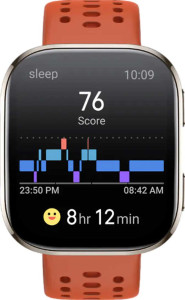
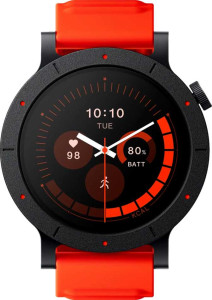
Both the Amazfit Bip 6 and CMF Watch 3 Pro share the same display technology — OLED/AMOLED panels with Always-On Display support — and both carry identical formal water-resistance credentials: 5 ATM and IP68. Despite this, the Bip 6 is labeled ″water resistant″ while the CMF Watch 3 Pro is labeled only ″sweat resistant,″ which may reflect differences in manufacturer positioning or practical usage guidance, and is worth noting for buyers planning aquatic activities.

Where the two watches diverge sharply is in screen size versus sharpness. The Bip 6 offers a considerably larger 1.97″ display at 302 ppi, while the CMF Watch 3 Pro packs a smaller 1.43″ screen but at a noticeably higher 326 ppi — meaning the Bip 6 gives you more real estate for glanceability and readability, while the CMF delivers a crisper image within a tighter canvas. The CMF also uses a squarish 47 mm wide case that leans circular, versus the Bip 6′s more rectangular 40.2 mm wide form factor.

The most decisive physical differentiator, however, is wearability comfort. The Bip 6 is dramatically lighter at 27.9 g versus the CMF′s 51.9 g, and meaningfully slimmer at 10.45 mm thick compared to 14.4 mm — nearly 4 mm thicker on the wrist. For all-day and sleep tracking use, this gap is significant. The Bip 6 holds a clear edge in design ergonomics and everyday wearability, while the CMF Watch 3 Pro appeals more to users who prioritize display crispness and a rounder aesthetic over a lightweight profile.

Sensors:
Monitors blood oxygenation levels
Has a heart rate monitor
has GPS
has an accelerometer
Has a temperature sensor
has a compass
Has a barometer
has a gyroscope
Has a cadence sensor
Monitors perspiration

The sensor suites of the Amazfit Bip 6 and CMF Watch 3 Pro are nearly identical across the board — both include a heart rate monitor, SpO2 tracking, GPS, accelerometer, gyroscope, and compass. For the vast majority of users, this shared foundation covers all the essentials: continuous health monitoring, accurate outdoor navigation, and motion-based activity detection are all present on either device.

The only meaningful divergence is the Bip 6′s inclusion of a cadence sensor, which the CMF Watch 3 Pro lacks. For runners and cyclists, cadence data — steps or pedal strokes per minute — is a genuine training metric that helps optimize efficiency and reduce injury risk. It is a niche but legitimate advantage for fitness-focused users who go beyond casual step counting.

Notably, neither watch includes a barometer or temperature sensor, which limits their utility for hiking and altitude-aware activities compared to more premium sport-oriented wearables. Overall, the Bip 6 holds a slim edge in this category purely due to the cadence sensor, but for users who do not actively track running or cycling performance, the two watches are effectively tied on sensors.

Activity tracking:
Tracks your sleep
Tracks distance
Tracks steps taken
Measures pace
Provides sleep reports
Detects activities automatically
Has a route tracker
Tracks elevation
Has multi-sport mode
Has exercise tagging
Has a stroke counter for swimming
Tracks calorie intake
Designed for diving
Designed for golf

Activity tracking is a strong suit for both watches, and the overlap here is substantial. Sleep tracking with full reports, automatic activity detection, route tracking, elevation, pace, distance, steps, calorie intake, and even a stroke counter for swimming — all of these are present on both the Amazfit Bip 6 and the CMF Watch 3 Pro. For the everyday fitness user, either watch delivers a well-rounded tracking experience without meaningful gaps.

The single point of separation is multi-sport mode, which the CMF Watch 3 Pro supports and the Bip 6 does not. This feature matters more than it might initially appear: multi-sport mode allows athletes to switch seamlessly between disciplines — such as swim, bike, and run — within a single workout session, logging each segment separately without stopping to manually end and restart tracking. For triathletes or anyone who regularly combines activities in one session, this is a tangible functional advantage.

For users who train in a single sport at a time, the absence of multi-sport mode on the Bip 6 is largely inconsequential, since exercise tagging and automatic activity detection cover most single-discipline needs. But taken strictly on the data provided, the CMF Watch 3 Pro holds a narrow edge in this category by offering a more flexible tracking framework for varied or compound workout routines.

Connectivity:
has a cellular module
Is compatible with iOS
Is compatible with Android
Bluetooth version 5.2 5.3
supports Wi-Fi
supports ANT+
has NFC
supports Galileo

Connectivity is the most closely matched category between these two watches. Both support iOS and Android, neither offers cellular, Wi-Fi, NFC, or ANT+, and both include Galileo satellite support alongside GPS. In practical terms, users of either device will experience the same ecosystem compatibility and the same absence of standalone connectivity features — phone pairing is required for notifications and data sync on both.

The only measurable difference is the Bluetooth version: the CMF Watch 3 Pro uses Bluetooth 5.3 versus the Bip 6′s Bluetooth 5.2. In real-world use, this one-generation gap is unlikely to produce a noticeable difference in connection stability or range for the vast majority of users, as both versions are modern and capable. The improvement from 5.2 to 5.3 is primarily architectural — offering minor efficiency refinements — rather than a leap in practical performance.

Given how minimal the gap is, this category is effectively a tie. Neither watch offers a connectivity feature the other lacks in any meaningful way, and the Bluetooth version difference is too incremental to constitute a real-world advantage for typical smartwatch use cases.

Battery:
battery life 14 days 13 days
battery power 340 mAh 350 mAh
battery life in training mode 14 hours 108 hours
charge time 2 hours 1.65 hours
battery life in power save mode 624 hours 1440 hours
battery life with GPS on 32 hours 17.2 hours
has wireless charging
has a rechargeable battery
Has a solar power battery
has a removable battery

Raw capacity is nearly identical — 340 mAh for the Amazfit Bip 6 versus 350 mAh for the CMF Watch 3 Pro — yet how each watch deploys that power tells a very different story depending on how you use it. In everyday wear, the two are essentially neck-and-neck: 14 days for the Bip 6 versus 13 days for the CMF, a difference most users would never notice in practice.

Where the gap becomes dramatic is in more demanding modes. The Bip 6 holds a substantial lead in GPS-on endurance at 32 hours, nearly double the CMF′s 17.2 hours — a critical advantage for long-distance runners, hikers, or anyone logging extended outdoor sessions without access to a charger. The CMF Watch 3 Pro, however, flips the script entirely in training mode, claiming a remarkable 108 hours versus the Bip 6′s 14 hours. The CMF also dominates in power-save mode at 1,440 hours compared to 624 hours, and charges faster at 1.65 hours versus 2 hours.

This category does not have a single winner — it has two different winners for two different user profiles. The Bip 6 is the stronger choice for GPS-intensive outdoor activities, while the CMF Watch 3 Pro is better suited to users who prioritize longevity in training mode or need an emergency reserve that lasts as long as possible. Buyers should weigh which scenario reflects their actual usage before treating either figure as the deciding factor.

Features:
release date April 2025 July 2025
has HRV tracking
measures VO2 max
measures resting heart rate
has fast/slow heart rate notifications
Can be used to answer calls
Locates your phone
Has call control
Has notifications
has irregular heart rate warnings
Has ECG technology
Has silent alarm
Has vibrating alerts
has fall detection
Has a stopwatch
Has smart alarm
has voice commands
Has a built-in camera remote control function
Acquires GPS faster
warranty period 1 years 1 years
has a front camera

Across the features category, these two watches are remarkably well-matched. Both offer call answering and control, voice commands, notifications, HRV tracking, VO2 max estimation, camera remote control, and a shared set of alert and alarm tools. For most users evaluating smartwatch utility, the functional overlap here is near-total — daily convenience and health-monitoring features are comprehensively covered on either device.

The one distinguishing entry is the Amazfit Bip 6′s support for irregular heart rate warnings, which the CMF Watch 3 Pro does not include. This goes beyond the standard fast/slow heart rate alerts that both watches share — irregular rhythm detection can flag potentially significant cardiac events such as arrhythmias during passive monitoring, making it a meaningful health-safety differentiator rather than a minor convenience feature. For users with a personal or family history of heart conditions, this addition carries real weight.

Neither watch includes ECG technology or fall detection, which keeps both in the same tier of health monitoring depth. But on the strength of irregular heart rate warnings alone, the Amazfit Bip 6 holds a clear edge in this category for health-conscious buyers — it offers a layer of passive cardiac oversight that the CMF Watch 3 Pro simply does not provide.

App & Software:
Provides activity reports
Has inactivity alerts
Counts how many calories you've burned
Has goal setting
Has achievements
Free app
Has exercise diary
Ad-free
Has coaching
Has temperature tracking
Has period notifications
Supports routes
Syncs with existing calendars
Has music playback
Displays fertile window notifications
Predicts ovulation
Predicts start date
Can be personalised
Has barcode scanner on app
Tracks water intake
Has weight tracking

The companion app experience is one of the more lopsided comparisons between these two watches. A solid common foundation exists — both apps are free, ad-free, and cover the essentials: activity reports, calorie tracking, goal setting, inactivity alerts, exercise diary, water intake, weight tracking, and a full suite of reproductive health features including period notifications, fertile window display, and ovulation prediction. For casual users, that shared core is sufficient.

Beyond that baseline, however, the Amazfit Bip 6′s app pulls meaningfully ahead across multiple dimensions. It adds coaching, route support, calendar sync, music playback control, temperature tracking, and app personalization — none of which are present in the CMF Watch 3 Pro′s app. These are not marginal additions: coaching provides structured workout guidance, route support connects to the GPS capabilities established in the sensor spec, and calendar sync integrates the watch into a user′s broader daily workflow. Music playback control is a frequently used convenience feature for anyone who listens while exercising.

On app and software depth, the Amazfit Bip 6 holds a clear and substantial advantage. The CMF Watch 3 Pro′s app covers the fundamentals competently, but the Bip 6′s ecosystem is noticeably richer — particularly for users who want their watch to function as a more integrated part of their daily routine rather than a standalone fitness tracker.
Miscellaneous:
has a battery level indicator
Has auto pause
Has passcode
Compatible with external heart rate monitors
Is compatible with Windows
has an external memory slot
Is compatible with Mac OS X
has a socket for a 3.5 mm audio jack

This final category is compact but telling. Both watches share a battery level indicator and the same absence of external memory, desktop OS compatibility, or a 3.5mm audio jack — none of which are surprising omissions at this product tier. The meaningful content here lies entirely in what the Amazfit Bip 6 offers that the CMF Watch 3 Pro does not.

The Bip 6 supports auto pause, a passcode, and compatibility with external heart rate monitors — three features absent on the CMF. Auto pause is a practical workout tool that stops tracking when movement ceases and resumes automatically, keeping session data clean without manual intervention. Passcode protection adds a basic but genuine layer of personal security, particularly useful if the watch displays notifications with sensitive content. External heart rate monitor compatibility is a niche but valued feature for athletes who prefer chest-strap accuracy over wrist-based optical readings during high-intensity training.

None of these are headline specifications, but collectively they reinforce a pattern visible across multiple categories in this comparison: the Amazfit Bip 6 consistently offers a broader and more refined feature set for active and detail-oriented users. The CMF Watch 3 Pro has no offsetting advantages in this group, giving the Bip 6 a clear edge here.

Comparison Summary & Verdict

After a thorough look at the specs, these two watches target subtly different users. The Amazfit Bip 6 stands out with its larger 1.97″ screen, significantly lighter 27.9 g build, and a richer software suite that includes coaching, music playback, calendar sync, route support, and irregular heart rate warnings — all of which make it a compelling all-rounder for everyday users who want more from their wrist. It also holds a clear edge in GPS battery endurance at 32 hours versus 17.2 hours. The CMF Watch 3 Pro, on the other hand, wins on training mode stamina at an impressive 108 hours, offers a higher pixel density display, includes multi-sport mode, and lasts far longer in power-save mode at 1440 hours. If long workout sessions and sport versatility are your priority, the CMF Watch 3 Pro is the stronger companion.

Amazfit Bip 6
Buy Amazfit Bip 6 if...

Buy the Amazfit Bip 6 if you want a lightweight, feature-rich smartwatch with a larger display, longer GPS battery life, music playback, coaching, and a broader software experience for daily use.

CMF Watch 3 Pro
Buy CMF Watch 3 Pro if...

Buy the CMF Watch 3 Pro if you prioritize exceptional training mode battery life, multi-sport mode support, and a more compact form factor built for extended workout sessions.