Amazfit Bip 6
Huawei Watch Fit 4

Amazfit Bip 6 Huawei Watch Fit 4

Overview

When choosing between the Amazfit Bip 6 and the Huawei Watch Fit 4, you are looking at two capable fitness-focused smartwatches that share a strong common foundation yet diverge in meaningful ways. Both offer AMOLED displays, GPS, heart rate monitoring, and broad activity tracking, but the real decisions come down to battery endurance, build compactness, and smart connectivity features. Read on to see exactly how these two watches stack up across every specification that matters.

Common Features

  • Both watches feature an OLED/AMOLED display.
  • Both have a 5 ATM water resistance rating.
  • Both carry an IP68 ingress protection rating with a waterproof depth of 50 m.
  • Always-On Display is available on both watches.
  • The watch band is replaceable on both models.
  • Neither watch has branded damage-resistant glass.
  • Both monitors blood oxygenation levels.
  • Both are equipped with a heart rate monitor.
  • Both watches have built-in GPS.
  • Both include an accelerometer, a gyroscope, a compass, and a cadence sensor.
  • Neither watch has a temperature sensor.
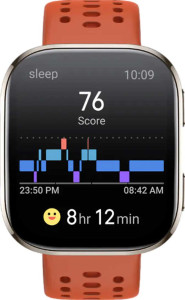
  • Both watches track sleep and provide sleep reports.
  • Both track distance, steps taken, pace, elevation, and include a route tracker.
  • Automatic activity detection is available on both watches.
  • Neither watch has a cellular module, Wi-Fi support, or ANT+ support.
  • Both are compatible with iOS and Android, and support Galileo.
  • Bluetooth version 5.2 is used on both watches.
  • Neither watch has a solar power battery or a removable battery, but both have a rechargeable battery.
  • Both measure VO2 max and resting heart rate, and provide fast/slow heart rate notifications.
  • Both watches support call answering, call control, phone locating, and notifications.
  • Both show a readiness level indicator.
  • Activity reports, inactivity alerts, calorie tracking, goal setting, achievements, an exercise diary, and a free ad-free app are available on both watches.
  • Both have a battery level indicator, auto pause, passcode protection, and compatibility with smart scales and external heart rate monitors.
  • Neither watch is compatible with Windows or Mac OS X, and neither has an external memory slot.

Main Differences

  • Screen size is 1.97″ on the Amazfit Bip 6 and 1.82″ on the Huawei Watch Fit 4.
  • Pixel density is 302 ppi on the Amazfit Bip 6 and 347 ppi on the Huawei Watch Fit 4.
  • Resolution is 390 x 450 px on the Amazfit Bip 6 and 408 x 480 px on the Huawei Watch Fit 4.
  • Thickness is 10.45 mm on the Amazfit Bip 6 and 9.5 mm on the Huawei Watch Fit 4.
  • Weight is 27.9 g on the Amazfit Bip 6 and 27 g on the Huawei Watch Fit 4.
  • Height is 46.3 mm on the Amazfit Bip 6 and 43 mm on the Huawei Watch Fit 4.
  • Width is 40.2 mm on the Amazfit Bip 6 and 38 mm on the Huawei Watch Fit 4.
  • Volume is 19.45 cm³ on the Amazfit Bip 6 and 15.52 cm³ on the Huawei Watch Fit 4.
  • Band width is 22 mm on the Amazfit Bip 6 and 20 mm on the Huawei Watch Fit 4.
  • The water resistance classification is listed as water resistant for the Amazfit Bip 6 and waterproof for the Huawei Watch Fit 4.
  • A barometer is present on the Huawei Watch Fit 4 but not available on the Amazfit Bip 6.
  • Multi-sport mode is available on the Huawei Watch Fit 4 but not on the Amazfit Bip 6.
  • NFC is present on the Huawei Watch Fit 4 but not available on the Amazfit Bip 6.
  • Battery life is 14 days on the Amazfit Bip 6 and 10 days on the Huawei Watch Fit 4.
  • Battery capacity is 340 mAh on the Amazfit Bip 6 and 400 mAh on the Huawei Watch Fit 4.
  • Charge time is 2 hours on the Amazfit Bip 6 and 0.75 hours on the Huawei Watch Fit 4.
  • Wireless charging is supported on the Huawei Watch Fit 4 but not on the Amazfit Bip 6.
  • Voice commands are available on the Amazfit Bip 6 but not on the Huawei Watch Fit 4.
  • Internal storage is 0.5 GB on the Amazfit Bip 6 and 4 GB on the Huawei Watch Fit 4.
  • Temperature tracking in the app is available on the Amazfit Bip 6 but not on the Huawei Watch Fit 4.
Specs Comparison
Amazfit Bip 6

Amazfit Bip 6

Huawei Watch Fit 4

Huawei Watch Fit 4

Design:
screen size 1.97" 1.82"
Display type OLED/AMOLED OLED/AMOLED
water resistance Water resistant Waterproof
ATM rating 5 ATM 5 ATM
Ingress Protection (IP) rating IP68 IP68
waterproof depth rating 50 m 50 m
Always-On Display
pixel density 302 ppi 347 ppi
resolution 390 x 450 px 408 x 480 px
Watch band is replaceable
has branded damage-resistant glass
thickness 10.45 mm 9.5 mm
weight 27.9 g 27 g
height 46.3 mm 43 mm
width 40.2 mm 38 mm
Has a display
has a touch screen
Has sapphire glass display
volume 19.450167 cm³ 15.523 cm³
is designed for kids
width of band 22 mm 20 mm

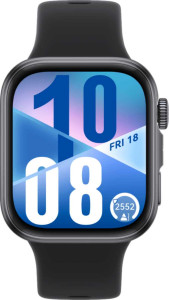
The most immediately noticeable design difference is screen size: the Amazfit Bip 6 sports a larger 1.97″ OLED panel compared to the Huawei Watch Fit 4's 1.82″ display. In practice, the Bip 6 offers more screen real estate for reading notifications, workout metrics, and watch faces. However, the Fit 4 compensates with a noticeably sharper image — its 347 ppi pixel density versus the Bip 6's 302 ppi means text and graphics appear crisper and more refined, even on a smaller canvas. Both share the same OLED/AMOLED technology and support Always-On Display, so the core visual experience is qualitatively similar, but the Fit 4 wins on sharpness while the Bip 6 wins on size.

On the physical form factor, the Fit 4 is the more compact and wrist-friendly device. It measures 43 × 38 mm with a slimmer 9.5 mm profile, compared to the Bip 6's bulkier 46.3 × 40.2 mm footprint and 10.45 mm thickness. The volume difference is significant — 15.52 cm³ versus 19.45 cm³ — meaning the Fit 4 sits considerably lower and flatter on the wrist, which typically translates to better comfort during sleep tracking or all-day wear. Despite this size gap, both watches weigh almost identically (27 g vs 27.9 g), so the weight advantage is negligible in daily use. The Bip 6 also uses a slightly wider 22 mm band versus the Fit 4's 20 mm, which aligns with its larger case and may offer a broader ecosystem of third-party strap options.

Both watches are rated at 5 ATM / IP68 / 50 m water resistance and feature replaceable bands, with neither offering sapphire or branded damage-resistant glass — so durability and customization are essentially on par. Overall, the Huawei Watch Fit 4 holds a clear design edge for users who prioritize a sleeker, sharper, and more compact wearable, while the Amazfit Bip 6 is the better choice for those who prefer a larger display despite a slightly bulkier chassis.

Sensors:
Monitors blood oxygenation levels
Has a heart rate monitor
has GPS
has an accelerometer
Has a temperature sensor
has a compass
Has a barometer
has a gyroscope
Has a cadence sensor
Monitors perspiration

At the core sensor level, these two watches are remarkably alike — both pack heart rate monitoring, SpO2 (blood oxygen), GPS, accelerometer, gyroscope, compass, and cadence sensor. This shared foundation means both are well-equipped for mainstream fitness tracking and outdoor activities like running, hiking, and cycling, where movement data, positioning, and rhythm monitoring all matter.

The single but meaningful differentiator here is the barometer, which the Huawei Watch Fit 4 includes and the Amazfit Bip 6 does not. A barometer serves two practical purposes: it enables accurate altitude tracking by measuring atmospheric pressure — far more reliable than GPS-derived elevation alone — and it can be used for basic weather trend detection. For hikers, trail runners, or anyone navigating elevation changes, this is a genuine functional advantage, not a superficial one. The Bip 6's lack of a barometer means it must rely solely on GPS for elevation data, which is known to drift and accumulate errors over longer sessions.

Neither watch includes a temperature sensor or perspiration monitoring, so both are on equal footing in those more niche health metrics. On balance, the Huawei Watch Fit 4 holds a clear edge in this category purely because of the barometer — a sensor that meaningfully improves outdoor sports accuracy with no corresponding trade-off from the Bip 6 to offset it.

Activity tracking:
Tracks your sleep
Tracks distance
Tracks steps taken
Measures pace
Provides sleep reports
Detects activities automatically
Has a route tracker
Tracks elevation
Has multi-sport mode
Has exercise tagging
Has a stroke counter for swimming
Tracks calorie intake
Designed for diving
Designed for golf

For the vast majority of tracking capabilities, these two watches are functionally identical. Sleep tracking with reports, step and distance counting, pace measurement, route tracking, elevation, automatic activity detection, swim stroke counting, and calorie intake logging — all present on both. This is a strong shared foundation that covers the needs of most everyday fitness users without any compromise on either side.

The one point where the data diverges is multi-sport mode, which the Huawei Watch Fit 4 supports and the Amazfit Bip 6 does not. Multi-sport mode allows users to log several different activities within a single workout session — switching between, say, cycling and running in a triathlon or a mixed training block — without stopping to manually end and restart tracking. For athletes who train across disciplines or participate in events like duathlons, this is a practical and time-sensitive feature. The Bip 6's absence of this capability means users engaging in back-to-back or combined sports sessions would need to manage each activity as a separate tracked event.

Neither watch is designed for diving or golf, so those omissions are not differentiating factors. Overall, the Huawei Watch Fit 4 takes a narrow but clear edge in this category — its activity tracking feature set is a strict superset of the Bip 6's, with multi-sport mode being the sole but meaningful addition for more varied or competitive training routines.

Connectivity:
has a cellular module
Is compatible with iOS
Is compatible with Android
Bluetooth version 5.2 5.2
supports Wi-Fi
supports ANT+
has NFC
supports Galileo

Connectivity is largely a tie between these two watches. Both run on Bluetooth 5.2, offer compatibility with iOS and Android, support the Galileo satellite system for GPS accuracy, and skip cellular, Wi-Fi, and ANT+ entirely. The shared Bluetooth version matters in practice — 5.2 delivers reliable, low-energy connections with stable pairing, so neither watch has an edge in day-to-day phone synchronization or audio control.

The single differentiator in this category is NFC, which the Huawei Watch Fit 4 includes and the Amazfit Bip 6 does not. NFC enables contactless payments directly from the wrist — a convenience feature that effectively lets users leave their wallet or phone behind for quick transactions. For commuters or gym-goers who prefer to travel light, this is a tangible real-world advantage. The Bip 6's lack of NFC means payment functionality simply isn't available on the watch itself.

With no other connectivity differences in the provided data, the Huawei Watch Fit 4 holds a clear, if narrow, edge in this category. Users who have no interest in wrist-based payments will find both watches effectively equivalent here, but for those who value the convenience of tap-to-pay, the Fit 4 is the only option of the two.

Battery:
battery life 14 days 10 days
battery power 340 mAh 400 mAh
charge time 2 hours 0.75 hours
has wireless charging
has a rechargeable battery
Has a solar power battery
has a removable battery

Battery life and charging speed pull in opposite directions here, making this a genuinely interesting trade-off. The Amazfit Bip 6 claims a rated 14-day battery life from a smaller 340 mAh cell, while the Huawei Watch Fit 4 packs a larger 400 mAh battery yet achieves only 10 days of rated endurance. This suggests the Fit 4's additional features — including its barometer, NFC, and higher-resolution display — draw more power, offsetting its larger capacity. For users who travel, camp, or simply dislike charging routines, the Bip 6's four extra days between charges is a meaningful lifestyle advantage.

Where the Fit 4 decisively flips the script is charging speed. It refills in just 45 minutes compared to the Bip 6's 2 hours — nearly a 3× faster turnaround. Combined with support for wireless charging, which the Bip 6 lacks entirely, the Fit 4 is far more convenient to top up on short notice. A quick charge while getting ready in the morning can restore a significant portion of battery, which partially compensates for its shorter overall endurance in practice.

Which advantage matters more comes down to user habits. Those who prefer set-and-forget battery management will lean toward the Amazfit Bip 6 and its longer life. Users who charge more frequently but want it done quickly — and appreciate the cable-free convenience of wireless charging — will find the Huawei Watch Fit 4 better suited to their routine. Neither watch holds an unconditional overall edge; this is a direct trade-off between longevity and charging convenience.

Features:
release date April 2025 May 2025
measures VO2 max
measures resting heart rate
has fast/slow heart rate notifications
shows readiness level
Can be used to answer calls
Locates your phone
Has call control
Has notifications
has irregular heart rate warnings
Has ECG technology
Has silent alarm
Has vibrating alerts
has fall detection
Has a stopwatch
Has smart alarm
has voice commands
internal storage 0.5GB 4GB
Has a built-in camera remote control function
warranty period 1 years 1 years
number of microphones 1 1
has a front camera

Across the broad feature set, these two watches are strikingly well-matched. Both support call answering and control, notifications, VO2 max and resting heart rate tracking, readiness scores, irregular heart rate warnings, vibrating alerts, silent alarms, a stopwatch, camera remote control, and a single microphone — with identical warranty periods and no ECG, fall detection, or smart alarm on either. For the majority of everyday smartwatch use cases, users will find no functional difference between them.

Two specs do separate them. The Huawei Watch Fit 4 offers substantially more internal storage at 4 GB, compared to the Bip 6's modest 0.5 GB. In practical terms, this gap is most relevant for storing music or offline content directly on the watch for phone-free playback during workouts — 0.5 GB is tight even for a modest playlist, while 4 GB provides genuine usability for this purpose. On the flip side, the Amazfit Bip 6 supports voice commands, which the Fit 4 does not. This enables hands-free interaction with the watch — useful during workouts or when your hands are occupied — though its real-world utility depends heavily on the depth of the supported command set, which the provided data does not specify.

These two advantages pull in different directions and serve different user needs. The storage gap is arguably more broadly impactful — it affects anyone who wants music on the watch — while voice commands appeal to a more specific interaction preference. On balance, the Huawei Watch Fit 4 holds a slight practical edge in this group due to its significantly larger internal storage, but users who value voice-driven control will find the Amazfit Bip 6 uniquely appealing in this category.

App & Software:
Provides activity reports
Has inactivity alerts
Counts how many calories you've burned
Has goal setting
Has achievements
Free app
Has exercise diary
Ad-free
Has coaching
Has temperature tracking
Has period notifications
Supports routes
Has music playback
Displays fertile window notifications
Includes maps
Predicts ovulation
Predicts start date
Supports widgets
Can be personalised
Has barcode scanner on app
Tracks water intake
Has weight tracking
Has live tracking
Tracks BMI

Software and app experience is about as close as it gets between these two watches. Both companion apps are free, ad-free, and deliver a comprehensive feature set: activity reports, exercise diary, coaching, goal setting, achievements, live tracking, route and map support, music playback, water intake, weight and BMI tracking, widgets, and full personalization. Notably, both also include a well-rounded suite of women's health features — period notifications, fertile window alerts, ovulation prediction, and cycle start date forecasting — making either a capable choice for users who rely on menstrual health tracking.

The only divergence in the entire dataset is temperature tracking in the app, which the Amazfit Bip 6 supports and the Huawei Watch Fit 4 does not. This aligns with the hardware picture established in the Sensors category, where neither watch includes a dedicated temperature sensor — so the Bip 6's app-level temperature tracking likely reflects ambient or derived data rather than continuous wrist-based body temperature monitoring. Its practical significance is therefore limited, though it does represent an additional data dimension the Fit 4's app simply does not offer.

In this category, the verdict is effectively a tie. The Amazfit Bip 6 has a marginal edge on paper by virtue of the temperature tracking field, but given the narrow scope of that difference, users choosing between these two watches are unlikely to find their decision meaningfully influenced by the app and software comparison alone — both deliver a rich, well-rounded companion experience.
Miscellaneous:
has a battery level indicator
Has auto pause
Has passcode
Compatible with smart scales
Compatible with external heart rate monitors
Is compatible with Windows
has an external memory slot
Is compatible with Mac OS X
has a socket for a 3.5 mm audio jack

This is the rare category where the data leaves absolutely nothing to separate the two watches. Every single spec in this group is identical: both the Amazfit Bip 6 and the Huawei Watch Fit 4 include a battery level indicator, auto pause, passcode protection, smart scale compatibility, and support for external heart rate monitors. Both equally lack Windows and Mac OS X compatibility, an external memory slot, and a 3.5 mm audio jack.

The shared highlights worth noting in context are external heart rate monitor compatibility and smart scale integration, which together allow both watches to slot into a broader connected fitness ecosystem — pairing with chest straps for more accurate training data and syncing body composition metrics from compatible scales. These are genuinely useful ecosystem features for dedicated fitness users, and neither watch holds any advantage over the other in accessing them.

The verdict here is an unambiguous tie. The miscellaneous spec group introduces no differentiating factors whatsoever between these two products. Users can set this category aside entirely when making their purchasing decision, as it will have no bearing on the outcome.

Comparison Summary & Verdict

After a thorough comparison, both watches prove themselves as well-rounded fitness companions, but they cater to different priorities. The Amazfit Bip 6 stands out with its larger screen, impressive 14-day battery life, voice command support, and temperature tracking in the app, making it ideal for users who want a long-lasting, feature-rich watch without frequent charging. The Huawei Watch Fit 4, on the other hand, edges ahead with a slimmer and lighter design, higher pixel density, a built-in barometer, multi-sport mode, NFC payments, wireless charging in just 45 minutes, and significantly more internal storage at 4 GB. It is the better pick for those who value a premium, compact form factor and richer sport and connectivity features over raw battery longevity.

Amazfit Bip 6
Buy Amazfit Bip 6 if...

Buy the Amazfit Bip 6 if you prioritize a longer battery life of up to 14 days, a larger display, and want voice command support without needing to recharge frequently.

Huawei Watch Fit 4
Buy Huawei Watch Fit 4 if...

Buy the Huawei Watch Fit 4 if you want a slimmer, lighter design with wireless charging, NFC payments, a barometer, multi-sport mode, and 4 GB of internal storage.