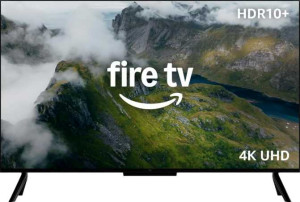
Amazon Fire TV 4-Series 2025 50"
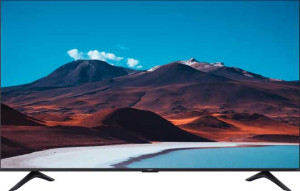
Xiaomi TV F 2026 50"

Amazon Fire TV 4-Series 2025 50" Xiaomi TV F 2026 50"

Overview

Welcome to our in-depth comparison of the Amazon Fire TV 4-Series 2025 50″ and the Xiaomi TV F 2026 50″, two competitively priced 50-inch 4K televisions targeting the same living-room audience. While both share a strong foundation of shared features, the battle heats up around display technology, connectivity options, and physical design trade-offs that could make one a better fit for your home than the other.

Common Features

  • Both TVs have a 4K UHD display resolution of 3840 x 2160 px.
  • Both TVs support a color depth of 1070 million colors at 10-bit.
  • Both TVs have a 60Hz refresh rate.
  • HDR10 support is available on both products.
  • Dolby Vision support is not available on either product.
  • HLG support is available on both products.
  • Both TVs have Bluetooth 5.0.
  • Both TVs support Wi-Fi.
  • Both TVs use HDMI 2.1 ports.
  • Both TVs have 1 USB port and 1 RJ45 (Ethernet) port.
  • Miracast support is available on both products.
  • Both TVs include a 3.5mm audio jack.
  • Both TVs deliver 2 x 10W audio output power with stereo speakers.
  • Dolby Audio support is available on both products.
  • Dolby Atmos support is not available on either product.
  • Digital audio output is supported on both products.
  • Both TVs support VESA mounting.
  • AirPlay support is available on both products.
  • Both TVs work with Alexa.
  • USB recording is supported on both products.
  • Both TVs have a standby power consumption of 0.5W.
  • Neither TV has a rechargeable remote control.
  • Works with Siri/Apple HomeKit is not available on either product.

Main Differences

  • The display type is LED-backlit LCD on Amazon Fire TV 4-Series 2025 50″ and QLED LED-backlit LCD on Xiaomi TV F 2026 50″.
  • The screen size is 49.5″ on Amazon Fire TV 4-Series 2025 50″ and 50″ on Xiaomi TV F 2026 50″.
  • Pixel density is 89 ppi on Amazon Fire TV 4-Series 2025 50″ and 88 ppi on Xiaomi TV F 2026 50″.
  • HDR10+ support is available on Amazon Fire TV 4-Series 2025 50″ but not on Xiaomi TV F 2026 50″.
  • The number of HDMI ports is 4 on Amazon Fire TV 4-Series 2025 50″ and 3 on Xiaomi TV F 2026 50″.
  • Wi-Fi 6 (802.11ax) support is present on Amazon Fire TV 4-Series 2025 50″ but not available on Xiaomi TV F 2026 50″, which supports only up to Wi-Fi 5 (802.11ac).
  • The width is 1109.9 mm on Amazon Fire TV 4-Series 2025 50″ and 1111 mm on Xiaomi TV F 2026 50″.
  • The weight is 8482 g on Amazon Fire TV 4-Series 2025 50″ and 7400 g on Xiaomi TV F 2026 50″.
  • The thickness is 81.3 mm on Amazon Fire TV 4-Series 2025 50″ and 73 mm on Xiaomi TV F 2026 50″.
  • The height is 647.7 mm on Amazon Fire TV 4-Series 2025 50″ and 643 mm on Xiaomi TV F 2026 50″.
  • The volume is 58445.125299 cm³ on Amazon Fire TV 4-Series 2025 50″ and 52149.229 cm³ on Xiaomi TV F 2026 50″.
Specs Comparison
Amazon Fire TV 4-Series 2025 50"

Amazon Fire TV 4-Series 2025 50"

Xiaomi TV F 2026 50"

Xiaomi TV F 2026 50"

Display:
display resolution 4K (UHD) 4K (UHD)
Display type LED-backlit, LCD QLED, LED-backlit, LCD
screen size 49.5" 50"
resolution 3840 x 2160 px 3840 x 2160 px
pixel density 89 ppi 88 ppi
display colors 1070 million 1070 million
bit depth 10-bit 10-bit
refresh rate 60Hz 60Hz
supports HDR10
supports HDR10+
supports Dolby Vision
supports HLG
has anti-reflection coating
has an ambient light sensor
maximum horizontal viewing angle 178º 178º
maximum vertical viewing angle 178º 178º

Both the Amazon Fire TV 4-Series 2025 50″ and the Xiaomi TV F 2026 50″ share a strong display foundation: 4K UHD resolution (3840 x 2160 px), a 10-bit panel capable of rendering over a billion colors, a 60Hz refresh rate, and identical 178° viewing angles in both directions. In everyday use, these shared traits mean both TVs will look sharp and color-rich from virtually any seat in the room, with no meaningful difference in pixel sharpness given their near-identical pixel densities of 89 and 88 ppi respectively.

The most significant differentiator is panel technology. The Xiaomi TV F 2026 uses a QLED layer on top of its LED-backlit LCD, which means quantum dots are used to enhance color volume and brightness — typically resulting in more vivid, saturated colors and better peak luminance compared to a conventional LED-backlit LCD like the one in the Fire TV 4-Series. In real-world viewing, this can translate to a noticeably punchier image, especially with HDR content. On the other hand, the Amazon Fire TV 4-Series counters with HDR10+ support — a dynamic metadata HDR format that adjusts tone mapping scene by scene — which the Xiaomi lacks. If you watch content from services like Amazon Prime Video that actively use HDR10+, the Fire TV can extract more nuanced highlight detail than the Xiaomi's static HDR10.

Overall, neither TV has a sweeping advantage. The Xiaomi TV F 2026 edges ahead on raw image quality potential thanks to its QLED panel, which benefits all content regardless of streaming platform. The Fire TV 4-Series holds a niche but real advantage for HDR10+ content specifically. If picture quality across the board is the priority, the Xiaomi's QLED technology is the more impactful differentiator for most users.

Connectivity:
Has Bluetooth
HDMI version HDMI 2.1 HDMI 2.1
HDMI ports 4 3
supports Wi-Fi
Wi-Fi version Wi-Fi 4 (802.11n), Wi-Fi 5 (802.11ac), Wi-Fi 6 (802.11ax) Wi-Fi 4 (802.11n), Wi-Fi 5 (802.11ac)
Bluetooth version 5 5
USB ports 1 1
RJ45 ports 1 1
supports Miracast
has a socket for a 3.5 mm audio jack
has an external memory slot
has a VGA connector
has a DVI connector

Shared across both TVs is a solid connectivity baseline: HDMI 2.1, Bluetooth 5, a single USB port, an Ethernet (RJ45) port, Miracast support, and a 3.5mm audio jack. HDMI 2.1 is particularly noteworthy as it supports bandwidth for 4K signals with headroom for future use, and Bluetooth 5 ensures stable, low-latency connections to wireless peripherals and audio devices.

The two meaningful differentiators are HDMI port count and Wi-Fi generation. The Amazon Fire TV 4-Series offers 4 HDMI ports versus the Xiaomi TV F 2026′s 3 — a practical advantage for users juggling multiple sources like a games console, Blu-ray player, and streaming stick simultaneously. More significantly, the Fire TV 4-Series supports Wi-Fi 6 (802.11ax) in addition to Wi-Fi 4 and 5, while the Xiaomi tops out at Wi-Fi 5 (802.11ac). Wi-Fi 6 delivers higher throughput, better performance in congested multi-device households, and improved efficiency — all of which translate to more reliable 4K streaming without buffering when multiple devices are competing for bandwidth.

The connectivity advantage clearly belongs to the Amazon Fire TV 4-Series 2025. Both its extra HDMI port and Wi-Fi 6 support address real, common usage scenarios — and for anyone with a busy home network or several external devices to connect, these are meaningful practical upgrades over the Xiaomi TV F 2026.

Audio:
audio output power 2 x 10W 2 x 10W
supports Digital Out
has SRS TheaterSound HD
has stereo speakers
has Dolby Atmos
has Dolby Audio
supports Dolby Virtual
has a subwoofer
HDMI ARC / eARC HDMI ARC, HDMI eARC HDMI ARC, HDMI eARC

Audio is the rare category where these two TVs are in complete lockstep. Both deliver 2 x 10W stereo output, support Dolby Audio, include Digital Out, and offer both HDMI ARC and eARC — the latter being particularly useful, as eARC carries high-bandwidth audio formats to a compatible soundbar without needing a separate optical cable.

Neither TV includes Dolby Atmos, a subwoofer, or any spatial audio processing, which sets a realistic ceiling on built-in sound quality. At 20W total from stereo drivers, both will handle everyday TV watching adequately, but neither is engineered for immersive or room-filling audio on its own. The eARC port on both models does, however, make it straightforward to pair either TV with an external audio system that can unlock those higher-end formats.

This group is a complete tie. Every specification — output power, supported formats, speaker configuration, and ARC/eARC capability — is identical. Audio performance should have no bearing on choosing between the Amazon Fire TV 4-Series 2025 and the Xiaomi TV F 2026; the decision is better made on other grounds.

Design:
width 1109.9 mm 1111 mm
weight 8482 g 7400 g
thickness 81.3 mm 73 mm
height 647.7 mm 643 mm
volume 58445.125299 cm³ 52149.229 cm³
Supports VESA mount

Footprint-wise, these two TVs are virtually indistinguishable — their widths differ by just 1mm and heights by under 5mm, meaning they will occupy essentially the same wall or cabinet space. Both support VESA mounting, so installation flexibility is equal across the board.

Where they diverge is in bulk and weight. The Xiaomi TV F 2026 is notably 1082g lighter (7400g versus 8482g) and 8.3mm thinner (73mm versus 81.3mm). In practice, the weight difference is most relevant during installation — a lighter panel is meaningfully easier to handle solo when wall-mounting, reducing the risk of strain or misalignment. The slimmer profile also gives the Xiaomi a slightly more refined look when mounted flush against a wall, and it contributes to the Xiaomi's notably smaller overall volume: roughly 52,149 cm³ compared to the Fire TV 4-Series′s 58,445 cm³.

The design edge goes to the Xiaomi TV F 2026. While neither TV is drastically bulky, the Xiaomi is meaningfully lighter and thinner — advantages that matter during setup and contribute to a sleeker installed appearance, without any trade-off in mounting compatibility.

Features:
release date September 2025 September 2025
has AirPlay
has built-in smart TV
works with Alexa
works with Siri/Apple HomeKit
supports a remote smartphone
has a rechargeable remote control
supports USB recording
standby power consumption 0.5W 0.5W
has a search browser
has a sleep timer
has a child lock
warranty period 1 years 1 years
has voice commands

Features is another category where these two TVs are mirror images of each other. Both carry AirPlay support, Alexa voice commands, smartphone remote capability, USB recording, a built-in browser, sleep timer, child lock, and an identical 0.5W standby power draw — every single feature in the provided data is shared identically between the two.

A few of these shared features are worth contextualizing. AirPlay on both TVs means iPhone and Mac users can wirelessly mirror or cast content without additional hardware — a genuinely useful convenience. USB recording allows users to capture live broadcast content directly to a connected drive, which is a feature not to be taken for granted at this price tier. The absence of Apple HomeKit support on both models is a minor limitation for users deeply embedded in the Apple smart home ecosystem, but since neither TV has it, it is not a differentiator.

This group is a complete tie. The feature sets of the Amazon Fire TV 4-Series 2025 and the Xiaomi TV F 2026 are identical across every data point provided, from smart platform capabilities to warranty length. Prospective buyers should look to other specification groups — display technology, connectivity, or design — to make their final call.

Comparison Summary & Verdict

After reviewing all the specifications, both TVs deliver a solid 4K HDR experience with identical audio output, AirPlay, Alexa compatibility, and Dolby Audio. However, key differences set them apart. The Amazon Fire TV 4-Series 2025 50″ stands out with HDR10+ support, an extra HDMI port (4 vs 3), and Wi-Fi 6 connectivity, making it the stronger pick for users who demand future-proof wiring flexibility and the widest HDR format coverage. On the other hand, the Xiaomi TV F 2026 50″ impresses with its QLED panel, notably lighter build at just 7400 g versus 8482 g, and a slimmer 73 mm profile, appealing to those who prioritize vibrant picture quality and a sleeker, easier-to-mount design. Neither TV is a clear-cut winner; your ideal choice depends on whether you value connectivity and HDR range or display technology and a more refined form factor.

Amazon Fire TV 4-Series 2025 50
Buy Amazon Fire TV 4-Series 2025 50" if...

Buy the Amazon Fire TV 4-Series 2025 50″ if you want HDR10+ support, four HDMI ports for multiple devices, and Wi-Fi 6 for the fastest wireless connection available.

Xiaomi TV F 2026 50
Buy Xiaomi TV F 2026 50" if...

Buy the Xiaomi TV F 2026 50″ if you prefer a QLED display for richer colors, a lighter and slimmer design that is easier to wall-mount, and a more compact overall footprint.