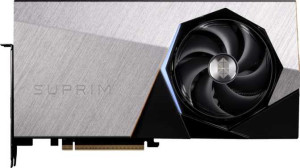
The clock speed story here is nuanced. The AMD Radeon AI Pro R9700 has a lower base clock at 1660 MHz versus the MSI GeForce RTX 5080 Suprim Liquid OC's 2295 MHz, but the R9700 rockets to a peak turbo of 2920 MHz — significantly above the RTX 5080's 2700 MHz ceiling. This means the R9700 is designed to hit explosive short-burst frequencies, while the RTX 5080 sustains a much higher floor, which in practice tends to translate to more consistent sustained performance under prolonged workloads.
On raw compute throughput, the RTX 5080 holds a clear lead. Its 58.06 TFLOPS of floating-point performance outpaces the R9700's 47.8 TFLOPS, and its texture throughput advantage — 907.2 GTexels/s versus 747.5 GTexels/s — is meaningful in heavily textured rendering scenarios. This is powered by the RTX 5080's dramatically higher shader count (10,752 vs. 4,096), which gives it a substantial parallel processing advantage for general graphics workloads. Where the R9700 pushes back is in pixel output and memory bandwidth: its 128 ROPs (vs. 112) give it a higher pixel fill rate of 373.76 GPixel/s vs. 302.4 GPixel/s, and its 2518 MHz memory speed noticeably outpaces the RTX 5080's 1875 MHz — potentially an advantage in memory-latency-sensitive tasks. Both cards support Double Precision Floating Point, which matters for compute and professional workloads.
Overall, the RTX 5080 Suprim Liquid OC has the edge in pure graphics compute — its TFLOPS advantage, superior texture throughput, and vastly larger shader array make it the stronger performer for traditional rendering pipelines. The R9700 counters with a higher pixel fill rate and faster memory, but these advantages are narrower in scope. For users prioritizing general gaming or GPU-accelerated graphics rendering, the RTX 5080 holds a meaningful performance lead in this group.