AMD Radeon RX 9060
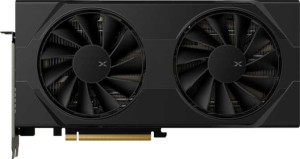
XFX Swift Radeon RX 9060 XT OC Gaming Edition 16GB

AMD Radeon RX 9060 XFX Swift Radeon RX 9060 XT OC Gaming Edition 16GB

Overview

Welcome to our in-depth specification comparison between the AMD Radeon RX 9060 and the XFX Swift Radeon RX 9060 XT OC Gaming Edition 16GB. Both cards share the same RDNA 4.0 architecture and 4 nm process node, yet they diverge meaningfully across GPU clock speeds, shader counts, memory capacity, and thermal envelopes. Whether you are budget-conscious or chasing maximum performance, this comparison will help you understand exactly where each card stands.

Common Features

  • GPU memory speed is 2518 MHz on both products.
  • Both products have 64 render output units (ROPs).
  • Double Precision Floating Point (DPFP) is supported on both products.
  • Both products use GDDR6 memory.
  • Memory bus width is 128-bit on both products.
  • ECC memory is supported on both products.
  • Both products support DirectX 12 Ultimate.
  • OpenGL version 4.6 is available on both products.
  • OpenCL version 2.2 is available on both products.
  • Multi-display technology is supported on both products.
  • Ray tracing is supported on both products.
  • 3D support is available on both products.
  • DLSS is not supported on either product.
  • FSR4 is available on both products.
  • Both products have an HDMI output with 1 HDMI port.
  • HDMI version is 2.1b on both products.
  • Both products have 2 DisplayPort outputs.
  • Neither product has USB-C, DVI, or mini DisplayPort outputs.
  • Both products are built on the RDNA 4.0 GPU architecture.
  • Both products use PCIe version 5 and a 4 nm semiconductor size with 29,700 million transistors.
  • Neither product uses air-water cooling.

Main Differences

  • GPU clock speed is 1700 MHz on AMD Radeon RX 9060 and 1900 MHz on XFX Swift Radeon RX 9060 XT OC Gaming Edition 16GB.
  • GPU turbo speed is 2990 MHz on AMD Radeon RX 9060 and 3320 MHz on XFX Swift Radeon RX 9060 XT OC Gaming Edition 16GB.
  • Pixel rate is 191.4 GPixel/s on AMD Radeon RX 9060 and 212.5 GPixel/s on XFX Swift Radeon RX 9060 XT OC Gaming Edition 16GB.
  • Floating-point performance is 21.4 TFLOPS on AMD Radeon RX 9060 and 27.2 TFLOPS on XFX Swift Radeon RX 9060 XT OC Gaming Edition 16GB.
  • Texture rate is 334.9 GTexels/s on AMD Radeon RX 9060 and 425 GTexels/s on XFX Swift Radeon RX 9060 XT OC Gaming Edition 16GB.
  • Shading units number 1792 on AMD Radeon RX 9060 and 2048 on XFX Swift Radeon RX 9060 XT OC Gaming Edition 16GB.
  • Texture mapping units (TMUs) total 112 on AMD Radeon RX 9060 and 128 on XFX Swift Radeon RX 9060 XT OC Gaming Edition 16GB.
  • Effective memory speed is 18000 MHz on AMD Radeon RX 9060 and 20000 MHz on XFX Swift Radeon RX 9060 XT OC Gaming Edition 16GB.
  • Maximum memory bandwidth is 288 GB/s on AMD Radeon RX 9060 and 340 GB/s on XFX Swift Radeon RX 9060 XT OC Gaming Edition 16GB.
  • VRAM is 8GB on AMD Radeon RX 9060 and 16GB on XFX Swift Radeon RX 9060 XT OC Gaming Edition 16GB.
  • RGB lighting is not present on AMD Radeon RX 9060 but is available on XFX Swift Radeon RX 9060 XT OC Gaming Edition 16GB.
  • Thermal Design Power (TDP) is 132W on AMD Radeon RX 9060 and 160W on XFX Swift Radeon RX 9060 XT OC Gaming Edition 16GB.
Specs Comparison
AMD Radeon RX 9060

AMD Radeon RX 9060

XFX Swift Radeon RX 9060 XT OC Gaming Edition 16GB

XFX Swift Radeon RX 9060 XT OC Gaming Edition 16GB

Performance:
GPU clock speed 1700 MHz 1900 MHz
GPU turbo 2990 MHz 3320 MHz
pixel rate 191.4 GPixel/s 212.5 GPixel/s
floating-point performance 21.4 TFLOPS 27.2 TFLOPS
texture rate 334.9 GTexels/s 425 GTexels/s
GPU memory speed 2518 MHz 2518 MHz
shading units 1792 2048
texture mapping units (TMUs) 112 128
render output units (ROPs) 64 64
Has Double Precision Floating Point (DPFP)

The performance gap between these two cards is meaningful and consistent across every compute metric. The XFX Swift RX 9060 XT OC fields 2048 shading units against the standard RX 9060's 1792 — a 14% wider shader array — and pairs that with a notably higher GPU turbo of 3320 MHz versus 2990 MHz. More shaders running at higher clocks compound multiplicatively, which is exactly why the floating-point performance delta is larger than either individual gap suggests: 27.2 TFLOPS on the XT OC versus 21.4 TFLOPS on the base 9060, a difference of roughly 27%. In practical terms, this translates directly to headroom for higher framerates, better performance at 1440p, and more sustained throughput in compute-heavy workloads.

The texture throughput story follows the same pattern. The XT OC's 128 TMUs at its higher boost clock deliver 425 GTexels/s, compared to 334.9 GTexels/s on the standard card — a gap that becomes visible in texture-heavy scenes and at higher resolutions where the GPU must process more texel data per frame. The one area where the two cards are completely level is rasterization output and memory subsystem speed: both share 64 ROPs and identical GPU memory speeds of 2518 MHz, meaning pixel fill rate and memory bandwidth are not differentiating factors here.

Overall, the XFX Swift RX 9060 XT OC holds a clear and well-rounded performance advantage in this group. Its lead is not marginal — a 27% TFLOPS advantage and nearly 27% higher texture throughput represent a genuine tier of difference in rendering capability, not just a binning tweak. The standard AMD Radeon RX 9060 is not outclassed in areas like memory speed or pixel output, but on pure compute and shading muscle, the XT OC is the stronger card by a significant margin.

Memory:
effective memory speed 18000 MHz 20000 MHz
maximum memory bandwidth 288 GB/s 340 GB/s
VRAM 8GB 16GB
GDDR version GDDR6 GDDR6
memory bus width 128-bit 128-bit
Supports ECC memory

The most consequential difference in this group is not speed — it is capacity. The XFX Swift RX 9060 XT OC carries 16GB of VRAM, exactly double the 8GB found on the standard AMD Radeon RX 9060. On a shared 128-bit memory bus, VRAM capacity determines how large a scene, texture set, or dataset the GPU can hold on-die without spilling to slower system memory. At 1440p and especially 4K, modern games increasingly push beyond 8GB in VRAM usage, meaning the base RX 9060 can hit a hard ceiling in demanding titles where the XT OC continues to operate without compromise.

Memory speed also favors the XT OC, though the gap is proportionally smaller. Its effective speed of 20000 MHz versus 18000 MHz on the standard card translates to peak bandwidth figures of 340 GB/s and 288 GB/s respectively — an 18% bandwidth advantage that compounds the capacity lead. Faster bandwidth means the GPU can feed its shader array more efficiently, reducing stalls in bandwidth-sensitive scenarios like high-resolution rendering or effects-heavy post-processing. Both cards use GDDR6 and support ECC memory, so the architectural foundation is identical; the XT OC simply runs it faster.

In memory terms, the XFX Swift RX 9060 XT OC holds a decisive and practical advantage. Double the VRAM is not a spec-sheet luxury at this performance tier — it directly extends the card's useful lifespan as game engines grow more memory-hungry, and it makes the XT OC meaningfully better suited for 1440p and beyond. The standard RX 9060's 8GB is workable today but leaves little headroom for the future.

Features:
DirectX version DirectX 12 Ultimate DirectX 12 Ultimate
OpenGL version 4.6 4.6
OpenCL version 2.2 2.2
Supports multi-display technology
supports ray tracing
Supports 3D
supports DLSS
has FSR4
has XeSS (XMX)
AMD SAM / Intel Resizable BAR AMD SAM AMD SAM
has LHR
has RGB lighting

Across every feature that materially affects gaming and compute capability, these two cards are identical. Both support DirectX 12 Ultimate and ray tracing, placing them on equal footing for modern rendering pipelines. Both implement AMD FSR4 — AMD's latest upscaling generation — which is the most relevant AI-assisted image quality feature available on this platform, given that neither card supports DLSS or XeSS. AMD SAM (Smart Access Memory) is also present on both, enabling the CPU to access the full VRAM pool directly when paired with a compatible AMD platform, a feature that can yield measurable performance gains in supported titles.

The sole differentiator in this group is RGB lighting, which the XFX Swift RX 9060 XT OC includes and the standard AMD Radeon RX 9060 does not. This is purely cosmetic — it has no bearing on rendering performance, compatibility, or software feature access. For builders who prioritize aesthetic cohesion in a windowed case, it is a genuine consideration; for everyone else, it is irrelevant to the purchase decision.

On features, these cards are effectively tied in every dimension that matters. The shared DirectX 12 Ultimate support, ray tracing capability, FSR4 integration, and AMD SAM compatibility mean buyers lose nothing functionally by choosing either card. RGB lighting is the only point of distinction, making this group a wash for performance-focused users and a marginal edge for the XFX XT OC only if case aesthetics are a priority.

Ports:
has an HDMI output
HDMI ports 1 1
HDMI version HDMI 2.1b HDMI 2.1b
DisplayPort outputs 2 2
USB-C ports 0 0
DVI outputs 0 0
mini DisplayPort outputs 0 0

Port configuration is identical across both cards, with no exceptions. Each offers one HDMI 2.1b output and two DisplayPort outputs, supporting up to three simultaneous displays — a practical ceiling that covers the vast majority of gaming and productivity multi-monitor setups. Neither card includes USB-C or DVI outputs, so users with legacy DVI monitors or those seeking a USB-C display connection will need an adapter regardless of which card they choose.

The presence of HDMI 2.1b on both is worth noting for its real-world implications: it supports 4K at high refresh rates and 8K output, making either card capable of driving current and near-future display hardware without a bandwidth bottleneck at the port level. DisplayPort outputs similarly carry sufficient bandwidth for high-resolution, high-refresh-rate panels.

This group is a complete tie. Every port type, count, and version is identical between the AMD Radeon RX 9060 and the XFX Swift RX 9060 XT OC. Display connectivity plays no role in differentiating these two cards.

General info:
GPU architecture RDNA 4.0 RDNA 4.0
release date August 2025 June 2025
Thermal Design Power (TDP) 132W 160W
PCI Express (PCIe) version 5 5
semiconductor size 4 nm 4 nm
number of transistors 29700 million 29700 million
Has air-water cooling

Both cards share the same foundational silicon: the RDNA 4.0 architecture built on a 4nm process node with an identical 29,700 million transistors. This confirms they are derivatives of the same GPU die, which explains the architectural parity seen across features and connectivity. The shared PCIe 5.0 interface ensures neither card is bottlenecked by the motherboard slot on any current platform.

Where they diverge is power consumption. The XFX Swift RX 9060 XT OC carries a TDP of 160W, compared to 132W for the standard AMD Radeon RX 9060 — a 28W difference, or roughly 21% more power drawn at the wall. This gap matters in a few practical ways: it places higher demands on the PSU, generates more heat that the cooling solution must dissipate, and may be a consideration in small form factor builds where thermal headroom is limited. Neither card uses liquid cooling, so both rely entirely on their air cooler to manage thermals within their respective TDP envelopes.

Given identical silicon, the TDP delta is essentially the cost of the XT OC's higher clocks and wider shader array. For most mid-tower builds with adequate airflow, 160W is well within normal handling range and not a red flag — but for compact or thermally constrained systems, the standard RX 9060's 132W envelope offers a tangible advantage. On general architecture and platform compatibility, the two cards are fully tied; power efficiency is the only differentiator here, and it favors the base RX 9060.

Comparison Summary & Verdict

After examining every specification, a clear picture emerges for each buyer. The AMD Radeon RX 9060, with its 132W TDP and 8GB of GDDR6 memory, is the more power-efficient and accessible option, making it an excellent fit for compact builds or users whose workloads sit comfortably within 8GB of VRAM. The XFX Swift Radeon RX 9060 XT OC Gaming Edition 16GB, on the other hand, pushes significantly further with a 3320 MHz turbo clock, 27.2 TFLOPS of floating-point performance, 16GB of GDDR6 VRAM, and a 340 GB/s memory bandwidth advantage, all of which translate into a tangible edge in demanding games and creative workloads. It also adds RGB lighting for aesthetics-conscious builders. Both cards support ray tracing, FSR4, and DirectX 12 Ultimate, so the platform foundation is identical. Your choice ultimately comes down to budget versus headroom.

AMD Radeon RX 9060
Buy AMD Radeon RX 9060 if...

Buy the AMD Radeon RX 9060 if you want a power-efficient card with a 132W TDP that fits well in compact or budget-friendly builds where 8GB of VRAM is sufficient.

XFX Swift Radeon RX 9060 XT OC Gaming Edition 16GB
Buy XFX Swift Radeon RX 9060 XT OC Gaming Edition 16GB if...

Buy the XFX Swift Radeon RX 9060 XT OC Gaming Edition 16GB if you need maximum GPU performance, a higher 3320 MHz turbo clock, and 16GB of GDDR6 VRAM for demanding games and memory-intensive workloads.