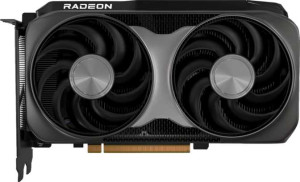
AMD Radeon RX 9060 XT 16GB
AMD Radeon RX 9070 XT

AMD Radeon RX 9060 XT 16GB AMD Radeon RX 9070 XT

Overview

When choosing between the AMD Radeon RX 9060 XT 16GB and the AMD Radeon RX 9070 XT, buyers face a compelling trade-off between power efficiency and raw compute muscle. Both cards are built on the same RDNA 4.0 architecture at 4 nm, share 16 GB of GDDR6 memory, and support DirectX 12 Ultimate, ray tracing, and FSR4 — but they diverge sharply in shading units, memory bandwidth, and thermal envelope. This comparison breaks down every key specification to help you decide which card truly fits your needs.

Common Features

  • GPU memory speed is 2518 MHz on both AMD Radeon RX 9060 XT 16GB and AMD Radeon RX 9070 XT.
  • Double Precision Floating Point (DPFP) support is available on both products.
  • Effective memory speed is 20000 MHz on both AMD Radeon RX 9060 XT 16GB and AMD Radeon RX 9070 XT.
  • Both products feature 16GB of VRAM.
  • Both products use GDDR6 memory.
  • ECC memory support is available on both products.
  • Both products support DirectX 12 Ultimate.
  • OpenGL version is 4.6 on both AMD Radeon RX 9060 XT 16GB and AMD Radeon RX 9070 XT.
  • OpenCL version is 2.2 on both AMD Radeon RX 9060 XT 16GB and AMD Radeon RX 9070 XT.
  • Multi-display technology is supported on both products.
  • Ray tracing is supported on both AMD Radeon RX 9060 XT 16GB and AMD Radeon RX 9070 XT.
  • 3D support is available on both products.
  • FSR4 is supported on both AMD Radeon RX 9060 XT 16GB and AMD Radeon RX 9070 XT.
  • XeSS (XMX) support is not available on either product.
  • Both products have one HDMI output.
  • Neither product has USB-C ports.
  • Neither product has DVI outputs.
  • Neither product has mini DisplayPort outputs.
  • Both products are built on the RDNA 4.0 GPU architecture.
  • Both products use a 4 nm semiconductor size.
  • PCIe version is 5 on both AMD Radeon RX 9060 XT 16GB and AMD Radeon RX 9070 XT.
  • Air-water cooling is not available on either product.
  • Both products share the same dimensions of 267 mm width and 111 mm height.

Main Differences

  • GPU clock speed is 1700 MHz on AMD Radeon RX 9060 XT 16GB and 1660 MHz on AMD Radeon RX 9070 XT.
  • GPU turbo speed is 3130 MHz on AMD Radeon RX 9060 XT 16GB and 2970 MHz on AMD Radeon RX 9070 XT.
  • Pixel rate is 200.3 GPixel/s on AMD Radeon RX 9060 XT 16GB and 380.2 GPixel/s on AMD Radeon RX 9070 XT.
  • Floating-point performance is 25.6 TFLOPS on AMD Radeon RX 9060 XT 16GB and 48.7 TFLOPS on AMD Radeon RX 9070 XT.
  • Texture rate is 400.6 GTexels/s on AMD Radeon RX 9060 XT 16GB and 760.3 GTexels/s on AMD Radeon RX 9070 XT.
  • Shading units number 2048 on AMD Radeon RX 9060 XT 16GB and 4096 on AMD Radeon RX 9070 XT.
  • Texture mapping units (TMUs) total 128 on AMD Radeon RX 9060 XT 16GB and 256 on AMD Radeon RX 9070 XT.
  • Render output units (ROPs) total 64 on AMD Radeon RX 9060 XT 16GB and 128 on AMD Radeon RX 9070 XT.
  • Maximum memory bandwidth is 320 GB/s on AMD Radeon RX 9060 XT 16GB and 640 GB/s on AMD Radeon RX 9070 XT.
  • Memory bus width is 128-bit on AMD Radeon RX 9060 XT 16GB and 256-bit on AMD Radeon RX 9070 XT.
  • Supported displays number 3 on AMD Radeon RX 9060 XT 16GB and 4 on AMD Radeon RX 9070 XT.
  • HDMI version is HDMI 2.1b on AMD Radeon RX 9060 XT 16GB and HDMI 2.1a on AMD Radeon RX 9070 XT.
  • DisplayPort outputs number 2 on AMD Radeon RX 9060 XT 16GB and 3 on AMD Radeon RX 9070 XT.
  • Thermal Design Power (TDP) is 160W on AMD Radeon RX 9060 XT 16GB and 304W on AMD Radeon RX 9070 XT.
  • Number of transistors is 29700 million on AMD Radeon RX 9060 XT 16GB and 53900 million on AMD Radeon RX 9070 XT.
Specs Comparison
AMD Radeon RX 9060 XT 16GB

AMD Radeon RX 9060 XT 16GB

AMD Radeon RX 9070 XT

AMD Radeon RX 9070 XT

Performance:
GPU clock speed 1700 MHz 1660 MHz
GPU turbo 3130 MHz 2970 MHz
pixel rate 200.3 GPixel/s 380.2 GPixel/s
floating-point performance 25.6 TFLOPS 48.7 TFLOPS
texture rate 400.6 GTexels/s 760.3 GTexels/s
GPU memory speed 2518 MHz 2518 MHz
shading units 2048 4096
texture mapping units (TMUs) 128 256
render output units (ROPs) 64 128
Has Double Precision Floating Point (DPFP)

The most telling story in this performance group is the shader architecture gap. The RX 9070 XT fields exactly twice the shading units (4096 vs. 2048), twice the TMUs (256 vs. 128), and twice the ROPs (128 vs. 64) compared to the RX 9060 XT 16GB. These are not minor increments — doubling all three core compute and rasterization resources means the 9070 XT has a fundamentally wider GPU die capable of processing far more geometry, texture samples, and pixel output per clock cycle simultaneously.

That structural advantage translates directly into the throughput numbers: the 9070 XT delivers 48.7 TFLOPS of floating-point performance versus 25.6 TFLOPS on the 9060 XT 16GB — nearly a 90% lead — while its texture rate of 760.3 GTexels/s and pixel rate of 380.2 GPixel/s are approximately double as well. The one area where the 9060 XT 16GB closes the gap is raw clock speed: its GPU turbo reaches 3130 MHz against the 9070 XT's 2970 MHz, meaning each individual shader runs faster on the smaller card. However, higher clocks cannot compensate for half the number of execution units — the 9070 XT's throughput advantage is too large to be offset by a clock speed edge alone. Both cards share identical memory speed (2518 MHz) and both support Double Precision Floating Point, so neither has an advantage in those areas.

The RX 9070 XT holds a clear and decisive performance advantage in this group across every throughput metric. It is the stronger choice for demanding rendering workloads, high-resolution gaming, and compute-heavy tasks, while the RX 9060 XT 16GB positions itself as a more modest performer that trades raw horsepower for what is likely a lower price point.

Memory:
effective memory speed 20000 MHz 20000 MHz
maximum memory bandwidth 320 GB/s 640 GB/s
VRAM 16GB 16GB
GDDR version GDDR6 GDDR6
memory bus width 128-bit 256-bit
Supports ECC memory

The AMD Radeon RX 9060 XT 16GB and AMD Radeon RX 9070 XT both feature 16GB of VRAM and use GDDR6 memory, ensuring high performance. Both cards also support ECC memory, which helps detect and correct errors, maintaining data integrity. Their effective memory speeds are identical at 20000 MHz, providing the same speed for both models.

However, the memory bandwidth and memory bus width differ significantly between the two cards. The RX 9060 XT has a maximum memory bandwidth of 320 GB/s, which is lower compared to the RX 9070 XT’s 640 GB/s. Additionally, the RX 9060 XT has a 128-bit memory bus width, while the RX 9070 XT features a wider 256-bit memory bus width. These differences in bandwidth and bus width suggest that the RX 9070 XT is designed to handle more data at once, offering a substantial increase in memory throughput.

Overall, while both cards share the same VRAM and memory type, the RX 9070 XT stands out with higher memory bandwidth and a wider memory bus, which could provide advantages in certain high-demand applications.

Features:
DirectX version DirectX 12 Ultimate DirectX 12 Ultimate
OpenGL version 4.6 4.6
OpenCL version 2.2 2.2
Supports multi-display technology
supports ray tracing
Supports 3D
has FSR4
has XeSS (XMX)
AMD SAM / Intel Resizable BAR AMD SAM AMD SAM
has LHR
has RGB lighting
supported displays 3 4

The AMD Radeon RX 9060 XT 16GB and AMD Radeon RX 9070 XT share several key features, including support for DirectX 12 Ultimate, OpenGL 4.6, and OpenCL 2.2. Both cards also support multi-display technology, ray tracing, and 3D rendering, making them capable of handling advanced graphical tasks. Additionally, both models include FSR4 technology, enabling upscaling for better performance.

There are no differences between the two products in terms of DirectX, OpenGL, OpenCL, ray tracing, 3D support, FSR4, XeSS (XMX) support, AMD SAM, or LHR features. Both cards feature the same AMD SAM / Intel Resizable BAR support and do not include LHR or RGB lighting.

The primary difference between the two products lies in the number of supported displays. The RX 9060 XT supports up to 3 displays, while the RX 9070 XT can support 4 displays. This could be an important factor for users seeking to connect more monitors for multitasking or immersive setups.

Ports:
has an HDMI output
HDMI ports 1 1
HDMI version HDMI 2.1b HDMI 2.1a
DisplayPort outputs 2 3
USB-C ports 0 0
DVI outputs 0 0
mini DisplayPort outputs 0 0

Both the AMD Radeon RX 9060 XT 16GB and the AMD Radeon RX 9070 XT include an HDMI output, with each having one HDMI port. The RX 9060 XT supports HDMI 2.1b, while the RX 9070 XT features HDMI 2.1a, which are both high-bandwidth versions suitable for modern displays.

When it comes to DisplayPort outputs, the RX 9060 XT has two, while the RX 9070 XT has three, giving the latter an advantage in terms of connecting more monitors or high-performance displays. Neither card includes USB-C, DVI, or mini DisplayPort outputs, which are the same for both models.

In summary, the primary difference between the two models in terms of ports is that the RX 9070 XT supports one more DisplayPort output than the RX 9060 XT. Both cards share similar HDMI output configurations, but the RX 9060 XT has HDMI 2.1b while the RX 9070 XT uses HDMI 2.1a.

General info:
GPU architecture RDNA 4.0 RDNA 4.0
release date May 2025 January 2025
Thermal Design Power (TDP) 160W 304W
PCI Express (PCIe) version 5 5
semiconductor size 4 nm 4 nm
number of transistors 29700 million 53900 million
Has air-water cooling
width 267 mm 267 mm
height 111 mm 111 mm

Both the AMD Radeon RX 9060 XT 16GB and AMD Radeon RX 9070 XT share the same GPU architecture, RDNA 4.0, and use the same semiconductor size of 4 nm. Additionally, both cards support PCI Express version 5.0. The dimensions of the cards are identical, with both having a width of 267 mm and a height of 111 mm. Neither card includes air-water cooling, indicating that they rely on standard cooling solutions.

The most notable difference between the two products lies in their thermal design power (TDP) and number of transistors. The RX 9060 XT has a TDP of 160W, while the RX 9070 XT has a significantly higher TDP of 304W. The RX 9070 XT also has more transistors, with 53,900 million compared to the RX 9060 XT's 29,700 million.

Overall, while the two products are similar in terms of architecture and size, the RX 9070 XT has higher power consumption and more transistors, which may suggest it is designed for more demanding workloads.

Comparison Summary & Verdict

Having examined every specification, the two cards serve distinctly different audiences. The AMD Radeon RX 9070 XT is the clear performance leader, doubling the shading units to 4096, pushing memory bandwidth to 640 GB/s via a 256-bit bus, and delivering 48.7 TFLOPS of floating-point performance — nearly twice that of its sibling. It also supports up to 4 displays and offers 3 DisplayPort outputs. The trade-off is a demanding 304W TDP and a significantly higher transistor count of 53,900 million. The AMD Radeon RX 9060 XT 16GB, by contrast, operates at just 160W, making it far more power-efficient and ideal for compact or power-conscious builds, while still delivering 16 GB of GDDR6, full RDNA 4.0 feature support, and respectable 1080p to 1440p gaming capability. Choose the RX 9070 XT for maximum performance; choose the RX 9060 XT 16GB for efficiency-first builds.

AMD Radeon RX 9060 XT 16GB
Buy AMD Radeon RX 9060 XT 16GB if...

Buy the AMD Radeon RX 9060 XT 16GB if you want a power-efficient RDNA 4.0 card with a 160W TDP and 16 GB of GDDR6 memory, ideal for compact builds or energy-conscious gamers targeting 1080p to 1440p resolutions.

AMD Radeon RX 9070 XT
Buy AMD Radeon RX 9070 XT if...

Buy the AMD Radeon RX 9070 XT if you demand top-tier performance, with 4096 shading units, 640 GB/s memory bandwidth, 48.7 TFLOPS, and support for up to 4 displays for high-resolution gaming and demanding workloads.