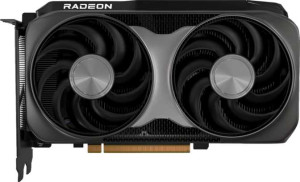
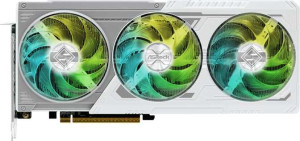
Both cards share identical GPU silicon — the same 2048 shading units, 128 TMUs, and 64 ROPs — confirming they are built on the exact same die with no architectural differences between them. Memory bandwidth is also on equal footing, with both running at 2518 MHz. Where they diverge is entirely in clock speeds: the ASRock Steel Legend OC ships with a factory overclock that raises the base clock to 1900 MHz versus 1700 MHz on the reference AMD card, and the boost clock climbs to 3320 MHz against 3130 MHz. That is roughly a 6% uplift across the board.
Those higher clocks translate directly into measurable throughput gains. The ASRock delivers 27.2 TFLOPS of floating-point performance compared to 25.6 TFLOPS for the reference model, and its texture rate of 425 GTexels/s edges ahead of the reference card's 400.6 GTexels/s. In real-world terms, this gap is most relevant in GPU-bound scenarios — think high-fidelity rasterization, heavy shader workloads, or compute tasks — where sustained clock speeds directly determine throughput. In everyday gaming at moderate settings, the difference will often be within noise, but in demanding titles or at higher resolutions, the ASRock's headroom gives it a consistent, if modest, edge.
The ASRock Steel Legend OC holds a clear performance advantage in this group, driven entirely by its factory overclock rather than any underlying hardware difference. For users who would otherwise manually overclock a reference card, the ASRock effectively delivers that result out of the box. The AMD reference card is not outclassed, but if raw performance within this GPU tier is the priority, the ASRock's higher clocks make it the stronger choice on paper.