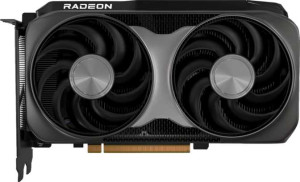
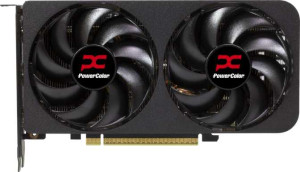
Both cards share identical foundations: a 1700 MHz base clock, 2048 shading units, 128 TMUs, and 64 ROPs. This means their rendering pipelines are architecturally the same, and under light or thermally constrained workloads, they will perform identically. The real divergence begins at boost frequencies.
The PowerColor Reaper carries a factory-overclocked turbo of 3230 MHz versus the reference 3130 MHz — a 100 MHz advantage that cascades directly into every derived throughput metric. Its floating-point performance reaches 26.46 TFLOPS compared to 25.6 TFLOPS, its texture rate hits 413.4 GTexels/s versus 400.6, and its pixel fill rate leads at 206.7 GPixel/s versus 200.3. In practice, this roughly 3% performance uplift is unlikely to change minimum framerates or enable higher quality settings on its own, but in sustained workloads that fully leverage boost clocks — such as demanding rasterized titles or GPU compute tasks — the Reaper will consistently pull slightly ahead without any user tuning required.
The memory subsystem is identical at 2518 MHz, so bandwidth is not a differentiator here. Both cards support Double Precision Floating Point, which matters for certain professional or compute workloads. Overall, the PowerColor Reaper holds a clear, if modest, performance edge in this group purely due to its higher factory boost clock — making it the stronger choice for users who want every bit of headroom out of this GPU tier without manual overclocking.