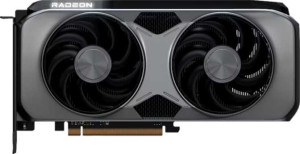
At first glance, the RX 9070 GRE appears competitive thanks to its higher base and boost clocks — 1420 MHz / 2790 MHz versus the RX 9070's 1330 MHz / 2520 MHz. However, clock speed alone does not determine throughput; the number of execution units underneath those clocks matters equally. The RX 9070 carries significantly more hardware muscle with 3584 shading units, 224 TMUs, and 128 ROPs, compared to the GRE's 3072 shading units, 192 TMUs, and 96 ROPs — a roughly 17% wider compute and rasterization pipeline.
When those two factors are multiplied together, the RX 9070's broader pipeline overcomes the GRE's clock advantage across every throughput metric. The RX 9070 delivers 36.1 TFLOPS of floating-point performance and a pixel rate of 322.6 GPixel/s, versus 34.3 TFLOPS and only 267.8 GPixel/s on the GRE. The pixel rate gap is particularly meaningful in practice: ROPs are the final stage of the rendering pipeline responsible for writing pixels to the framebuffer, so the RX 9070's 33% more ROPs translate directly into a higher ceiling for high-resolution, high-framerate rendering. Similarly, the RX 9070's faster memory speed of 2518 MHz (versus 2250 MHz on the GRE) helps feed its wider pipeline without becoming a bottleneck.
Both cards support Double Precision Floating Point, making them equally capable for compute workloads that require DPFP. Overall, however, the RX 9070 holds a clear performance edge in this group: its higher shader count, ROPs, and memory speed produce meaningfully greater throughput in rendering, texturing, and fill-rate-limited scenarios, despite the GRE's clock speed lead.