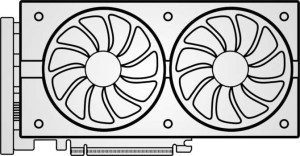
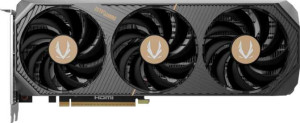
The most striking divergence between these two GPUs lies in their raw compute pipelines. The Zotac RTX 5070 Ti fields a massive 8,960 shading units versus the RX 9070's 3,584 — a 2.5× advantage that directly fuels its lead in floating-point throughput: 43.94 TFLOPS against 36.1 TFLOPS. In practice, this means the RTX 5070 Ti has more raw horsepower for compute-heavy workloads like ray tracing, AI-accelerated rendering, and heavily shaded scenes. Its larger TMU count (280 vs. 224) also translates to a noticeably higher texture fill rate (686.6 vs. 564.5 GTexels/s), which matters in texture-dense environments at high resolutions.
The RX 9070 punches back in two notable areas. It carries significantly more render output units (128 ROPs vs. 96), which is why it achieves a higher pixel fill rate (322.6 vs. 235.4 GPixel/s) despite its lower shader count — ROPs govern how quickly pixels are written to the framebuffer, so this advantage benefits high-resolution, high-refresh-rate output scenarios. The RX 9070 also runs its GDDR memory at a considerably faster 2518 MHz versus 1750 MHz, which can reduce memory bottlenecks when bandwidth per clock is at a premium, though actual throughput depends on bus width data not present here.
On clock speeds, the RTX 5070 Ti operates at a much higher base (2295 MHz vs. 1330 MHz), meaning it sustains performance more consistently, while the RX 9070 closes the gap at boost (2520 MHz vs. 2452 MHz), suggesting a wider dynamic range rather than a higher sustained floor. Overall, the RTX 5070 Ti Solid SFF holds the clear performance edge in compute and texture throughput — the metrics most closely tied to gaming and rendering workload performance — while the RX 9070's ROP and memory speed advantages represent narrower, situational wins rather than a counterbalancing lead.