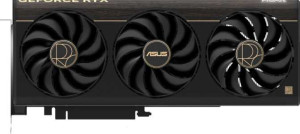
The most striking contrast between these two GPUs lies in their shader architectures. The Asus ProArt RTX 5080 deploys a massive 10,752 shading units alongside 336 TMUs, dwarfing the AMD Radeon RX 9070 XT's 4,096 shading units and 256 TMUs. This directly translates into the RTX 5080's higher raw compute figure of 56.28 TFLOPS versus 48.7 TFLOPS, and a superior texture rate of 879.3 GTexels/s versus 760.3 GTexels/s — advantages that matter most in heavily shader-bound workloads like complex rendering, ray tracing, and compute tasks typical of a ″ProArt″ creative workstation use case.
The clock speed story is more nuanced. The RTX 5080 leads on base clock at 2295 MHz versus 1660 MHz, reflecting a higher sustained floor, but the RX 9070 XT counterstrikes with a dramatically higher turbo of 2970 MHz against just 2617 MHz — a nearly 350 MHz peak advantage. This means the RX 9070 XT can burst to higher frequencies under short workloads, though the RTX 5080's larger shader array means it accomplishes more work per clock despite the lower ceiling. The RX 9070 XT also edges ahead on memory bus speed at 2518 MHz versus 1875 MHz, which can benefit memory-bandwidth-sensitive scenarios. Conversely, the RX 9070 XT's 128 ROPs versus the RTX 5080's 112 ROPs gives it a clear pixel fillrate lead — 380.2 GPixel/s against 293.1 GPixel/s — an advantage in high-resolution rasterization and anti-aliasing.
Overall, the RTX 5080 holds the stronger performance profile for compute-intensive and texture-heavy professional workloads, owing to its commanding lead in shader count, TMUs, and floating-point throughput. The RX 9070 XT carves out a real edge in pixel output rate and peak burst clocks, making it more competitive in pure rasterization scenarios. Both support Double Precision Floating Point, keeping them on equal footing for precision compute tasks. For users prioritizing raw throughput and texturing power, the RTX 5080 has the clear advantage; for those where pixel fillrate and memory speed are the bottleneck, the RX 9070 XT punches above its shader count.