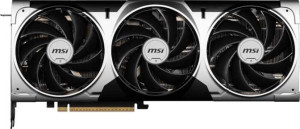
The most striking contrast here is in how each GPU reaches its peak performance. The MSI RTX 5070 Ti runs a higher base clock at 2295 MHz, meaning it operates closer to its ceiling at all times, while the AMD RX 9070 XT starts lower at 1660 MHz but turbos up aggressively to 2970 MHz — a nearly 500 MHz advantage at peak. In practice, this means the RX 9070 XT can hit higher burst performance during demanding workloads, while the RTX 5070 Ti delivers more consistent, predictable clock behavior. Neither approach is inherently superior, but the RX 9070 XT's turbo headroom is notable.
When it comes to raw throughput, the RX 9070 XT holds a meaningful lead across the board. Its 48.7 TFLOPS of floating-point performance outpaces the RTX 5070 Ti's 44.48 TFLOPS, and its pixel rate of 380.2 GPixel/s versus 238.3 GPixel/s is a particularly wide gap — directly impacting how fast the GPU can fill the screen at high resolutions and framerates. The texture rate tells a similar story: 760.3 GTexels/s vs 695 GTexels/s. The RTX 5070 Ti does field significantly more shading units (8960 vs 4096) and a slight TMU edge (280 vs 256), but those advantages do not translate into higher aggregate throughput under the provided metrics. The RX 9070 XT also pairs these numbers with considerably faster memory at 2518 MHz versus 1750 MHz, which helps feed its compute units more efficiently. Both cards support Double Precision Floating Point, making neither uniquely suited for professional compute workloads based on this spec alone.
Overall, the AMD RX 9070 XT holds a clear edge in this performance group. It leads in peak turbo clock, floating-point throughput, pixel fill rate, texture rate, ROP count, and memory speed — the metrics most directly tied to gaming and rendering performance. The RTX 5070 Ti's higher shader count is an architectural curiosity that does not overcome the RX 9070 XT's advantage across every measurable throughput category provided here.