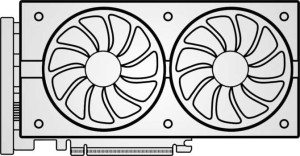
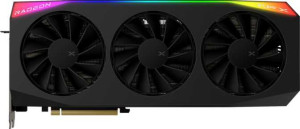
Both cards share the same fundamental GPU architecture — identical 4096 shading units, 256 TMUs, and 128 ROPs — meaning any performance gap between them comes entirely from clock speeds, not silicon differences. The XFX Mercury OC runs its base clock at 1870 MHz versus the reference AMD card's 1660 MHz, and pushes its boost to 3100 MHz compared to 2970 MHz. That 130 MHz turbo advantage translates directly into every derived throughput metric: the XFX reaches 50.79 TFLOPS of floating-point performance against 48.7 TFLOPS for the reference model, a roughly 4.3% uplift. Similarly, texture throughput rises from 760.3 to 793.6 GTexels/s, which matters in complex, texture-heavy scenes where the GPU is filtering many layers simultaneously.
In practical terms, a ~4% compute advantage rarely translates into a full extra frame per second on its own, but it does provide a small but consistent ceiling raise — particularly in GPU-bound workloads like high-resolution rasterization or ray tracing passes where every TFLOP counts. Memory speed is identical at 2518 MHz on both cards, so bandwidth is not a differentiator; the XFX advantage is purely a result of the factory overclock. Both cards support Double Precision Floating Point, making them equally capable for compute or professional workloads that rely on DPFP.
The XFX Mercury OC holds a clear, if modest, performance edge in this group. It is the better choice for users who want the maximum out-of-the-box clock headroom without manual overclocking, while the reference AMD RX 9070 XT offers essentially the same architecture at presumably lower clocks — suited for those who prioritize power efficiency or plan to tune frequencies themselves.