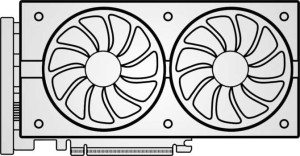
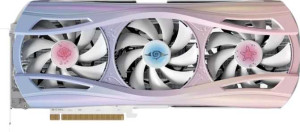
At first glance, the clock speed story seems split: the Yeston RTX 5070 Ti boasts a higher base clock of 2295 MHz versus the RX 9070 XT's 1660 MHz, suggesting a more consistent floor of performance. However, the RX 9070 XT storms back with a turbo clock of 2970 MHz — nearly 500 MHz above the 5070 Ti's 2482 MHz ceiling. In practice, turbo clocks drive the majority of sustained gaming workloads, meaning the RX 9070 XT is operating at significantly higher frequencies during real-world use.
That clock speed advantage compounds decisively across the throughput metrics. The RX 9070 XT delivers a pixel rate of 380.2 GPixel/s versus 238.3 GPixel/s for the RTX 5070 Ti — a roughly 60% lead that directly translates to higher fill-rate capacity and better frame output at high resolutions. Its floating-point performance of 48.7 TFLOPS edges out the 5070 Ti's 44.48 TFLOPS, and its texture rate of 760.3 GTexels/s versus 695 GTexels/s gives it an advantage in texture-heavy rendering scenarios. Notably, the RX 9070 XT also pairs these with a substantially faster memory interface speed of 2518 MHz compared to the 5070 Ti's 1750 MHz, which helps feed its shader cores more efficiently. The RTX 5070 Ti does field a far larger shader array — 8960 shading units versus 4096 — but that raw unit count does not translate into a throughput lead here, pointing to architectural and clock-speed efficiency differences between AMD's RDNA 4 and NVIDIA's Blackwell designs.
Overall, on the performance metrics provided, the AMD Radeon RX 9070 XT holds a clear edge. It leads in pixel rate, texture throughput, floating-point performance, and memory speed — all metrics that more directly govern rendering output than shading unit count alone. Both GPUs support double-precision floating point, so that is a non-differentiator. For users prioritizing raw rasterization throughput based on these specs, the RX 9070 XT is the stronger performer in this group.