AMD Ryzen 7 9700F
Apple M5 (9-core CPU)

AMD Ryzen 7 9700F Apple M5 (9-core CPU)

Overview

Welcome to our in-depth specification comparison between the AMD Ryzen 7 9700F and the Apple M5 (9-core CPU). These two processors represent fundamentally different design philosophies — one built for the desktop and the other engineered for laptop efficiency. In this comparison, we examine key battlegrounds including core architecture and CPU performance, memory capabilities, cache hierarchy, and platform features to help you determine which chip best suits your specific needs.

Common Features

  • Both processors support 64-bit computing.
  • Both processors use DDR5 memory.
  • The NX bit security feature is present on both processors.

Main Differences

  • The AMD Ryzen 7 9700F is a desktop processor, while the Apple M5 (9-core CPU) is a laptop processor.
  • Integrated graphics are not available on the AMD Ryzen 7 9700F, but are present on the Apple M5 (9-core CPU).
  • The semiconductor size is 4 nm on the AMD Ryzen 7 9700F and 3 nm on the Apple M5 (9-core CPU).
  • CPU speed is 8 x 3.8 GHz on the AMD Ryzen 7 9700F and 3 x 4.6 GHz plus 6 x 3.2 GHz on the Apple M5 (9-core CPU).
  • The AMD Ryzen 7 9700F has 16 CPU threads, while the Apple M5 (9-core CPU) has 9 CPU threads.
  • An unlocked multiplier is available on the AMD Ryzen 7 9700F but not on the Apple M5 (9-core CPU).
  • L2 cache is 8 MB on the AMD Ryzen 7 9700F and 16 MB on the Apple M5 (9-core CPU).
  • L1 cache is 640 KB on the AMD Ryzen 7 9700F and 320 KB on the Apple M5 (9-core CPU).
  • big.LITTLE technology is used by the Apple M5 (9-core CPU) but not by the AMD Ryzen 7 9700F.
  • The clock multiplier is 38 on the AMD Ryzen 7 9700F and 46 on the Apple M5 (9-core CPU).
  • Maximum RAM speed is 5600 MHz on the AMD Ryzen 7 9700F and 6400 MHz on the Apple M5 (9-core CPU).
  • The maximum supported memory amount is 192 GB on the AMD Ryzen 7 9700F and 64 GB on the Apple M5 (9-core CPU).
  • ECC memory support is present on the AMD Ryzen 7 9700F but not available on the Apple M5 (9-core CPU).
Specs Comparison
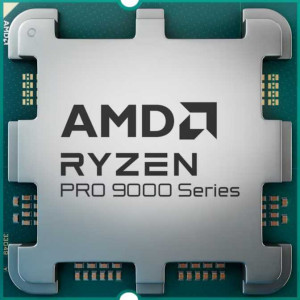
AMD Ryzen 7 9700F

AMD Ryzen 7 9700F

Apple M5 (9-core CPU)

Apple M5 (9-core CPU)

General info:
Type Desktop Laptop
Has integrated graphics
release date September 2025 October 2025
semiconductor size 4 nm 3 nm
Supports 64-bit

The most fundamental difference here is platform and purpose: the AMD Ryzen 7 9700F is a desktop processor, designed to be paired with a discrete GPU and installed in a tower or workstation, while the Apple M5 (9-core CPU) is a laptop chip built around a tightly integrated system-on-chip architecture. This shapes every other spec in this group — the M5 includes integrated graphics, eliminating the need for a separate GPU, whereas the 9700F explicitly omits integrated graphics, meaning a discrete card is mandatory for any display output.

At the fabrication level, the M5 is manufactured on a 3 nm process compared to the 9700F's 4 nm process. A smaller node generally translates to better power efficiency and higher transistor density, which is especially impactful in a laptop context where thermal headroom and battery life are constrained. For a desktop chip like the 9700F, the 4 nm node is still highly competitive, but the efficiency advantage of 3 nm is most meaningful in the portable form factor where the M5 operates.

Both chips fully support 64-bit computing, so there is no differentiation there. Overall, the Apple M5 holds a structural edge in this group: its 3 nm process, integrated graphics, and laptop-optimized design reflect a more modern and self-contained architecture. The 9700F is not at a disadvantage for its intended desktop context, but on paper, the M5's general specs are more advanced for the platform it targets.

Performance:
CPU speed 8 x 3.8 GHz 3 x 4.6 & 6 x 3.2 GHz
CPU threads 16 threads 9 threads
Has an unlocked multiplier
L2 cache 8 MB 16 MB
L1 cache 640 KB 320 KB
Uses big.LITTLE technology
clock multiplier 38 46

The core architectural divide here is homogeneous versus heterogeneous design. The Ryzen 7 9700F deploys 8 identical cores at 3.8 GHz with 16 threads, giving it a straightforward, symmetric workload distribution. The M5 (9-core CPU) takes a big.LITTLE approach — 3 high-performance cores at 4.6 GHz paired with 6 efficiency cores at 3.2 GHz — trading raw thread count for intelligent task routing. In practice, this means the M5 dispatches light background tasks to its efficiency cores to conserve power, while the performance cores handle demanding workloads. The 9700F's uniform core design is better suited to consistently heavy, parallelizable workloads where all cores can be saturated simultaneously.

Cache configuration reveals an interesting inversion. Despite having fewer threads, the M5 carries a significantly larger 16 MB L2 cache versus the 9700F's 8 MB, which helps compensate for lower thread count by keeping more data closer to the CPU and reducing expensive memory fetches. The 9700F, however, doubles the M5's L1 cache at 640 KB versus 320 KB, favoring lower-latency access for the kind of sustained, parallel throughput desktop workloads demand.

For users who want to push clock speeds beyond stock, the 9700F holds an exclusive advantage with its unlocked multiplier, enabling overclocking — a meaningful differentiator for enthusiast desktop builds. The M5 offers no such headroom. On balance, neither chip has a clean sweep: the Ryzen 7 9700F edges ahead for multi-threaded desktop workloads and overclocking flexibility, while the M5's big.LITTLE architecture and larger L2 cache give it a structural efficiency advantage better matched to its laptop context.

Memory:
RAM speed (max) 5600 MHz 6400 MHz
DDR memory version 5 5
maximum memory amount 192GB 64GB
Supports ECC memory

Both chips operate on DDR5 memory, placing them on equal footing in terms of generation. Where they diverge is in bandwidth ceiling: the M5 supports RAM speeds up to 6400 MHz versus the Ryzen 7 9700F's 5600 MHz cap. For a laptop chip with a unified memory architecture — where the CPU and GPU share the same pool — higher bandwidth is especially impactful, directly influencing graphics performance and data-intensive tasks. The 9700F's lower ceiling is typical for desktop DDR5 configurations, where gains beyond a certain threshold yield diminishing returns in most workloads.

The capacity story flips the advantage entirely. The 9700F supports up to a substantial 192 GB of RAM, dwarfing the M5's 64 GB maximum. For memory-intensive professional workloads — large virtual machines, expansive datasets, or high-resolution video editing with many simultaneous streams — that headroom is not theoretical; it is a hard ceiling that determines whether certain workloads are even feasible. The M5's 64 GB limit is generous for a laptop but constraining compared to what a desktop platform can accommodate.

A further desktop-oriented advantage is the 9700F's support for ECC memory, which detects and corrects single-bit memory errors — critical in workstation, server, or any environment where data integrity is non-negotiable. The M5 lacks ECC support entirely. On balance, the Ryzen 7 9700F holds the stronger overall position in this group: its vastly higher memory capacity ceiling and ECC support make it the more capable platform for demanding, professional-grade use cases, even if the M5 edges it out on raw memory speed.

Features:
Has NX bit

With only one data point in this group, the analysis is straightforward: both the Ryzen 7 9700F and the M5 support the NX bit (No-Execute bit), a hardware-level security feature that marks memory regions as non-executable. This prevents a class of attacks — most notably buffer overflow exploits — from injecting and running malicious code in data memory segments. It is a foundational security baseline expected of any modern processor, and both chips meet it without distinction.

This group is a complete tie. Neither chip holds any advantage here; NX bit support is a standard capability rather than a differentiator at this level of the market.

Comparison Summary & Verdict

After examining all the evidence, the AMD Ryzen 7 9700F and the Apple M5 (9-core CPU) each shine in distinct scenarios. The Ryzen 7 9700F stands out for desktop power users who need maximum flexibility: it offers 16 CPU threads, support for up to 192 GB of RAM, ECC memory compatibility, and an unlocked multiplier for overclocking. It is the stronger choice for workstation builds and memory-intensive professional tasks. The Apple M5, on the other hand, excels in the laptop space with its big.LITTLE hybrid architecture, a faster 3 nm process node, higher maximum RAM speed of 6400 MHz, and double the L2 cache at 16 MB — all paired with integrated graphics. Choose the AMD Ryzen 7 9700F for a powerful, expandable desktop system, and the Apple M5 (9-core CPU) for an efficient, integrated laptop platform.

AMD Ryzen 7 9700F
Buy AMD Ryzen 7 9700F if...

Buy the AMD Ryzen 7 9700F if you need a high-thread-count desktop processor with overclocking support, ECC memory compatibility, and the ability to configure up to 192 GB of RAM.

Apple M5 (9-core CPU)
Buy Apple M5 (9-core CPU) if...

Buy the Apple M5 (9-core CPU) if you want a power-efficient laptop chip with integrated graphics, a modern 3 nm process, faster maximum RAM speeds, and a larger L2 cache.