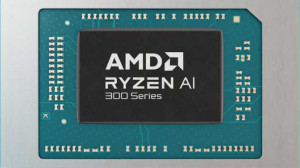
Both the AMD Ryzen AI 5 340 and Intel Core Ultra 5 225H share a 28W TDP and support integrated graphics and 64-bit computing — placing them in the same efficiency-focused tier aimed at thin-and-light use cases. However, the Ryzen AI 5 340 has a notable deployment advantage: it is rated for both laptop and desktop platforms, whereas the Core Ultra 5 225H is strictly a laptop-only chip. This gives AMD's offering broader applicability across form factors.
On the silicon front, the Core Ultra 5 225H is built on a 3 nm process versus the Ryzen AI 5 340's 4 nm, which in theory allows Intel to pack more transistors per area and achieve better power efficiency at the die level. Intel also holds an advantage in connectivity with PCIe 5.0 support, compared to AMD's PCIe 4.0 — a meaningful edge for users pairing the chip with next-generation NVMe SSDs or discrete GPUs that can saturate higher bandwidth lanes. The Core Ultra 5 225H also tolerates a higher maximum junction temperature at 110 °C versus 100 °C, giving OEMs slightly more thermal headroom before throttling kicks in.
In summary, Intel holds the edge in raw silicon modernity and I/O bandwidth, making the Core Ultra 5 225H the stronger choice for futureproofing and high-speed storage scenarios. AMD counters with its dual platform flexibility, which is a practical advantage for system integrators and users targeting desktop mini-PC builds. For pure laptop use, Intel's newer process node and PCIe 5.0 give it a tangible, if incremental, lead in this general specification group.