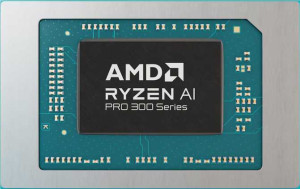
The most consequential difference in this group is thermal design power: the AMD Ryzen AI 5 Pro 340 is rated at just 28W TDP, while the Intel Core Ultra 7 265HX is rated at 55W — nearly double. In practice, this means the 265HX is built to sustain significantly higher performance workloads, but at the cost of greater heat output and battery drain. The Ryzen AI 5 Pro 340's lower envelope makes it far better suited for slim, fanless, or battery-sensitive designs, whereas the 265HX targets high-performance laptops that can accommodate robust cooling systems.
On the silicon side, the 265HX is fabricated on a 3 nm process versus the Ryzen's 4 nm, giving Intel a slight edge in transistor density and theoretical efficiency per watt at the chip level. However, this advantage is partially offset by the much higher TDP Intel demands in operation. The 265HX also supports PCIe 5.0 versus PCIe 4.0 on the Ryzen, which matters for users pairing the CPU with next-generation NVMe SSDs or discrete GPUs that can saturate Gen 5 bandwidth — a meaningful forward-looking advantage. The Ryzen's max CPU temperature ceiling of 100 °C is slightly more conservative than the 265HX's 105 °C, reflecting their different performance-versus-efficiency philosophies.
One exclusive advantage for the Ryzen AI 5 Pro 340 is its listed compatibility with both laptop and desktop form factors, while the Core Ultra 7 265HX is laptop-only. Overall, the Intel 265HX holds a clear edge for raw, sustained performance use cases, while the AMD Ryzen AI 5 Pro 340 has the advantage in versatility and power efficiency — making the right choice heavily dependent on whether the priority is peak throughput or thermal and platform flexibility.