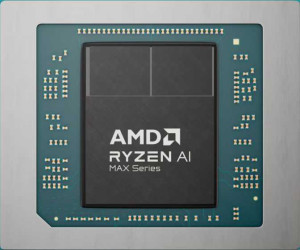
The most consequential difference in this group is that the AMD Ryzen AI Max 385 includes integrated graphics, while the Intel Core Ultra 7 265F has none. This is not a minor detail: without an iGPU, the Core Ultra 7 265F is entirely dependent on a discrete GPU to produce any output, making it a pure desktop-only component designed for systems where a dedicated graphics card is already assumed. The Ryzen AI Max 385, by contrast, can function as a standalone processor in both laptop and compact desktop contexts, giving it far greater platform flexibility.
On the efficiency front, the Ryzen AI Max 385 operates at a 55W TDP versus the Core Ultra 7 265F's 65W, a meaningful gap that reflects the AMD chip's dual laptop-and-desktop positioning — lower thermal output translates to cooler, quieter operation and longer battery life in mobile designs. The Intel chip's higher PCIe 5.0 support (versus AMD's PCIe 4.0) does offer greater theoretical bandwidth for next-generation discrete GPUs and NVMe drives, but this advantage is only relevant in a fully built-out desktop configuration where such components are actually present. The Intel chip's slightly smaller 3 nm process node versus AMD's 4 nm is notable but does not, on its own, offset the iGPU deficit or the higher power draw.
Overall, the Ryzen AI Max 385 holds a clear advantage in this group for any use case that values versatility, self-sufficiency, or power efficiency. The Core Ultra 7 265F's edge in PCIe generation is real but narrowly applicable, and its lack of integrated graphics imposes a hard constraint that limits its deployment options from the outset.