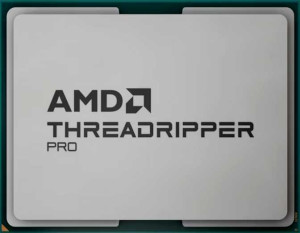
AMD Ryzen Threadripper Pro 9995WX
Apple M5

AMD Ryzen Threadripper Pro 9995WX Apple M5

Overview

Welcome to our in-depth specification comparison between the AMD Ryzen Threadripper Pro 9995WX and the Apple M5. These two processors represent fundamentally different philosophies: one built for maximum desktop workstation power, the other engineered for efficient laptop performance. In this comparison, we examine key battlegrounds including core and thread counts, cache architecture, memory capacity, and platform features to help you understand which chip aligns with your specific computing demands.

Common Features

  • Both processors support 64-bit computing.
  • Both processors support DDR5 memory.
  • Both processors have a maximum RAM speed of 6400 MHz.
  • Both processors include NX bit support.

Main Differences

  • The AMD Ryzen Threadripper Pro 9995WX is a desktop processor, while the Apple M5 is a laptop processor.
  • Integrated graphics are present on the Apple M5 but not available on the AMD Ryzen Threadripper Pro 9995WX.
  • The semiconductor size is 4 nm on the AMD Ryzen Threadripper Pro 9995WX and 3 nm on the Apple M5.
  • The number of transistors is 99780 million on the AMD Ryzen Threadripper Pro 9995WX and 38000 million on the Apple M5.
  • The CPU speed is 96 x 2.5 GHz on the AMD Ryzen Threadripper Pro 9995WX and 4 x 4.6 & 6 x 3.2 GHz on the Apple M5.
  • The AMD Ryzen Threadripper Pro 9995WX has 192 CPU threads, while the Apple M5 has 10 CPU threads.
  • An unlocked multiplier is available on the AMD Ryzen Threadripper Pro 9995WX but not on the Apple M5.
  • The L2 cache is 96 MB on the AMD Ryzen Threadripper Pro 9995WX and 16 MB on the Apple M5.
  • The L1 cache is 7680 KB on the AMD Ryzen Threadripper Pro 9995WX and 320 KB on the Apple M5.
  • big.LITTLE technology is used on the Apple M5 but not on the AMD Ryzen Threadripper Pro 9995WX.
  • The clock multiplier is 25 on the AMD Ryzen Threadripper Pro 9995WX and 46 on the Apple M5.
  • The maximum memory amount is 2000 GB on the AMD Ryzen Threadripper Pro 9995WX and 64 GB on the Apple M5.
  • ECC memory support is present on the AMD Ryzen Threadripper Pro 9995WX but not available on the Apple M5.
Specs Comparison
AMD Ryzen Threadripper Pro 9995WX

AMD Ryzen Threadripper Pro 9995WX

Apple M5

Apple M5

General info:
Type Desktop Laptop
Has integrated graphics
release date May 2025 October 2025
semiconductor size 4 nm 3 nm
number of transistors 99780 million 38000 million
Supports 64-bit

At a fundamental level, these two chips are built for entirely different contexts. The Threadripper Pro 9995WX is a desktop processor — a workstation-class part with no size or power constraints — while the Apple M5 is a laptop chip designed around efficiency and integration. That distinction shapes nearly every other spec in this group.

The most striking contrast is transistor count: the Threadripper Pro 9995WX packs a massive 99,780 million transistors versus the M5's 38,000 million. More transistors generally means more functional units — more cores, more cache, more execution resources — which translates to raw throughput in heavily threaded workloads. However, the M5 counters with a slightly more advanced 3 nm process node versus the Threadripper's 4 nm, meaning each of its transistors is more power-efficient. The M5 achieves a lot with fewer, more efficient transistors; the Threadripper simply uses far more of them to maximize peak capability regardless of power draw.

A key practical differentiator is that the M5 includes integrated graphics while the Threadripper Pro 9995WX does not, meaning the AMD chip requires a discrete GPU to produce any display output — a non-issue in a workstation build but a fundamental architectural difference. Both support 64-bit computing, which is a baseline expectation at this tier. Overall, neither chip is strictly ″better″: the Threadripper Pro 9995WX has a clear edge in sheer silicon scale for maximum compute density, while the M5 holds an advantage in process efficiency and self-contained integration suited to mobile use.

Performance:
CPU speed 96 x 2.5 GHz 4 x 4.6 & 6 x 3.2 GHz
CPU threads 192 threads 10 threads
Has an unlocked multiplier
L2 cache 96 MB 16 MB
L1 cache 7680 KB 320 KB
Uses big.LITTLE technology
clock multiplier 25 46

The performance philosophies of these two chips could not be more divergent. The Threadripper Pro 9995WX deploys a brute-force approach: 96 cores running at 2.5 GHz with 192 threads, delivering an almost incomprehensible level of parallelism for workloads that can scale across many cores simultaneously — think rendering farms, large-scale simulation, or massive code compilation jobs. The M5 takes the opposite route, using big.LITTLE technology to blend 4 performance cores at 4.6 GHz with 6 efficiency cores at 3.2 GHz across just 10 threads total. For single-threaded responsiveness and everyday tasks, the M5's higher per-core clock speeds are a real advantage; for massively parallel workloads, the Threadripper's core count is in a completely different league.

Cache architecture further reinforces this divide. The Threadripper Pro 9995WX carries a colossal 96 MB of L2 cache and 7,680 KB of L1 cache, keeping enormous working datasets close to its many cores and minimizing costly memory fetches. The M5's 16 MB L2 and 320 KB L1 are far more modest — sensible for a 10-core mobile chip, but not in the same class for data-intensive throughput. One notable advantage the Threadripper holds is an unlocked multiplier, giving enthusiasts the ability to push clock speeds beyond stock settings, a capability the M5 entirely lacks.

The Threadripper Pro 9995WX holds an overwhelming edge in raw parallel compute capacity by every metric in this group — core count, thread count, and cache volume. The M5's advantage lies in its efficiency-core architecture, which makes it far better suited to sustained, balanced performance within a power-constrained laptop. These chips are not truly competing for the same user, but on performance ceiling alone, the Threadripper Pro 9995WX is decisively ahead.

Memory:
RAM speed (max) 6400 MHz 6400 MHz
DDR memory version 5 5
maximum memory amount 2000GB 64GB
Supports ECC memory

Where memory bandwidth is concerned, these two chips are evenly matched on paper: both support DDR5 at a maximum of 6400 MHz. That parity means neither has an inherent advantage in raw data transfer speed to and from RAM, which matters for memory-bound workloads like large dataset processing or high-resolution video editing.

The real separation comes from capacity and reliability. The Threadripper Pro 9995WX supports a staggering 2000 GB of maximum RAM — enough to hold entire databases or multi-terabyte simulation datasets entirely in memory, a capability reserved for the most demanding professional workstations. The M5 caps out at 64 GB, which is reasonable for a laptop but represents a hard ceiling that rules it out for memory-intensive enterprise or scientific workloads. Equally significant is ECC memory support on the Threadripper Pro 9995WX: error-correcting memory detects and fixes bit-level data corruption on the fly, a critical requirement in financial computing, medical imaging, and any environment where silent data errors are unacceptable. The M5 offers no ECC support.

On memory, the Threadripper Pro 9995WX holds a decisive advantage across two dimensions that matter most for professional deployments — raw capacity and data integrity. The M5's 64 GB ceiling and lack of ECC are acceptable trade-offs for a laptop chip, but users who need vast, reliable memory headroom have only one option here.

Features:
Has NX bit

With only one data point in this group, the conclusion is straightforward: both the Threadripper Pro 9995WX and the M5 support the NX bit (No-Execute bit), a hardware-level security feature that prevents certain regions of memory from being executed as code. This is a meaningful baseline protection against a class of exploits — such as buffer overflow attacks — that attempt to inject and run malicious code in data memory segments.

This is a complete tie. Neither chip holds any advantage over the other based on the available data for this group. NX bit support is effectively a universal expectation in modern processors across all market segments, so its presence here differentiates nothing between these two products.

Comparison Summary & Verdict

After examining the full specification breakdown, it is clear that the AMD Ryzen Threadripper Pro 9995WX and the Apple M5 are designed for very different audiences. The Threadripper Pro 9995WX dominates in sheer scale, offering 192 CPU threads, up to 2000 GB of ECC-capable RAM support, a massive 96 MB L2 cache, and an unlocked multiplier — making it the definitive choice for demanding workstation workloads. The Apple M5, on the other hand, leverages a 3 nm process node, big.LITTLE technology, integrated graphics, and a higher clock multiplier, positioning it as a refined and efficient solution for portable use. Both share DDR5 support at 6400 MHz and NX bit security. Your choice ultimately depends on whether you need extreme multi-threaded horsepower or a capable, power-efficient mobile processor.

AMD Ryzen Threadripper Pro 9995WX
Buy AMD Ryzen Threadripper Pro 9995WX if...

Buy the AMD Ryzen Threadripper Pro 9995WX if you need extreme multi-threaded desktop workstation performance, massive memory capacity up to 2000 GB, ECC memory support, and an unlocked multiplier for advanced tuning.

Apple M5
Buy Apple M5 if...

Buy the Apple M5 if you need an efficient laptop processor with integrated graphics, big.LITTLE technology for adaptive performance, and a compact 3 nm design with a higher clock multiplier.