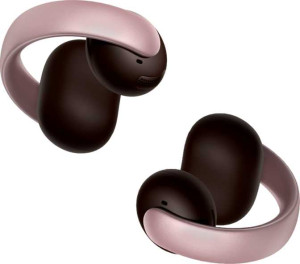
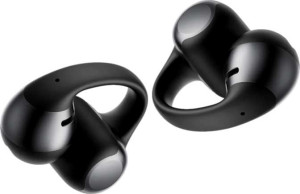
Anker Soundcore AeroClip
Shokz OpenDots One

Anker Soundcore AeroClip Shokz OpenDots One

Overview

Welcome to this in-depth specification comparison between the Anker Soundcore AeroClip and the Shokz OpenDots One, two open-ear wireless earbuds competing in the increasingly popular clip-style segment. Both share a sweat-resistant, wire-free design with multipoint connectivity and noise-canceling microphones, but key battlegrounds emerge around battery endurance, ingress protection, charging convenience, and audio codec support. Read on to see how these two stack up spec by spec.

Common Features

  • Both products have an open-ear fit.
  • Both products are sweat resistant.
  • Neither product has wires or cables.
  • Neither product is a neckband earbud design.
  • Neither product includes wingtips.
  • Neither product has RGB lighting.
  • Both products have stereo speakers.
  • Neither product has a UV light.
  • Both products cover a frequency range of 20 Hz to 20000 Hz.
  • Neither product has active noise cancellation.
  • Neither product has passive noise reduction.
  • Neither product supports spatial audio.
  • Neither product has Dolby Atmos.
  • Neither product has Dirac Virtuo.
  • Neither product has a neodymium magnet.
  • Neither product has a solar power battery.
  • Both products have a battery level indicator.
  • Both products have a rechargeable battery.
  • Neither product supports fast pairing.
  • Both products have a USB Type-C port.
  • Neither product supports LDAC.
  • Neither product supports LDHC.
  • Neither product supports Bluetooth LE Audio.
  • Neither product supports aptX Adaptive.
  • Neither product supports aptX Low Latency.
  • Neither product supports aptX HD.
  • Neither product has an ambient sound mode.
  • Neither product has in/on-ear detection.
  • Both products have a find device feature.
  • Both products support fast charging.
  • Both products support multipoint connection with up to 2 devices.
  • Neither product can read notifications.
  • Both products have a mute function.
  • Both products can be used as a headset.
  • Both products have 4 microphones.
  • Both products have a noise-canceling microphone.

Main Differences

  • The IP rating is IPX4 on Anker Soundcore AeroClip and IP54 on Shokz OpenDots One.
  • Weight is 11.8 g on Anker Soundcore AeroClip and 13 g on Shokz OpenDots One.
  • Battery life is 8 hours on Anker Soundcore AeroClip and 10 hours on Shokz OpenDots One.
  • Battery life of the charging case is 24 hours on Anker Soundcore AeroClip and 30 hours on Shokz OpenDots One.
  • Charge time is 1.5 hours on Anker Soundcore AeroClip and 1 hour on Shokz OpenDots One.
  • Wireless charging is available on Shokz OpenDots One but not on Anker Soundcore AeroClip.
  • AAC support is present on Anker Soundcore AeroClip but not available on Shokz OpenDots One.
Specs Comparison
Anker Soundcore AeroClip

Anker Soundcore AeroClip

Shokz OpenDots One

Shokz OpenDots One

Design:
Fit Open-ear Open-ear
Ingress Protection (IP) rating IPX4 IP54
water resistance Sweat resistant Sweat resistant
weight 11.8 g 13 g
has no wires or cables
are neckband earbuds
wingtips included
has RGB lighting
has stereo speakers
has UV light
Has a display

Both the Anker Soundcore AeroClip and the Shokz OpenDots One share the same fundamental design philosophy: fully wireless, open-ear earbuds with no neckband, no wingtips, stereo speakers, and sweat resistance. For users, this means both are designed for active use while keeping you aware of your surroundings — a key selling point of open-ear form factors.

The most meaningful differentiator in this group is ingress protection. The AeroClip carries an IPX4 rating, which guards against sweat and light splashes from any direction. The OpenDots One steps this up with a full IP54 rating, adding a degree of dust resistance alongside a slightly higher water resistance threshold. In practice, IP54 makes the OpenDots One more resilient in dusty environments like outdoor trails or gym floors — a tangible real-world advantage for active users.

Weight is another subtle but practical difference: the AeroClip comes in at 11.8 g versus the OpenDots One's 13 g. That 1.2 g gap is minor, but over long listening sessions the AeroClip may feel marginally lighter on the ear. Overall, the Shokz OpenDots One holds a slight design edge due to its superior IP54 rating, while the AeroClip counters with a fractionally lower weight — making the choice here dependent on whether durability or feather-light comfort is the higher priority.

Sound quality:
has active noise cancellation (ANC)
has passive noise reduction
lowest frequency 20 Hz 20 Hz
highest frequency 20000 Hz 20000 Hz
supports spatial audio
has Dolby Atmos
has Dirac Virtuo
has a neodymium magnet

On paper, the sound quality specs for these two earbuds are identical across every measured dimension. Both cover the standard 20 Hz – 20,000 Hz frequency range, which spans the full extent of human hearing — meaning neither product is spec'd to favor bass-heavy reproduction or extended treble detail over the other.

Notably, neither earbud offers active noise cancellation, passive noise reduction, spatial audio, or any premium audio processing like Dolby Atmos. For open-ear designs, the absence of ANC and passive isolation is expected and intentional — these earbuds are built for situational awareness, not immersion. Users prioritizing noise blocking or cinematic soundscapes should look elsewhere, but for casual listening, commuting, or workouts where ambient awareness matters, neither product is at a disadvantage here.

This group is a complete tie. The spec data provides no basis to distinguish the AeroClip from the OpenDots One in terms of sound quality on paper. Real-world sonic differences, if any, would come down to driver tuning and acoustic chamber design — factors not reflected in the data provided.

Power:
Battery life 8 hours 10 hours
Battery life of charging case 24 hours 30 hours
charge time 1.5 hours 1 hours
has wireless charging
Has a solar power battery
has a battery level indicator
has a rechargeable battery

Battery endurance is where the Shokz OpenDots One pulls ahead meaningfully. Its 10-hour earbud battery life outpaces the AeroClip's 8 hours by a notable margin, and that gap compounds when you factor in the charging case: 30 total hours versus 24 hours for the AeroClip. For heavy daily users or travelers who go days between charges, that extra headroom is a genuine practical advantage.

Charge time and wireless charging widen the gap further. The OpenDots One refills in 1 hour compared to the AeroClip's 1.5 hours, meaning less time tethered to a cable. More significantly, the OpenDots One supports wireless charging — a convenience feature the AeroClip lacks entirely. For users already in a Qi ecosystem with a wireless pad on their desk or nightstand, this removes the need to hunt for a cable altogether.

The Shokz OpenDots One holds a clear and well-rounded advantage in this category — longer playtime, more case backup, faster wired charging, and wireless charging support. The AeroClip has no offsetting power advantage from the provided data, making this a decisive win for the OpenDots One for power-conscious buyers.

Connectivity:
has fast pairing
Has USB Type-C
has LDAC
has LDHC
has Bluetooth LE Audio
has aptX Adaptive
has aptX Low Latency
has aptX HD
has aptX
has aptX Lossless
has aptX Voice
has Auracast
maximum Bluetooth range 10 m 10 m
supports Bluetooth pairing using NFC
Can be used wirelessly
has AAC

Connectivity between these two earbuds is largely uniform — both are fully wireless, cap out at a 10 m Bluetooth range, use USB-C for charging, and skip advanced codec support like LDAC, aptX, or Bluetooth LE Audio. For most users, the shared range and lack of premium codecs means real-world wireless performance should be broadly comparable day-to-day.

The one tangible differentiator is codec support for Apple device users: the AeroClip supports AAC, while the OpenDots One does not. AAC is Apple's preferred wireless audio codec, and on iPhones and iPads it delivers noticeably more stable and higher-quality audio transmission compared to the SBC fallback the OpenDots One would default to. For Android users the gap is negligible, but for anyone in the Apple ecosystem, AAC support is a meaningful practical advantage.

The AeroClip edges ahead in this category, but only for a specific audience. iPhone and iPad users will benefit directly from its AAC support, while Android users will find the two products effectively tied. Neither earbud offers fast pairing or NFC, so the gap does not extend beyond codec fidelity.

Features:
release date January 2025 March 2025
has ambient sound mode
has in/on-ear detection
has find device feature
Supports fast charging
multipoint count 2 2
can read notifications
has a mute function
can be used as a headset
control panel placed on a device
Has voice prompts
travel bag is included
Has an in-line control panel
Has a temperature sensor
Has a built-in camera remote control function

When it comes to features, these two earbuds are in complete lockstep. Both support multipoint connection to two devices simultaneously — a practical daily-use feature that lets users seamlessly switch between, say, a laptop and a phone without manual re-pairing. Both also include fast charging, a find-device function, mute, voice prompts, on-device controls, and even a travel bag in the box.

For professionals, the shared headset capability and mute function are worth highlighting: both earbuds can handle calls and video meetings, and the ability to mute directly from the earbud controls is a small but genuinely useful quality-of-life feature in work-from-anywhere scenarios. Neither product offers ambient sound mode or in-ear detection, which is consistent with their open-ear design — ambient awareness is built into the form factor itself rather than processed electronically.

This group is an unambiguous tie. Every single feature in the provided data is identical across both products. Buyers who are weighing these two earbuds purely on feature set will find no differentiator here — the decision will need to rest on the advantages surfaced in other specification groups.

Microphone:
number of microphones 4 4
has a noise-canceling microphone

Microphone hardware is identical across both earbuds: each packs 4 microphones with noise-canceling capability. A quad-mic array is a competitive setup at this product tier — more microphones generally allow for better beamforming, meaning the array can more precisely isolate the speaker's voice and suppress background noise from multiple directions.

Noise-canceling microphones are particularly relevant for open-ear earbuds, which by design don't block ambient sound physically. Having active mic noise cancellation compensates for that openness during calls, helping ensure the person on the other end hears a clean voice even in noisy environments like a busy street or gym.

With no differences to separate them, this category is a complete tie. Both the AeroClip and the OpenDots One arrive at the same microphone specification, and the provided data gives no basis to favor one over the other for call quality or voice pickup performance.

Comparison Summary & Verdict

After a thorough comparison, both earbuds deliver a solid open-ear experience with identical frequency response, four-microphone setups, and fast-charging support. However, their differences point each product toward a distinct user. The Shokz OpenDots One pulls ahead on endurance, offering 10 hours of battery life and a 30-hour case, faster 1-hour charge time, wireless charging, and a superior IP54 rating for dust and sweat resistance — making it the stronger choice for active or outdoor users. The Anker Soundcore AeroClip, on the other hand, is the lighter of the two at 11.8 g and uniquely supports the AAC codec, which may appeal to Apple ecosystem users who value audio quality. Choose accordingly based on whether endurance and protection or lightweight comfort and codec compatibility matter most to you.

Anker Soundcore AeroClip
Buy Anker Soundcore AeroClip if...

Buy the Anker Soundcore AeroClip if you prioritize a lighter fit and AAC codec support, especially within the Apple ecosystem.

Shokz OpenDots One
Buy Shokz OpenDots One if...

Buy the Shokz OpenDots One if you want longer battery life, faster charging, wireless charging convenience, and stronger IP54 dust and water resistance.