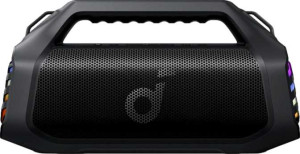
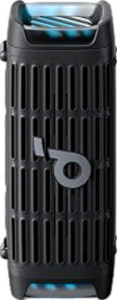
The most defining difference in this group is sheer physical scale. The Boom 2 Pro is a substantially larger unit — measuring 442 × 228 × 151 mm with a volume of roughly 15,217 cm³ — while the Boom 3i is a compact cylinder at just 85 × 210 × 78.5 mm and approximately 1,401 cm³. That makes the Boom 2 Pro roughly ten times the volume of the Boom 3i. In real-world terms, the Boom 2 Pro is a party or outdoor statement speaker that demands dedicated space, while the Boom 3i is clearly designed for portability and everyday carry.
Both speakers share an IP68 waterproof rating, which is the highest tier in consumer audio — meaning full submersion protection, not just splash resistance. Both also include a detachable cable and an on-device control panel, and neither includes a travel bag, touch screen, RGB lighting, or remote control. These shared traits suggest a similar philosophy on durability and direct physical control, applied to two very different size classes. One notable hardware distinction: the Boom 2 Pro uses a neodymium magnet in its driver assembly, while the Boom 3i does not. Neodymium magnets are lighter and more powerful for their size, which typically enables more efficient, higher-output transducers — a meaningful engineering choice in a larger speaker chasing louder output.
On design, the Boom 2 Pro holds the edge in build sophistication thanks to the neodymium magnet advantage and its large-format construction intended for high-output use cases. The Boom 3i, however, wins on portability — its compact footprint makes it the practical choice for users who prioritize taking their speaker anywhere. Neither product is ″better″ in an absolute sense here; the right choice depends entirely on whether the user values raw output potential or everyday convenience.