Anker Soundcore Liberty 5
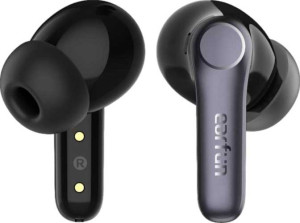
EarFun Air Pro 4 Plus

Anker Soundcore Liberty 5 EarFun Air Pro 4 Plus

Overview

Welcome to our in-depth spec comparison between the Anker Soundcore Liberty 5 and the EarFun Air Pro 4 Plus. Both earbuds share a solid foundation — IP55 water resistance, six-microphone ANC, LDAC support, and wireless charging — but key battlegrounds emerge around audio frequency range, battery performance, and Bluetooth connectivity. Read on to discover which of these true wireless earbuds best fits your lifestyle.

Common Features

  • Both products use an in-ear fit design.
  • Both products carry an IP55 ingress protection rating.
  • Both products are water resistant.
  • Both products are true wireless with no wires or cables.
  • Neither product is a neckband earbud style.
  • Neither product includes wingtips.
  • Neither product has RGB lighting.
  • Both products feature stereo speakers.
  • Both products have active noise cancellation (ANC).
  • Both products offer passive noise reduction.
  • Both products have a lowest frequency of 20 Hz.
  • Spatial audio is not supported on either product.
  • Dirac Virtuo is not available on either product.
  • Neither product uses a neodymium magnet.
  • Both products have a charge time of 1.5 hours.
  • Both products support wireless charging.
  • Neither product has a solar power battery.
  • Both products have a battery level indicator.
  • Both products have a rechargeable battery.
  • Both products include a USB Type-C port.
  • Both products support LDAC audio codec.
  • LDHC support is not available on either product.
  • aptX Low Latency support is not available on either product.
  • aptX HD support is not available on either product.
  • aptX support is not available on either product.
  • aptX Voice support is not available on either product.
  • Both products have a maximum Bluetooth range of 10 m.
  • Both products have an ambient sound mode.
  • Both products feature in/on-ear detection.
  • Both products support fast charging.
  • Both products support multipoint connection for up to 2 devices.
  • Neither product can read notifications.
  • Both products have a mute function.
  • Both products can be used as a headset.
  • Both products have a control panel placed on the device.
  • Both products are equipped with 6 microphones.
  • Both products have a noise-canceling microphone.

Main Differences

  • The driver unit size is 9.2 mm on Anker Soundcore Liberty 5 and 10 mm on EarFun Air Pro 4 Plus.
  • The highest frequency reaches 40000 Hz on Anker Soundcore Liberty 5 and 20000 Hz on EarFun Air Pro 4 Plus.
  • Dolby Atmos support is present on Anker Soundcore Liberty 5 but not available on EarFun Air Pro 4 Plus.
  • Battery life is 8 hours on Anker Soundcore Liberty 5 and 12 hours on EarFun Air Pro 4 Plus.
  • Battery life of the charging case is 40 hours on Anker Soundcore Liberty 5 and 42 hours on EarFun Air Pro 4 Plus.
  • Battery life with ANC enabled is 12 hours on Anker Soundcore Liberty 5 and 8 hours on EarFun Air Pro 4 Plus.
  • Fast pairing is available on EarFun Air Pro 4 Plus but not on Anker Soundcore Liberty 5.
  • The Bluetooth version is 5.4 on Anker Soundcore Liberty 5 and 6 on EarFun Air Pro 4 Plus.
  • Bluetooth LE Audio support is present on EarFun Air Pro 4 Plus but not available on Anker Soundcore Liberty 5.
  • aptX Adaptive support is present on EarFun Air Pro 4 Plus but not available on Anker Soundcore Liberty 5.
  • aptX Lossless support is present on EarFun Air Pro 4 Plus but not available on Anker Soundcore Liberty 5.
  • Auracast support is present on EarFun Air Pro 4 Plus but not available on Anker Soundcore Liberty 5.
  • A built-in translator is available on EarFun Air Pro 4 Plus but not on Anker Soundcore Liberty 5.
Specs Comparison
Anker Soundcore Liberty 5

Anker Soundcore Liberty 5

EarFun Air Pro 4 Plus

EarFun Air Pro 4 Plus

Design:
Fit In-ear In-ear
Ingress Protection (IP) rating IP55 IP55
water resistance Water resistant Water resistant
has no wires or cables
are neckband earbuds
wingtips included
has RGB lighting
has stereo speakers
has UV light
Has a display

In terms of design, the Anker Soundcore Liberty 5 and the EarFun Air Pro 4 Plus are virtually identical across every measured specification. Both adopt a true wireless, in-ear fit with no neckband, no wires, and no wingtips included in the box. They share the same IP55 ingress protection rating, meaning both are rated to resist dust ingress and low-pressure water jets from any direction — solid protection for workouts and light rain, though neither is suited for submersion.

Beyond protection, both skip extras like RGB lighting, UV sanitization, or an onboard display, keeping the focus squarely on core audio functionality rather than novelty features. Stereo playback is confirmed on both units, which is the expected standard for true wireless earbuds in this category.

With every design spec matching exactly, this category is a complete tie. Neither product holds any advantage in fit style, water resistance, wireless freedom, or physical feature set. Buyers should look to other specification groups — such as audio performance, battery life, or connectivity — to differentiate between these two models.

Sound quality:
has active noise cancellation (ANC)
has passive noise reduction
driver unit size 9.2 mm 10 mm
lowest frequency 20 Hz 20 Hz
highest frequency 40000 Hz 20000 Hz
supports spatial audio
has Dolby Atmos
has Dirac Virtuo
has a neodymium magnet

Both earbuds share a strong foundation for sound quality: active noise cancellation, passive noise reduction, and an identical low-end floor of 20 Hz. The meaningful differences emerge at the upper end of the frequency response and in driver configuration. The Soundcore Liberty 5 reaches an impressive 40,000 Hz ceiling — double the 20,000 Hz limit of the EarFun Air Pro 4 Plus. While human hearing typically tops out around 20 kHz, a higher-frequency driver can influence perceived airiness and detail in the upper registers, and is especially relevant for listeners using Hi-Res Audio sources.

The Liberty 5 also pairs its wider frequency range with Dolby Atmos support, a certified spatial audio processing pipeline that can meaningfully enhance soundstage depth and immersion — particularly for compatible content like movies and games. The EarFun Air Pro 4 Plus offers no equivalent certification. On the hardware side, the Air Pro 4 Plus counters with a slightly larger 10 mm driver versus the Liberty 5′s 9.2 mm unit. A larger driver can theoretically move more air for stronger bass presence, but driver size alone is not a reliable predictor of audio quality without tuning data to support it.

Weighing these factors strictly against the provided data, the Soundcore Liberty 5 holds a clear edge in this category. Its significantly wider frequency response and Dolby Atmos certification represent concrete, verifiable advantages in audio capability — while the EarFun′s marginal driver size advantage is too ambiguous to offset them.

Power:
Battery life 8 hours 12 hours
Battery life of charging case 40 hours 42 hours
Battery life (ANC) 12 hours 8 hours
charge time 1.5 hours 1.5 hours
has wireless charging
Has a solar power battery
has a battery level indicator
has a rechargeable battery

The power specs here reveal an intriguing inversion between the two models. The EarFun Air Pro 4 Plus leads on standard playback endurance at 12 hours per charge versus 8 hours for the Soundcore Liberty 5 — a 50% gap that is genuinely significant for all-day listeners who prefer to keep ANC off. Flip ANC on, however, and the standings reverse entirely: the Liberty 5 extends to 12 hours with ANC active, while the EarFun drops to 8 hours. This means the ″better″ pick in this category depends almost entirely on how you use your earbuds day-to-day.

Total system endurance — earbuds plus case — is nearly identical, with the EarFun edging ahead at 42 hours combined versus 40 hours for the Liberty 5. That two-hour difference is negligible in practice. Both share a 1.5-hour charge time, wireless charging support, and a battery level indicator, so the ownership experience around charging is effectively the same.

There is no outright winner here — the result is genuinely usage-dependent. ANC-heavy users will find the Soundcore Liberty 5 the stronger choice, while those who primarily listen without noise cancellation will get more continuous playtime from the EarFun Air Pro 4 Plus. Buyers should honestly assess their own listening habits before letting battery life tip their decision.

Connectivity:
has fast pairing
Has USB Type-C
Bluetooth version 5.4 6
has LDAC
has LDHC
has Bluetooth LE Audio
has aptX Adaptive
has aptX Low Latency
has aptX HD
has aptX
has aptX Lossless
has aptX Voice
has Auracast
maximum Bluetooth range 10 m 10 m
supports Bluetooth pairing using NFC
Can be used wirelessly
has AAC

Connectivity is where the gap between these two products becomes most pronounced. The EarFun Air Pro 4 Plus runs on Bluetooth 6, the latest generation of the standard, compared to Bluetooth 5.4 on the Soundcore Liberty 5. A newer Bluetooth version generally brings improvements in connection stability, latency, and power efficiency — advantages that compound over extended listening sessions. The EarFun also adds fast pairing, cutting the friction out of the initial device setup, while the Liberty 5 offers no equivalent.

The codec picture is even more lopsided. Both support LDAC and AAC, but the EarFun Air Pro 4 Plus extends further with aptX Adaptive and aptX Lossless — codecs designed to deliver higher-resolution audio with adaptive bitrate management over Bluetooth. Crucially, the EarFun also supports Bluetooth LE Audio and Auracast, which are forward-looking standards enabling multi-device audio broadcasting and improved hearing aid interoperability. These are not just checkbox features; they represent meaningful future-proofing as the audio ecosystem gradually adopts LE Audio infrastructure.

The EarFun Air Pro 4 Plus holds a decisive advantage in this category. Across Bluetooth generation, codec versatility, and emerging audio standards, it outpaces the Soundcore Liberty 5 at nearly every turn. The Liberty 5′s connectivity suite is functional but clearly dated by comparison — users who prioritize high-fidelity wireless streaming or want their earbuds to remain relevant as standards evolve should take note.

Features:
release date July 2025 January 2025
has ambient sound mode
has in/on-ear detection
Supports fast charging
multipoint count 2 2
can read notifications
Has a built-in translator
has a mute function
can be used as a headset
control panel placed on a device
Has voice prompts
travel bag is included
Has an in-line control panel
Has a temperature sensor
Has a built-in camera remote control function

Across the bulk of this feature set, the two earbuds are mirror images of each other. Ambient sound mode, in-ear detection, fast charging, 2-device multipoint connectivity, on-device controls, voice prompts, a mute function, headset capability, and an included travel bag — all present on both. For most users, this shared foundation covers everything they would realistically expect from a pair of premium true wireless earbuds.

The sole differentiator is the built-in translator found exclusively on the EarFun Air Pro 4 Plus. This feature enables real-time language translation directly through the earbuds, without needing to route audio through a separate app in the same way. For frequent travelers or professionals working across language barriers, this is a genuinely practical tool — not a novelty. The Soundcore Liberty 5 has no equivalent.

Given how closely matched everything else is, the EarFun Air Pro 4 Plus takes a narrow but clear edge in this category on the strength of its built-in translator. It is the only feature separating the two products here, but for the right user, it is a meaningful one.

Microphone:
number of microphones 6 6
has a noise-canceling microphone

The microphone specifications for these two earbuds are identical in every measurable way. Both deploy a 6-microphone array paired with noise-canceling processing — a configuration that, at this count, typically enables beamforming and multi-directional wind/background noise suppression to isolate the speaker's voice during calls. This is a competitive setup for the price tier and should perform well in moderately noisy environments.

With no differentiating data points available between the two models, this category is a complete tie. Neither the Anker Soundcore Liberty 5 nor the EarFun Air Pro 4 Plus holds any specifiable advantage here. Call quality performance in practice may ultimately differ due to software tuning and microphone placement, but those factors fall outside the scope of the provided specifications.

Comparison Summary & Verdict

After examining every spec, both earbuds prove competitive in their own right. The Anker Soundcore Liberty 5 stands out with its wider 40000 Hz frequency range and Dolby Atmos support, making it a compelling pick for audiophiles who want richer, more extended sound reproduction. Its 12-hour ANC battery life also gives it an edge for users who rely heavily on noise cancellation throughout the day. The EarFun Air Pro 4 Plus, on the other hand, pulls ahead with Bluetooth 6 and LE Audio, aptX Adaptive, aptX Lossless, Auracast, and a built-in translator, appealing to users who prioritize cutting-edge wireless technology and versatility. Its 12-hour standard battery life (without ANC) also suits casual listeners who prefer longer playback. Choose the Anker Soundcore Liberty 5 for superior sound fidelity and ANC endurance; choose the EarFun Air Pro 4 Plus for next-generation connectivity and feature breadth.

Anker Soundcore Liberty 5
Buy Anker Soundcore Liberty 5 if...

Buy the Anker Soundcore Liberty 5 if you prioritize extended ANC battery life and a wider audio frequency range with Dolby Atmos support for a richer listening experience.

EarFun Air Pro 4 Plus
Buy EarFun Air Pro 4 Plus if...

Buy the EarFun Air Pro 4 Plus if you want the latest Bluetooth 6 with LE Audio, aptX Lossless, Auracast, and a built-in translator for a more connected and versatile daily experience.