Anker Soundcore R60i
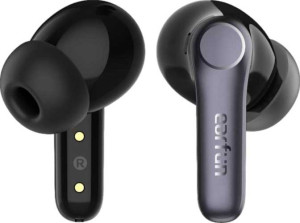
EarFun Air Pro 4 Plus

Anker Soundcore R60i EarFun Air Pro 4 Plus

Overview

Welcome to our detailed spec comparison between the Anker Soundcore R60i and the EarFun Air Pro 4 Plus — two compelling true wireless earbuds that share a strong foundation but diverge in some meaningful ways. Both offer active noise cancellation, IP55 water resistance, and LDAC support, yet they take different paths when it comes to battery performance, audio codec support, and wireless charging capabilities. Read on to see how these two earbuds stack up across every key specification.

Common Features

  • Both earbuds have an in-ear fit.
  • Both products carry an IP55 ingress protection rating.
  • Both are water resistant.
  • Neither product uses wires or cables.
  • Neither product is a neckband earbud design.
  • Wingtips are not included with either product.
  • RGB lighting is not present on either product.
  • Both products feature stereo speakers.
  • Active noise cancellation (ANC) is available on both products.
  • Passive noise reduction is present on both products.
  • Both products share a frequency range of 20 Hz to 20000 Hz.
  • Dolby Atmos support is not available on either product.
  • A neodymium magnet is not used in either product.
  • Battery life with ANC enabled is 8 hours on both products.
  • Neither product has a solar power battery.
  • A battery level indicator is present on both products.
  • Both products have a rechargeable battery.
  • Fast pairing is supported on both products.
  • Both products include a USB Type-C connection.
  • LDAC support is available on both products.
  • LDHC support is not available on either product.
  • aptX Low Latency support is not available on either product.
  • aptX HD support is not available on either product.
  • aptX support is not available on either product.
  • Both products have an audio latency of 50 ms.
  • An ambient sound mode is available on both products.
  • Fast charging is supported on both products.
  • Both products support multipoint connection with up to 2 devices.
  • Neither product can read notifications.
  • A built-in translator is available on both products.
  • A mute function is present on both products.
  • Both products can be used as a headset.
  • A control panel is placed on the device on both products.
  • A noise-canceling microphone is present on both products.

Main Differences

  • Driver unit size is 11 mm on Anker Soundcore R60i and 10 mm on EarFun Air Pro 4 Plus.
  • Spatial audio support is present on Anker Soundcore R60i but not available on EarFun Air Pro 4 Plus.
  • Battery life (without ANC) is 10 hours on Anker Soundcore R60i and 12 hours on EarFun Air Pro 4 Plus.
  • Battery life of the charging case is 40 hours on Anker Soundcore R60i and 42 hours on EarFun Air Pro 4 Plus.
  • Charge time is 2 hours on Anker Soundcore R60i and 1.5 hours on EarFun Air Pro 4 Plus.
  • Wireless charging is not available on Anker Soundcore R60i but is supported on EarFun Air Pro 4 Plus.
  • Bluetooth version is 6.1 on Anker Soundcore R60i and 6 on EarFun Air Pro 4 Plus.
  • Bluetooth LE Audio support is not available on Anker Soundcore R60i but is present on EarFun Air Pro 4 Plus.
  • aptX Adaptive support is not available on Anker Soundcore R60i but is present on EarFun Air Pro 4 Plus.
  • aptX Lossless support is not available on Anker Soundcore R60i but is present on EarFun Air Pro 4 Plus.
  • Auracast support is not available on Anker Soundcore R60i but is present on EarFun Air Pro 4 Plus.
Specs Comparison
Anker Soundcore R60i

Anker Soundcore R60i

EarFun Air Pro 4 Plus

EarFun Air Pro 4 Plus

Design:
Fit In-ear In-ear
Ingress Protection (IP) rating IP55 IP55
water resistance Water resistant Water resistant
has no wires or cables
are neckband earbuds
wingtips included
has RGB lighting
has stereo speakers
has UV light
Has a display

In terms of design, the Anker Soundcore R60i and the EarFun Air Pro 4 Plus are virtually identical across every measured attribute. Both adopt a true wireless in-ear fit, carry an IP55 ingress protection rating, and are rated as water resistant — meaning they can handle sweat and light rain but are not fully submersible. Neither includes wingtips, neckband styling, RGB lighting, a UV sanitizing light, or a display.

The IP55 rating is worth contextualizing: the first digit (5) indicates protection against dust ingress sufficient for most real-world conditions, while the second digit (5) confirms resistance to low-pressure water jets from any direction. For everyday gym use or outdoor workouts in light rain, both earbuds offer a comparable and adequate level of protection — neither holds a meaningful edge here.

With every design spec aligning perfectly between the two, this category is a complete tie. Buyers prioritizing design characteristics such as form factor, water resistance, or build extras will find no distinguishing reason to choose one over the other based solely on the data provided.

Sound quality:
has active noise cancellation (ANC)
has passive noise reduction
driver unit size 11 mm 10 mm
lowest frequency 20 Hz 20 Hz
highest frequency 20000 Hz 20000 Hz
supports spatial audio
has Dolby Atmos
has Dirac Virtuo
has a neodymium magnet

Both earbuds share a strong foundation for sound quality: each covers the full standard audible range of 20 Hz to 20,000 Hz, pairs active noise cancellation with passive noise reduction, and foregoes proprietary spatial audio processing platforms like Dolby Atmos or Dirac Virtuo. At this level, the shared ANC implementation is a meaningful inclusion — combining active and passive noise reduction delivers a layered isolation approach that outperforms passive-only designs, especially in mid-range earbuds.

The most notable hardware difference is driver size: the Anker Soundcore R60i uses an 11 mm driver versus the 10 mm unit in the EarFun Air Pro 4 Plus. A larger driver membrane can — in theory — move more air, which tends to benefit low-frequency reproduction and overall perceived fullness. However, driver size alone is not a guarantee of superior sound; tuning and implementation matter enormously. That said, based strictly on the provided specs, the R60i holds a marginal physical advantage here.

The more decisive differentiator is spatial audio support: the R60i offers it, the Air Pro 4 Plus does not. For users who consume immersive content — gaming, films, or spatially mixed music — this is a practical, real-world capability gap. Combined with the slightly larger driver, the Anker Soundcore R60i holds a clear edge in this category.

Power:
Battery life 10 hours 12 hours
Battery life of charging case 40 hours 42 hours
Battery life (ANC) 8 hours 8 hours
charge time 2 hours 1.5 hours
has wireless charging
Has a solar power battery
has a battery level indicator
has a rechargeable battery

Across most power metrics, the EarFun Air Pro 4 Plus holds a consistent lead. Its earbud battery life of 12 hours outpaces the R60i's 10 hours, and the combined case capacity of 42 hours versus 40 hours extends that advantage across multi-day use. For heavy listeners or frequent travelers, those extra hours reduce how often you're reaching for a cable — a tangible quality-of-life difference rather than a purely spec-sheet gap.

Charging speed and convenience further widen the gap. The Air Pro 4 Plus refills in 1.5 hours compared to the R60i's 2 hours, and critically, it supports wireless charging — a feature the R60i entirely lacks. Wireless charging may seem like a luxury, but for users already running a Qi pad on their desk or nightstand, the ability to drop the case down without hunting for a cable is a genuinely useful daily convenience.

The one area where both products align is ANC battery performance: each delivers 8 hours with noise cancellation active, meaning neither penalizes you more heavily than the other for using ANC. Still, across the remaining metrics — runtime, recharge speed, and charging flexibility — the EarFun Air Pro 4 Plus holds a clear and well-rounded advantage in this category.

Connectivity:
has fast pairing
Has USB Type-C
Bluetooth version 6.1 6
has LDAC
has LDHC
has Bluetooth LE Audio
has aptX Adaptive
has aptX Low Latency
has aptX HD
has aptX
has aptX Lossless
audio latency 50 ms 50 ms
has aptX Voice
has Auracast
maximum Bluetooth range 10 m 10 m
supports Bluetooth pairing using NFC
Can be used wirelessly
has AAC

On the surface, these two earbuds share a solid connectivity baseline — both offer fast pairing, USB-C, LDAC, AAC, a 50 ms audio latency figure, and an identical 10 m maximum Bluetooth range. The Anker Soundcore R60i edges ahead with Bluetooth 6.1 versus the Air Pro 4 Plus's Bluetooth 6.0, which can mean marginally improved connection stability and efficiency in congested wireless environments — though real-world differences at this version gap are subtle.

Where the gap becomes substantial is in codec and protocol support. The EarFun Air Pro 4 Plus adds aptX Adaptive, aptX Lossless, and Bluetooth LE Audio — a trio the R60i entirely lacks. aptX Adaptive dynamically scales bitrate to balance quality and latency, aptX Lossless enables CD-quality transmission over Bluetooth where supported, and LE Audio is a next-generation standard offering improved efficiency and multi-stream capabilities. Together, these codecs give the Air Pro 4 Plus significantly more flexibility with compatible source devices.

The Air Pro 4 Plus also supports Auracast, a broadcast audio feature built on LE Audio that allows one device to stream to multiple listeners simultaneously — a forward-looking capability with growing real-world applications. The R60i offers none of these. Despite its fractionally newer Bluetooth version, the EarFun Air Pro 4 Plus holds a decisive connectivity advantage, particularly for users with high-resolution audio sources or an eye toward emerging Bluetooth standards.

Features:
release date November 2025 January 2025
has ambient sound mode
Supports fast charging
multipoint count 2 2
can read notifications
Has a built-in translator
has a mute function
can be used as a headset
control panel placed on a device
Has voice prompts
travel bag is included
Has an in-line control panel
Has a temperature sensor
Has a built-in camera remote control function

Feature parity is total here — every single attribute in this group is identical between the Anker Soundcore R60i and the EarFun Air Pro 4 Plus. Both support ambient sound mode, fast charging, on-device controls, voice prompts, a mute function, and come bundled with a travel bag. Both also support 2-device multipoint pairing, which allows simultaneous connection to two sources — a phone and a laptop, for instance — without manually re-pairing when switching between them.

A few shared inclusions are worth highlighting for their practical value. The built-in translator feature positions both earbuds beyond pure audio playback, adding real-time language translation utility that can be genuinely useful for travelers or multilingual work environments. Headset capability, combined with on-device controls and a mute function, also makes both options viable for calls and video conferencing — not just music listening.

With no divergence across any feature data point, this category is an unambiguous tie. Buyers prioritizing these functional extras will find the two products perfectly matched, and the decision will need to rest on the differences surfaced in other specification groups.

Microphone:
has a noise-canceling microphone

The microphone data for this comparison is minimal but meaningful: both the Anker Soundcore R60i and the EarFun Air Pro 4 Plus include a noise-canceling microphone. For call quality in real-world environments — commutes, busy offices, or outdoor use — this is a more important baseline than a standard microphone, as it actively works to suppress background noise and keep your voice intelligible to the person on the other end.

With only a single shared data point available in this group, no differentiation can be drawn between the two products. This is a complete tie based on the provided specs, and buyers should look to other specification groups — particularly connectivity and sound quality — to inform their decision.

Comparison Summary & Verdict

After a thorough comparison, both earbuds prove to be well-rounded options with a shared set of solid fundamentals — including ANC, IP55 water resistance, LDAC, fast charging, and a 50 ms audio latency. The Anker Soundcore R60i distinguishes itself with a slightly larger 11 mm driver and spatial audio support, which may appeal to listeners who prioritize an immersive soundstage. The EarFun Air Pro 4 Plus, on the other hand, pulls ahead with a longer battery life of 12 hours, a faster 1.5-hour charge time, wireless charging, and a notably richer connectivity suite that includes aptX Adaptive, aptX Lossless, Bluetooth LE Audio, and Auracast. Buyers focused on cutting-edge audio transmission and charging convenience will find the EarFun the stronger choice, while those who value spatial audio and a marginally newer Bluetooth 6.1 standard may lean toward the Anker.

Anker Soundcore R60i
Buy Anker Soundcore R60i if...

Buy the Anker Soundcore R60i if you want spatial audio support and do not need wireless charging or advanced codecs like aptX Lossless and aptX Adaptive.

EarFun Air Pro 4 Plus
Buy EarFun Air Pro 4 Plus if...

Buy the EarFun Air Pro 4 Plus if you want longer battery life, faster charging, wireless charging, and a richer codec suite including aptX Lossless, aptX Adaptive, and Bluetooth LE Audio.