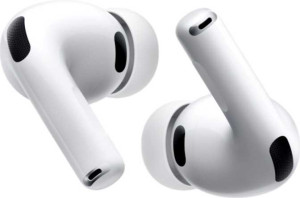
Apple AirPods Pro 3
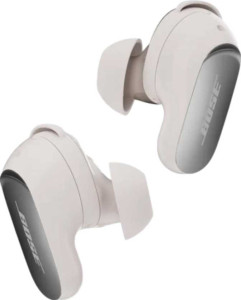
Bose QuietComfort Ultra Earbuds (2nd Gen)

Apple AirPods Pro 3 Bose QuietComfort Ultra Earbuds (2nd Gen)

Overview

When it comes to premium wireless earbuds, the Apple AirPods Pro 3 and the Bose QuietComfort Ultra Earbuds (2nd Gen) represent two of the most compelling options on the market. In this head-to-head comparison, we examine the key battlegrounds — including battery life, water resistance, spatial audio capabilities, and microphone performance — to help you determine which pair is the right fit for your lifestyle and listening needs.

Common Features

  • Both products use an in-ear fit design.
  • Neither product has wires or cables.
  • Neither product is a neckband earbud design.
  • Wingtips are not included with either product.
  • Neither product has RGB lighting.
  • Both products have stereo speakers.
  • Neither product has a UV light.
  • Neither product has a display.
  • Both products have active noise cancellation (ANC).
  • Both products have passive noise reduction.
  • The lowest frequency on both products is 20 Hz.
  • The highest frequency on both products is 20000 Hz.
  • Dirac Virtuo is not available on either product.
  • Neither product uses a neodymium magnet.
  • Both products support wireless charging.
  • Neither product has a solar power battery.
  • Both products have a battery level indicator.
  • Both products have a rechargeable battery.
  • Both products have USB Type-C.
  • Both products use Bluetooth version 5.3.
  • LDAC support is not available on either product.
  • LDHC support is not available on either product.
  • Bluetooth LE Audio is not supported on either product.
  • aptX Low Latency is not supported on either product.
  • aptX HD is not supported on either product.
  • aptX is not supported on either product.
  • Both products have an ambient sound mode.
  • Both products have a find device feature.
  • Both products support fast charging.
  • Both products have a mute function.
  • Both products can be used as a headset.
  • Both products have a control panel placed on the device.
  • Both products have voice prompts.
  • A travel bag is included with both products.
  • Both products have a noise-canceling microphone.

Main Differences

  • The Ingress Protection rating is IP57 on Apple AirPods Pro 3 and IPX4 on Bose QuietComfort Ultra Earbuds (2nd Gen).
  • Apple AirPods Pro 3 is waterproof, while Bose QuietComfort Ultra Earbuds (2nd Gen) is only sweat resistant.
  • The weight is 10.1 g on Apple AirPods Pro 3 and 15.4 g on Bose QuietComfort Ultra Earbuds (2nd Gen).
  • The driver unit size is 10.7 mm on Apple AirPods Pro 3 and 9.3 mm on Bose QuietComfort Ultra Earbuds (2nd Gen).
  • Spatial audio support is present on Apple AirPods Pro 3 but not available on Bose QuietComfort Ultra Earbuds (2nd Gen).
  • Dolby Atmos support is present on Apple AirPods Pro 3 but not available on Bose QuietComfort Ultra Earbuds (2nd Gen).
  • Battery life is 10 hours on Apple AirPods Pro 3 and 6 hours on Bose QuietComfort Ultra Earbuds (2nd Gen).
  • Battery life of the charging case is 20 hours on Apple AirPods Pro 3 and 18 hours on Bose QuietComfort Ultra Earbuds (2nd Gen).
  • Charge time is 1.5 hours on Apple AirPods Pro 3 and 1 hour on Bose QuietComfort Ultra Earbuds (2nd Gen).
  • Fast pairing is available on Apple AirPods Pro 3 but not on Bose QuietComfort Ultra Earbuds (2nd Gen).
  • aptX Adaptive support is present on Bose QuietComfort Ultra Earbuds (2nd Gen) but not available on Apple AirPods Pro 3.
  • Notification reading is supported on Apple AirPods Pro 3 but not on Bose QuietComfort Ultra Earbuds (2nd Gen).
  • A built-in translator is present on Apple AirPods Pro 3 but not on Bose QuietComfort Ultra Earbuds (2nd Gen).
  • A temperature sensor is present on Apple AirPods Pro 3 but not on Bose QuietComfort Ultra Earbuds (2nd Gen).
  • A built-in camera remote control function is available on Apple AirPods Pro 3 but not on Bose QuietComfort Ultra Earbuds (2nd Gen).
  • The number of microphones is 4 on Apple AirPods Pro 3 and 8 on Bose QuietComfort Ultra Earbuds (2nd Gen).
Specs Comparison
Apple AirPods Pro 3

Apple AirPods Pro 3

Bose QuietComfort Ultra Earbuds (2nd Gen)

Bose QuietComfort Ultra Earbuds (2nd Gen)

Design:
Fit In-ear In-ear
Ingress Protection (IP) rating IP57 IPX4
water resistance Waterproof Sweat resistant
weight 10.1 g 15.4 g
has no wires or cables
are neckband earbuds
wingtips included
has RGB lighting
has stereo speakers
has UV light
Has a display

Both the Apple AirPods Pro 3 and the Bose QuietComfort Ultra Earbuds (2nd Gen) share the same fundamental design philosophy: fully wireless, in-ear earbuds with no neckband, no wingtips, and no gimmicks like RGB lighting or displays. For users, this means a clean, minimal form factor on both sides. The real differences emerge when you look past the surface.

The most significant differentiator is protection. The AirPods Pro 3 carry an IP57 rating, meaning they are tested against both dust ingress and submersion in up to 1 meter of water — earning a ″Waterproof″ classification. The QuietComfort Ultra Earbuds carry only an IPX4 rating, which covers splash and sweat resistance but offers no dust protection and no submersion tolerance. For casual gym use, IPX4 is adequate, but for outdoor activity, rain, or accidental drops in water, the AirPods Pro 3 provide meaningfully stronger real-world durability.

Weight is the second key gap: the AirPods Pro 3 weigh 10.1 g versus 15.4 g for the Bose — a 52% difference. Over extended listening sessions, lighter earbuds reduce ear fatigue noticeably. On design, the AirPods Pro 3 hold a clear edge: they are lighter and substantially better protected against the elements.

Sound quality:
has active noise cancellation (ANC)
has passive noise reduction
driver unit size 10.7 mm 9.3 mm
lowest frequency 20 Hz 20 Hz
highest frequency 20000 Hz 20000 Hz
supports spatial audio
has Dolby Atmos
has Dirac Virtuo
has a neodymium magnet

At the foundational level, these two earbuds share quite a bit: both cover the full standard audible range of 20 Hz – 20,000 Hz, and both combine active noise cancellation with passive noise reduction for a layered approach to isolation. Neither relies on a neodymium magnet or Dirac Virtuo processing, so those factors don't differentiate them here.

Where they diverge is driver size and spatial audio capability. The AirPods Pro 3 use a 10.7 mm driver versus the Bose QuietComfort Ultra Earbuds' 9.3 mm unit — a larger driver generally has more physical surface area to move air, which can translate to more dynamic low-end response, though driver size alone is not a guarantee of superior sound. More decisive is the spatial audio picture: the AirPods Pro 3 support both spatial audio and Dolby Atmos, enabling a three-dimensional soundstage that is especially impactful for supported music, movies, and games. The Bose earbuds offer neither, meaning the listening experience remains in conventional stereo regardless of the content.

For users who consume Dolby Atmos content or value immersive, head-tracked audio, the AirPods Pro 3 hold a clear and meaningful edge in this group. The Bose QuietComfort Ultra Earbuds are competitive on raw frequency coverage and noise isolation, but the absence of spatial audio is a significant omission for modern multimedia listening.

Power:
Battery life 10 hours 6 hours
Battery life of charging case 20 hours 18 hours
charge time 1.5 hours 1 hours
has wireless charging
Has a solar power battery
has a battery level indicator
has a rechargeable battery

Battery life is where the AirPods Pro 3 pull ahead most decisively in this group. At 10 hours per charge versus 6 hours for the Bose QuietComfort Ultra Earbuds, the AirPods Pro 3 last nearly 67% longer in a single session — a gap that matters enormously for long-haul flights, full workdays, or extended outdoor use where reaching for the case isn't always convenient.

The case-combined totals tell a similar story: 30 hours total for the AirPods Pro 3 (10 + 20) versus 24 hours for the Bose (6 + 18). The Bose case partially compensates by offering a faster 1-hour full charge time compared to 1.5 hours for the AirPods Pro 3, which is a minor but genuine advantage for users who are frequently topping up. Both support wireless charging, so neither has an edge on charging flexibility.

On balance, the AirPods Pro 3 win this category clearly. The Bose earbuds charge faster, but that advantage is largely a concession to their shorter battery life — users will simply need to charge them more often. For power users who prioritize fewer interruptions, the AirPods Pro 3 are the stronger choice here.

Connectivity:
has fast pairing
Has USB Type-C
Bluetooth version 5.3 5.3
has LDAC
has LDHC
has Bluetooth LE Audio
has aptX Adaptive
has aptX Low Latency
has aptX HD
has aptX
has aptX Lossless
has aptX Voice
has Auracast
maximum Bluetooth range 10 m 10 m
supports Bluetooth pairing using NFC
Can be used wirelessly
has AAC

The connectivity foundations are well-matched: both earbuds run on Bluetooth 5.3, share the same 10 m maximum range, include USB-C, and support AAC as their common high-quality audio codec. Neither offers NFC pairing, LDAC, or Bluetooth LE Audio, so those are non-factors in this comparison.

The two meaningful splits come down to codec support and pairing convenience. The Bose QuietComfort Ultra Earbuds add aptX Adaptive — a codec that dynamically scales bitrate up to 96 kHz and prioritizes low latency, which benefits Android users pairing with compatible devices for higher-resolution wireless audio. The AirPods Pro 3 skip aptX entirely (as is typical for Apple hardware), but counter with fast pairing, enabling quicker, more seamless device connections — a practical quality-of-life advantage for users frequently switching between paired devices.

Which edge matters more depends entirely on your ecosystem. For Android users with aptX Adaptive-compatible devices, the Bose earbuds offer a tangible audio quality and latency upgrade over AAC alone. For Apple ecosystem users, fast pairing is the more relevant daily-use feature, and the lack of aptX is irrelevant. Taken purely on the specs provided, this group is essentially a trade-off with no universal winner — each product's advantage aligns with a different user profile.

Features:
release date September 2025 August 2025
has ambient sound mode
has find device feature
Supports fast charging
can read notifications
Has a built-in translator
has a mute function
can be used as a headset
control panel placed on a device
Has voice prompts
travel bag is included
Has an in-line control panel
Has a temperature sensor
Has a built-in camera remote control function

The shared feature set is solid across both earbuds: ambient sound mode, find device, fast charging, mute, headset capability, on-device controls, voice prompts, and an included travel bag are all present on both. For most everyday use cases, neither product leaves users wanting for the basics.

The AirPods Pro 3, however, stack up a notable list of exclusive capabilities. Notification readout lets the earbuds announce incoming alerts hands-free — useful while driving or exercising. The built-in translator enables real-time language translation directly through the earbuds, a genuinely practical feature for travelers. A temperature sensor adds a health-monitoring dimension absent from the Bose. Perhaps most distinctive is the camera remote control function, which allows users to trigger a paired device's camera shutter — a convenience feature that speaks to deeper ecosystem integration. The Bose QuietComfort Ultra Earbuds offer none of these four features.

This group is not close. The AirPods Pro 3 deliver a meaningfully broader feature set, with each exclusive addition offering real-world utility rather than spec-sheet padding. Users who value smart device integration and hands-free convenience will find the AirPods Pro 3 the clear winner here.

Microphone:
number of microphones 4 8
has a noise-canceling microphone

Microphone hardware is sparse on specs here, but the one number that stands out is meaningful: the Bose QuietComfort Ultra Earbuds pack 8 microphones compared to 4 on the AirPods Pro 3. Both implement noise-canceling microphone processing, so the question is what doubling the mic count actually buys in practice.

More microphones allow for more sophisticated beamforming — the technique earbuds use to isolate your voice from surrounding noise by triangulating sound from multiple pickup points. With 8 mics distributed across both earbuds, the Bose system has more spatial data to work with when filtering out wind, crowd noise, or ambient environments during calls. This is particularly relevant for users who frequently take calls in noisy settings like commutes, open offices, or outdoor environments.

Based strictly on the provided specs, the Bose QuietComfort Ultra Earbuds hold the edge in this group. The shared noise-canceling capability is table stakes, but the raw microphone count gives the Bose a structural advantage in voice capture fidelity — especially in challenging acoustic environments.

Comparison Summary & Verdict

After reviewing every specification, each earbud earns its place for a different type of user. The Apple AirPods Pro 3 stands out with a superior IP57 waterproof rating, a lighter 10.1 g build, significantly longer 10-hour battery life, spatial audio with Dolby Atmos, fast pairing, a built-in translator, and a temperature sensor — making it the stronger all-rounder for Apple ecosystem users who want feature richness and durability. The Bose QuietComfort Ultra Earbuds (2nd Gen), on the other hand, counters with an impressive 8-microphone array for superior call clarity, aptX Adaptive codec support for higher-quality Bluetooth audio, and a faster 1-hour charge time. If crystal-clear calls and audio codec flexibility are your top priorities, Bose delivers. But for those who want a lighter, more feature-packed earbud with better stamina and robust water protection, the AirPods Pro 3 takes the edge.

Apple AirPods Pro 3
Buy Apple AirPods Pro 3 if...

Buy the Apple AirPods Pro 3 if you want superior waterproofing, longer battery life, spatial audio with Dolby Atmos, and a broader set of smart features like a built-in translator and temperature sensor.

Bose QuietComfort Ultra Earbuds (2nd Gen)
Buy Bose QuietComfort Ultra Earbuds (2nd Gen) if...

Buy the Bose QuietComfort Ultra Earbuds (2nd Gen) if you prioritize a larger 8-microphone setup for clearer calls, aptX Adaptive audio codec support, and a faster 1-hour charge time.