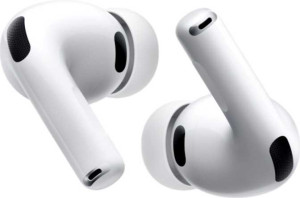
Apple AirPods Pro 3
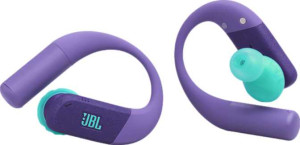
JBL Endurance Peak 4

Apple AirPods Pro 3 JBL Endurance Peak 4

Overview

Welcome to our detailed spec comparison between the Apple AirPods Pro 3 and the JBL Endurance Peak 4. These two true wireless earbuds share a solid foundation — including active noise cancellation, spatial audio, and fast charging — but diverge in meaningful ways across battery endurance, smart features, and water resistance ratings. Whether you value a lighter design packed with intelligent extras or a rugged, long-lasting companion for intense activity, this comparison will help you find your match.

Common Features

  • Both products use an in-ear fit.
  • Both products are waterproof.
  • Both products are fully wireless with no wires or cables.
  • Neither product is a neckband earbud design.
  • Neither product features RGB lighting.
  • Both products have stereo speakers.
  • Neither product includes a UV light.
  • Neither product has a built-in display.
  • Both products support active noise cancellation (ANC).
  • Both products provide passive noise reduction.
  • The lowest frequency on both products is 20 Hz.
  • The highest frequency on both products is 20000 Hz.
  • Both products support spatial audio.
  • Neither product uses a neodymium magnet.
  • Battery life with ANC enabled is 8 hours on both products.
  • Neither product has a solar power battery.
  • Both products include a battery level indicator.
  • Both products have a rechargeable battery.
  • Both products support fast pairing.
  • Both products feature a USB Type-C connection.
  • Neither product supports LDAC, LDHC, Bluetooth LE Audio, aptX Adaptive, aptX Low Latency, or aptX HD.
  • Both products include an ambient sound mode.
  • Both products have a find device feature.
  • Both products support fast charging.
  • Both products have a mute function.
  • Both products can be used as a headset.
  • Both products have a control panel placed on the device.
  • Both products offer voice prompts.
  • A travel bag is included with both products.
  • Both products have a noise-canceling microphone.

Main Differences

  • The Ingress Protection rating is IP57 on Apple AirPods Pro 3 and IP68 on JBL Endurance Peak 4.
  • The weight is 10.1 g on Apple AirPods Pro 3 and 21 g on JBL Endurance Peak 4.
  • Wingtips are included with JBL Endurance Peak 4 but not with Apple AirPods Pro 3.
  • The driver unit size is 10.7 mm on Apple AirPods Pro 3 and 10 mm on JBL Endurance Peak 4.
  • Dolby Atmos support is present on Apple AirPods Pro 3 but not available on JBL Endurance Peak 4.
  • The sound pressure level is 110 dB/mW on Apple AirPods Pro 3 and 108 dB/mW on JBL Endurance Peak 4.
  • Battery life is 10 hours on Apple AirPods Pro 3 and 12 hours on JBL Endurance Peak 4.
  • The battery life of the charging case is 20 hours on Apple AirPods Pro 3 and 36 hours on JBL Endurance Peak 4.
  • Charge time is 1.5 hours on Apple AirPods Pro 3 and 2 hours on JBL Endurance Peak 4.
  • Wireless charging is supported on Apple AirPods Pro 3 but not available on JBL Endurance Peak 4.
  • The Bluetooth version is 5.3 on Apple AirPods Pro 3 and 5.4 on JBL Endurance Peak 4.
  • AAC support is present on Apple AirPods Pro 3 but not available on JBL Endurance Peak 4.
  • The ability to read notifications is available on Apple AirPods Pro 3 but not on JBL Endurance Peak 4.
  • A built-in translator is present on Apple AirPods Pro 3 but not available on JBL Endurance Peak 4.
  • A temperature sensor is included on Apple AirPods Pro 3 but not on JBL Endurance Peak 4.
  • A built-in camera remote control function is available on Apple AirPods Pro 3 but not on JBL Endurance Peak 4.
  • The number of microphones is 4 on Apple AirPods Pro 3 and 6 on JBL Endurance Peak 4.
Specs Comparison
Apple AirPods Pro 3

Apple AirPods Pro 3

JBL Endurance Peak 4

JBL Endurance Peak 4

Design:
Fit In-ear In-ear
Ingress Protection (IP) rating IP57 IP68
water resistance Waterproof Waterproof
weight 10.1 g 21 g
has no wires or cables
are neckband earbuds
wingtips included
has RGB lighting
has stereo speakers
has UV light
Has a display

Both the Apple AirPods Pro 3 and the JBL Endurance Peak 4 share the same fundamental design philosophy: fully wireless, in-ear earbuds with no neckband, stereo playback, and no gimmicks like RGB lighting or displays. For most users, these shared traits confirm both are practical, modern true-wireless earbuds built for everyday use.

The most meaningful differences emerge in protection and weight. On durability, the JBL holds a clear edge with an IP68 rating versus the AirPods Pro 3's IP57 — in practice, IP68 means the JBL can withstand continuous submersion beyond 1 meter, making it more suitable for heavy sweating, rain, or accidental drops in water. The AirPods Pro 3's IP57 is still solid waterproofing, but it is rated for a shallower submersion threshold. On weight, however, the AirPods Pro 3 wins decisively at 10.1 g compared to the JBL's 21 g — that is more than double the mass. Over long listening sessions, this difference is felt in ear fatigue and comfort. The JBL also includes wingtips, which can improve stability during workouts, partially compensating for its heavier build.

In this group, neither product dominates outright. The JBL Endurance Peak 4 has the edge for water and sweat resistance and workout-focused fit security, while the AirPods Pro 3 wins on lightweight comfort for extended wear. Your priority — protection versus all-day comfort — should drive the decision here.

Sound quality:
has active noise cancellation (ANC)
has passive noise reduction
driver unit size 10.7 mm 10 mm
lowest frequency 20 Hz 20 Hz
highest frequency 20000 Hz 20000 Hz
supports spatial audio
has Dolby Atmos
has Dirac Virtuo
sound pressure level 110 dB/mW 108 dB/mW
has a neodymium magnet

At the foundation, both earbuds cover the full standard audible range of 20 Hz to 20,000 Hz, offer active and passive noise cancellation, and support spatial audio — so neither is lacking in the basics. The driver size difference (10.7 mm on the AirPods Pro 3 versus 10 mm on the JBL) is modest, but a slightly larger driver generally moves more air, which can translate to fuller low-end response and more dynamic headroom, giving the AirPods a marginal physical edge in raw driver capability.

Where the gap becomes more meaningful is in loudness and ecosystem features. The AirPods Pro 3 registers 110 dB/mW against the JBL's 108 dB/mW — a 2 dB difference that, while not dramatic, does mean the Apple earbuds can reach perceptibly higher peak volumes, which matters in loud environments. More significantly, the AirPods Pro 3 support Dolby Atmos, adding a certified three-dimensional audio layer on top of spatial audio. The JBL offers spatial audio but without Dolby Atmos, meaning its surround-sound experience is less standardized and potentially less immersive depending on the content.

The AirPods Pro 3 hold a clear advantage in this group. The combination of a larger driver, higher sound pressure level, and exclusive Dolby Atmos support tips the balance toward a richer, louder, and more cinematic listening experience — particularly for users who consume a lot of streaming content or movies that leverage Atmos mixes.

Power:
Battery life 10 hours 12 hours
Battery life of charging case 20 hours 36 hours
Battery life (ANC) 8 hours 8 hours
charge time 1.5 hours 2 hours
has wireless charging
Has a solar power battery
has a battery level indicator
has a rechargeable battery

Raw endurance is where the JBL Endurance Peak 4 pulls ahead most convincingly. Its earbuds last 12 hours per charge compared to 10 hours for the AirPods Pro 3 — a 20% advantage that makes a real difference for long travel days or extended workout sessions. The case gap is even wider: JBL's charging case delivers an additional 36 hours of backup power versus just 20 hours for Apple's case, giving the JBL a combined total of 48 hours compared to 30 hours. For users who frequently go days without access to a wall outlet, this is a substantial real-world advantage.

Once ANC is switched on, both earbuds converge at 8 hours of battery life, which tells an interesting story — the AirPods Pro 3 lose less runtime to ANC (2 hours) than the JBL (4 hours), suggesting Apple's ANC implementation is more power-efficient relative to its baseline. On recharging, the AirPods Pro 3 refill in 1.5 hours versus 2 hours for the JBL, and they also support wireless charging, which the JBL entirely lacks — a genuine convenience edge for users embedded in a Qi charging ecosystem.

The verdict depends on use case. The JBL Endurance Peak 4 wins on total battery capacity by a wide margin, making it the better pick for heavy, continuous use away from power sources. The AirPods Pro 3 counter with faster wired charging and wireless charging support, favouring users who prioritise quick top-ups and cable-free convenience over outright stamina.

Connectivity:
has fast pairing
Has USB Type-C
Bluetooth version 5.3 5.4
has LDAC
has LDHC
has Bluetooth LE Audio
has aptX Adaptive
has aptX Low Latency
has aptX HD
has aptX
has aptX Lossless
has aptX Voice
has Auracast
maximum Bluetooth range 10 m 10 m
supports Bluetooth pairing using NFC
Can be used wirelessly
has AAC

Connectivity between these two is remarkably similar on the surface — both offer fast pairing, USB-C, a maximum range of 10 m, and neither supports advanced codecs like LDAC, aptX, or Bluetooth LE Audio. The JBL Endurance Peak 4 runs on the marginally newer Bluetooth 5.4 versus 5.3 on the AirPods Pro 3, but in practice this version gap is negligible for everyday use; both deliver stable, low-latency wireless connections at equivalent real-world ranges.

The one meaningful differentiator is codec support. The AirPods Pro 3 support AAC, while the JBL does not list any advanced codec beyond standard SBC. AAC matters primarily for Apple device users, where it enables higher-quality wireless audio transmission compared to the baseline SBC codec. For Android users or those outside the Apple ecosystem, AAC's benefits diminish significantly, so the relevance of this advantage is audience-dependent.

Overall, connectivity is nearly a wash. The AirPods Pro 3 hold a narrow, ecosystem-specific edge thanks to AAC support, which benefits iPhone users in particular. For everyone else, the two products are functionally equivalent in this category, with no standout advantages on either side.

Features:
release date September 2025 September 2025
has ambient sound mode
has find device feature
Supports fast charging
can read notifications
Has a built-in translator
has a mute function
can be used as a headset
control panel placed on a device
Has voice prompts
travel bag is included
Has an in-line control panel
Has a temperature sensor
Has a built-in camera remote control function

The shared feature set between these two is already strong — both offer ambient sound mode, find-device functionality, fast charging, mute, on-device controls, voice prompts, and a travel bag. For most users, this common ground covers the everyday essentials comfortably. The divergence, however, is significant and clearly tilts in one direction.

The AirPods Pro 3 carry three exclusive features absent from the JBL: a built-in translator, notification reading, and a temperature sensor, plus a camera remote control function. The translator and notification reading are productivity-oriented, reducing the need to pull out a phone during calls, travel, or meetings. The temperature sensor adds a health-adjacent utility layer. The camera remote is a niche but genuinely convenient perk for photographers and content creators. None of these are mission-critical for audio performance, but collectively they represent a meaningfully richer feature ecosystem.

The AirPods Pro 3 win this category decisively. The JBL Endurance Peak 4 holds its own on the fundamentals, but the Apple earbuds pack considerably more smart functionality — making them a stronger choice for users who want their earbuds to serve as an extension of their device rather than a standalone audio accessory.

Microphone:
number of microphones 4 6
has a noise-canceling microphone

Microphone specs here are lean but telling. Both earbuds feature noise-canceling microphones, ensuring call quality is at least baseline-protected against ambient noise in either case. The key distinction is quantity: the JBL Endurance Peak 4 deploys 6 microphones compared to 4 on the AirPods Pro 3.

More microphones generally enable more sophisticated beamforming — the process of isolating the speaker's voice while suppressing surrounding noise from multiple directions. With two additional pickup points, the JBL has greater potential for accurate voice capture and wind noise rejection, which is particularly relevant during outdoor workouts or commutes where environmental noise is dynamic and unpredictable.

On paper, the JBL Endurance Peak 4 holds the edge in this category purely by microphone count. That said, the provided data covers only quantity and noise-canceling presence — not microphone placement, signal processing quality, or algorithm sophistication, all of which heavily influence real-world call performance. The JBL's 6-microphone array is a structural advantage, but the margin should be interpreted as a potential lead rather than a guaranteed one.

Comparison Summary & Verdict

After examining every specification, both earbuds prove themselves capable options, but they clearly serve different listeners. The Apple AirPods Pro 3 stands out for its lighter 10.1 g build, Dolby Atmos and AAC support, wireless charging, and an impressive suite of smart features including a built-in translator, temperature sensor, notification reading, and camera remote — making it the better choice for Apple ecosystem users who want a feature-rich, everyday companion. The JBL Endurance Peak 4, on the other hand, wins on endurance and durability, offering a superior IP68 rating, a massive 36-hour case battery life, 12 hours of playback, and 6 microphones — advantages that make it the more compelling pick for athletes and outdoor users who demand long-lasting, weather-resistant performance above all else.

Apple AirPods Pro 3
Buy Apple AirPods Pro 3 if...

Buy the Apple AirPods Pro 3 if you want a lightweight earbud loaded with smart features like a built-in translator, temperature sensor, Dolby Atmos, wireless charging, and seamless integration with the Apple ecosystem.

JBL Endurance Peak 4
Buy JBL Endurance Peak 4 if...

Buy the JBL Endurance Peak 4 if you prioritize rugged durability with an IP68 rating, a longer 12-hour battery life, and an impressive 36-hour charging case for extended use during sports and outdoor activities.