Apple AirPods Pro 3
Raycon Essential Open Earbuds

Apple AirPods Pro 3 Raycon Essential Open Earbuds

Overview

When choosing between the Apple AirPods Pro 3 and the Raycon Essential Open Earbuds, you are looking at two very different philosophies in wireless audio. This comparison examines their distinct approaches to fit and noise isolation, sound enhancement technologies, battery performance, and smart features to help you decide which earbud truly matches your lifestyle and listening needs.

Common Features

  • Both products are wireless with no wires or cables.
  • Neither product is a neckband earbud design.
  • Neither product features RGB lighting.
  • Both products have stereo speakers.
  • Neither product includes a UV light.
  • Neither product has a display.
  • Both products share a lowest frequency of 20 Hz and a highest frequency of 20000 Hz.
  • Neither product uses a neodymium magnet.
  • Neither product supports Dirac Virtuo.
  • Both products support wireless charging.
  • Neither product has a solar power battery.
  • Both products have a battery level indicator.
  • Both products have a rechargeable battery.
  • Both products have USB Type-C connectivity.
  • Neither product supports LDAC, LDHC, Bluetooth LE Audio, aptX Adaptive, aptX Low Latency, aptX HD, or aptX.
  • Both products support fast charging.
  • Both products have a mute function.
  • Both products can be used as a headset.
  • Both products have a control panel placed on the device.
  • Both products have voice prompts, a travel bag included, and a noise-canceling microphone.
  • Neither product has an in-line control panel.

Main Differences

  • The fit style is in-ear on Apple AirPods Pro 3 and open-ear on Raycon Essential Open Earbuds.
  • The Ingress Protection rating is IP57 on Apple AirPods Pro 3 and IPX4 on Raycon Essential Open Earbuds.
  • Apple AirPods Pro 3 are waterproof, while Raycon Essential Open Earbuds are only sweat resistant.
  • Wingtips are included with Raycon Essential Open Earbuds but not with Apple AirPods Pro 3.
  • Active noise cancellation (ANC) is available on Apple AirPods Pro 3 but not on Raycon Essential Open Earbuds.
  • Passive noise reduction is present on Apple AirPods Pro 3 but not on Raycon Essential Open Earbuds.
  • Spatial audio is supported on Apple AirPods Pro 3 but not on Raycon Essential Open Earbuds.
  • Dolby Atmos is supported on Apple AirPods Pro 3 but not on Raycon Essential Open Earbuds.
  • The sound pressure level is 110 dB/mW on Apple AirPods Pro 3 and 100 dB/mW on Raycon Essential Open Earbuds.
  • Battery life is 10 hours on Apple AirPods Pro 3 and 8 hours on Raycon Essential Open Earbuds.
  • The battery life of the charging case is 20 hours on Apple AirPods Pro 3 and 24 hours on Raycon Essential Open Earbuds.
  • Charge time is 1.5 hours on Apple AirPods Pro 3 and 1 hour on Raycon Essential Open Earbuds.
  • Fast pairing is available on Apple AirPods Pro 3 but not on Raycon Essential Open Earbuds.
  • The Bluetooth version is 5.3 on Apple AirPods Pro 3 and 6 on Raycon Essential Open Earbuds.
  • AAC codec support is present on Apple AirPods Pro 3 but not on Raycon Essential Open Earbuds.
  • Ambient sound mode is available on Apple AirPods Pro 3 but not on Raycon Essential Open Earbuds.
  • In/on-ear detection is featured on Apple AirPods Pro 3 but not on Raycon Essential Open Earbuds.
  • A find device feature is available on Apple AirPods Pro 3 but not on Raycon Essential Open Earbuds.
  • The ability to read notifications is present on Apple AirPods Pro 3 but not on Raycon Essential Open Earbuds.
  • A built-in translator is available on Apple AirPods Pro 3 but not on Raycon Essential Open Earbuds.
  • A temperature sensor is included in Apple AirPods Pro 3 but not in Raycon Essential Open Earbuds.
  • A built-in camera remote control function is present on Apple AirPods Pro 3 but not on Raycon Essential Open Earbuds.
Specs Comparison
Apple AirPods Pro 3

Apple AirPods Pro 3

Raycon Essential Open Earbuds

Raycon Essential Open Earbuds

Design:
Fit In-ear Open-ear
Ingress Protection (IP) rating IP57 IPX4
water resistance Waterproof Sweat resistant
has no wires or cables
are neckband earbuds
wingtips included
has RGB lighting
has stereo speakers
has UV light
Has a display

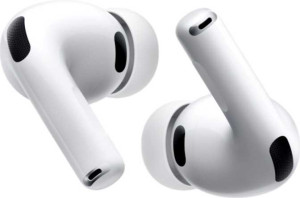
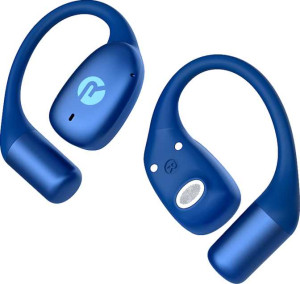
The most fundamental design divide here is the fit style: the AirPods Pro 3 uses an in-ear design with a silicone tip that seals inside the ear canal, while the Raycon Essential Open Earbuds sit open-ear, resting outside the canal entirely. This is not a minor ergonomic detail — it shapes the entire listening experience. In-ear designs typically deliver better passive noise isolation and stronger bass response, but can cause fatigue during extended wear. Open-ear designs sacrifice isolation in favor of situational awareness and all-day comfort, making them a compelling choice for outdoor activities or users who need to stay alert to their surroundings. The Raycon includes wingtips to compensate for the inherent fit challenge of an open-ear form factor, helping anchor the buds during movement.

On durability, the gap is significant. The AirPods Pro 3 carries an IP57 rating, meaning it is certified to withstand immersion in up to 1 meter of fresh water for 30 minutes — qualifying as genuinely waterproof. The Raycon Essential manages only IPX4, which covers splashes and sweat from multiple directions but offers no protection against submersion. For gym use or light rain, both are adequate; but for swimming, water sports, or heavy rain exposure, only the AirPods Pro 3 holds up.

Both earbuds are fully wireless, neither uses a neckband, and both offer stereo audio — so on those fronts they are evenly matched. Overall, the AirPods Pro 3 holds a clear design edge in terms of weather resilience. However, users who prioritize ambient awareness and extended comfort over isolation should weigh the open-ear form of the Raycon seriously, as that architectural choice reflects an intentionally different use-case philosophy rather than a compromise.

Sound quality:
has active noise cancellation (ANC)
has passive noise reduction
lowest frequency 20 Hz 20 Hz
highest frequency 20000 Hz 20000 Hz
supports spatial audio
has Dolby Atmos
has Dirac Virtuo
sound pressure level 110 dB/mW 100 dB/mW
has a neodymium magnet

Noise management is where these two products diverge most sharply. The AirPods Pro 3 combines active noise cancellation (ANC) with passive noise reduction — a dual-layer approach that electronically suppresses ambient sound while the in-ear seal physically blocks it. The Raycon Essential Open Earbuds offer neither, which is consistent with their open-ear design philosophy but means users are fully exposed to their environment at all times. For commuters, office workers, or anyone seeking immersive listening, this is a decisive gap.

Both earbuds share an identical frequency range of 20 Hz to 20,000 Hz, covering the full spectrum of human hearing on paper. However, the AirPods Pro 3 registers a sound pressure level of 110 dB/mW versus the Raycon's 100 dB/mW — a 10 dB difference that translates to roughly double the perceived loudness at the same power input. In practice, this gives the AirPods Pro 3 more headroom at high volumes and a stronger dynamic range. Beyond that, support for spatial audio and Dolby Atmos on the AirPods Pro 3 enables three-dimensional soundstage rendering for compatible content — a feature the Raycon entirely lacks.

Across every meaningful sound quality metric in this data set, the AirPods Pro 3 holds a commanding advantage. The Raycon Essential competes on equal footing only in raw frequency range, and even there the lack of noise isolation means real-world perceived audio quality will be heavily influenced by ambient noise. Users who prioritize audio fidelity, immersion, and versatility across content types will find the AirPods Pro 3 to be in a clearly different class.

Power:
Battery life 10 hours 8 hours
Battery life of charging case 20 hours 24 hours
charge time 1.5 hours 1 hours
has wireless charging
Has a solar power battery
has a battery level indicator
has a rechargeable battery

Per-session battery life leans in favor of the AirPods Pro 3, which lasts 10 hours on a single charge compared to the Raycon Essential's 8 hours. That 2-hour gap is meaningful for long-haul travelers or all-day listeners who want to avoid mid-session interruptions. Flip the lens to the charging case, however, and the Raycon pulls ahead — its case contributes an additional 24 hours of total backup versus the AirPods Pro 3's 20 hours. So while the AirPods Pro 3 goes longer between earbud charges, the Raycon ecosystem holds more total reserve energy across multiple recharges.

Charge time is another area where the Raycon has a practical edge: it refills in 1 hour flat, versus 1.5 hours for the AirPods Pro 3. For users who frequently top up during a commute or lunch break, faster charging reduces friction noticeably. Both products support wireless charging and include a battery level indicator, so neither has an advantage on convenience features.

Overall, this category is genuinely close, with each product winning on a different dimension. The AirPods Pro 3 is the better choice for users who prioritize longer continuous playtime per session, while the Raycon Essential edges ahead on total system endurance and faster recharging. Users who tend to charge their case nightly and listen in long uninterrupted stretches will favor the AirPods Pro 3; those who charge opportunistically throughout the day may find the Raycon's profile more practical.

Connectivity:
has fast pairing
Has USB Type-C
Bluetooth version 5.3 6
has LDAC
has LDHC
has Bluetooth LE Audio
has aptX Adaptive
has aptX Low Latency
has aptX HD
has aptX
has aptX Lossless
has aptX Voice
has Auracast
maximum Bluetooth range 10 m 10 m
supports Bluetooth pairing using NFC
Can be used wirelessly
has AAC

The Raycon Essential Open Earbuds carry the newer Bluetooth 6 standard compared to the AirPods Pro 3's Bluetooth 5.3. In principle, a higher Bluetooth version can bring improvements in connection stability, power efficiency, and latency. That said, the real-world benefit depends heavily on whether the paired device also supports the newer standard — and both earbuds share the same 10 m maximum range, so users should not expect a dramatic practical difference in day-to-day wireless performance.

Codec support is where the AirPods Pro 3 recovers ground. It includes AAC, which is Apple's preferred high-quality audio codec and delivers meaningfully better audio fidelity over Bluetooth when paired with iPhones, iPads, and Macs compared to standard SBC. The Raycon Essential lists no advanced codec support, defaulting to SBC — the baseline Bluetooth audio codec. For Apple ecosystem users in particular, the absence of AAC on the Raycon is a tangible audio quality disadvantage in wireless transmission. The AirPods Pro 3 also supports fast pairing, streamlining the initial connection experience, while the Raycon does not.

Neither product supports aptX variants, LDAC, NFC pairing, or Bluetooth LE Audio, so those are non-factors. Taken together, the AirPods Pro 3 holds the connectivity edge for Apple users thanks to AAC and fast pairing, while the Raycon's Bluetooth 6 is a forward-looking specification that currently offers limited practical uplift. The AirPods Pro 3 wins this category on real-world usability, particularly within the Apple ecosystem.
Features:
release date September 2025 September 2025
has ambient sound mode
has in/on-ear detection
has find device feature
Supports fast charging
can read notifications
Has a built-in translator
has a mute function
can be used as a headset
control panel placed on a device
Has voice prompts
travel bag is included
Has an in-line control panel
Has a temperature sensor
Has a built-in camera remote control function

The feature gap between these two products is substantial. The AirPods Pro 3 brings a dense set of intelligent capabilities that the Raycon Essential simply does not match. Ambient sound mode lets users pipe in environmental audio without removing the earbuds — particularly valuable for runners, cyclists, or anyone navigating busy environments. In/on-ear detection automatically pauses playback when an earbud is removed, a small but frequently appreciated convenience. The find device feature adds a meaningful safety net for users prone to misplacing their earbuds. And notification reading allows the earbuds to audibly relay incoming alerts, keeping the phone in the pocket more often.

Two AirPods Pro 3 features stand out as especially distinctive. A built-in translator enables real-time language translation directly through the earbuds — a genuinely useful tool for travelers or multilingual environments. The temperature sensor extends the device's utility beyond pure audio into basic health and environmental monitoring. A camera remote control function rounds out a feature set that positions these earbuds as a broader personal technology accessory rather than a single-purpose audio device.

The Raycon Essential holds its own on the basics — fast charging, mute function, headset capability, voice prompts, and an included travel bag are all present on both products. But beyond that shared foundation, the Raycon offers nothing that the AirPods Pro 3 does not also provide. The AirPods Pro 3 wins this category decisively, with a feature set that is broader in scope and meaningfully more useful in daily life across a wide range of use cases.

Microphone:
has a noise-canceling microphone

Both the AirPods Pro 3 and the Raycon Essential Open Earbuds include a noise-canceling microphone, ensuring that call quality and voice input are prioritized on each device. This feature filters out background noise during calls and voice assistant interactions, which is especially relevant in noisy environments like busy streets or open offices.

With only a single shared data point available for this category, there is no differentiator to analyze between the two products. Based strictly on the provided specifications, this group is a tie — neither product holds an advantage over the other in microphone capability as defined by this data set.

Comparison Summary & Verdict

After a thorough side-by-side review, the Apple AirPods Pro 3 emerges as the clear choice for listeners who demand a premium, feature-rich experience. Its active noise cancellation, spatial audio with Dolby Atmos, stronger IP57 waterproof rating, and an extensive suite of smart features — including a built-in translator, temperature sensor, and find device function — make it a powerhouse for focused listening and daily productivity. The Raycon Essential Open Earbuds, on the other hand, shine for users who prefer an open-ear, awareness-friendly design with wingtips for a secure fit, a longer 24-hour charging case, faster 1-hour charge time, and the latest Bluetooth 6 connectivity, all at a more accessible level of complexity. Choose the AirPods Pro 3 for immersive isolation and advanced features; choose the Raycon if you value situational awareness and straightforward, comfortable everyday wear.

Apple AirPods Pro 3
Buy Apple AirPods Pro 3 if...

Buy the Apple AirPods Pro 3 if you want active noise cancellation, superior water resistance, spatial audio with Dolby Atmos, and a rich set of smart features like ambient sound mode, a built-in translator, and in-ear detection.

Raycon Essential Open Earbuds
Buy Raycon Essential Open Earbuds if...

Buy the Raycon Essential Open Earbuds if you prefer an open-ear design for situational awareness, a longer-lasting charging case, faster charge times, and the latest Bluetooth 6 standard.