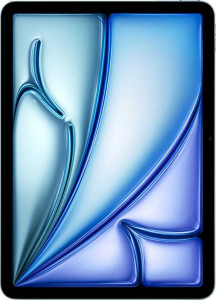
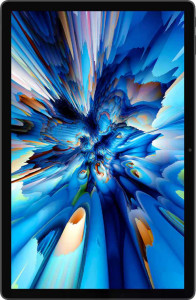
These two tablets take opposite approaches to display design, and the trade-offs are significant. The Blackview Mega 8 offers a larger 13″ panel compared to the iPad Air's 11″, which translates to more screen real estate for media, multitasking, and reading. However, size alone does not tell the full story — the Blackview achieves that larger canvas with a resolution of only 1920 x 1200 px, yielding a pixel density of just 174 ppi. The iPad Air 11 (2025), despite its smaller footprint, packs a 2360 x 1640 px resolution into a tighter area, resulting in 264 ppi — a 52% density advantage. At normal viewing distances, this difference is perceptible: text appears crisper, fine details in images are more defined, and the overall image simply looks more refined on the iPad Air.
Where the Blackview Mega 8 pushes back is refresh rate. Its 90Hz panel versus the iPad Air's 60Hz means scrolling and animations appear smoother on the Blackview, which some users — particularly those coming from high-refresh-rate phones — will notice immediately. That said, both devices share the same panel technology (IPS LCD) and both include an anti-reflection coating, so contrast, color accuracy, and outdoor glare handling start from the same baseline.
On balance, the iPad Air 11 (2025) holds the stronger display advantage for most users. The 90 ppi gap in pixel density has a broader and more constant impact on perceived quality than a 30Hz refresh rate uplift, which primarily benefits fast-scrolling or gaming scenarios. For productivity, reading, and content consumption — the primary use cases for tablets — sharpness wins out. The Blackview's larger screen is a genuine perk, but it is undermined by its comparatively low pixel density.