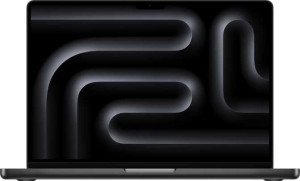
Apple MacBook Pro (2025) 14"
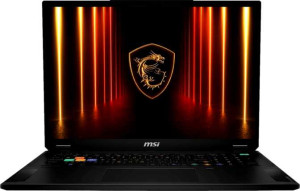
MSI Stealth A18 AI Plus A3XW (2025) 18"

Apple MacBook Pro (2025) 14" MSI Stealth A18 AI Plus A3XW (2025) 18"

Overview

Welcome to our in-depth spec comparison between the Apple MacBook Pro (2025) 14″ and the MSI Stealth A18 AI Plus A3XW (2025) 18″. These two laptops represent very different philosophies: one a refined productivity powerhouse built around efficiency and portability, the other a large-screen gaming machine engineered for raw capacity and graphical muscle. From CPU benchmark performance and display resolution to connectivity options and battery design, this comparison covers every key battleground to help you make the most informed choice.

Common Features

  • Neither product uses a fanless design.
  • Both products feature a backlit keyboard.
  • Neither product is weather-sealed or splashproof.
  • Neither product has a rugged build.
  • Both products use a Mini-LED display type.
  • Neither product has a touch screen.
  • Both products have a typical brightness of 1000 nits.
  • Both products have a 120Hz refresh rate.
  • Neither product has an anti-reflection coating.
  • Both products use flash storage that is NVMe SSD.
  • Both products support multithreading.
  • Both products use DDR5 memory.
  • Neither product has XeSS (XMX) support.
  • Both products support 64-bit processing.
  • Neither product has USB 3.2 Gen 2 ports (USB-C), USB 4 20Gbps ports, USB 3.2 Gen 1 ports (USB-C or USB-A), or Thunderbolt 3 ports.
  • Both products have an HDMI output.
  • Both products have USB Type-C connectivity.
  • Both products support Wi-Fi.
  • Both products have sleep-and-charge USB ports.
  • Both products have stereo speakers, a 3.5mm audio jack, a fingerprint scanner, 3D facial recognition, and a front camera.
  • Neither product includes a stylus or has an S/PDIF Out port or a gyroscope.
  • Neither product has an unlocked multiplier.
  • Both products have the NX bit and integrated graphics.

Main Differences

  • The Apple MacBook Pro (2025) 14″ is categorized as a Productivity laptop, while the MSI Stealth A18 AI Plus A3XW (2025) 18″ is categorized as a Gaming laptop.
  • Weight is 1550 g on the Apple MacBook Pro (2025) 14″ and 2890 g on the MSI Stealth A18 AI Plus A3XW (2025) 18″.
  • Volume is 1034.28 cm³ on the Apple MacBook Pro (2025) 14″ and 2190.909 cm³ on the MSI Stealth A18 AI Plus A3XW (2025) 18″.
  • Screen size is 14.2″ on the Apple MacBook Pro (2025) 14″ and 18″ on the MSI Stealth A18 AI Plus A3XW (2025) 18″.
  • Resolution is 3024 x 1964 px on the Apple MacBook Pro (2025) 14″ and 3840 x 2160 px on the MSI Stealth A18 AI Plus A3XW (2025) 18″.
  • Pixel density is 253 ppi on the Apple MacBook Pro (2025) 14″ and 244 ppi on the MSI Stealth A18 AI Plus A3XW (2025) 18″.
  • Supported external displays are 2 on the Apple MacBook Pro (2025) 14″ and 4 on the MSI Stealth A18 AI Plus A3XW (2025) 18″.
  • RAM is 32GB on the Apple MacBook Pro (2025) 14″ and 64GB on the MSI Stealth A18 AI Plus A3XW (2025) 18″.
  • Internal storage is 4096GB on the Apple MacBook Pro (2025) 14″ and 2048GB on the MSI Stealth A18 AI Plus A3XW (2025) 18″.
  • CPU speed is 4 x 4.6 & 6 x 3.2 GHz on the Apple MacBook Pro (2025) 14″ and 12 x 2 GHz on the MSI Stealth A18 AI Plus A3XW (2025) 18″.
  • CPU threads are 10 on the Apple MacBook Pro (2025) 14″ and 24 on the MSI Stealth A18 AI Plus A3XW (2025) 18″.
  • Maximum memory amount is 64GB on the Apple MacBook Pro (2025) 14″ and 96GB on the MSI Stealth A18 AI Plus A3XW (2025) 18″.
  • Semiconductor size is 3 nm on the Apple MacBook Pro (2025) 14″ and 4 nm on the MSI Stealth A18 AI Plus A3XW (2025) 18″.
  • Geekbench 6 multi-core score is 16832 on the Apple MacBook Pro (2025) 14″ and 13283 on the MSI Stealth A18 AI Plus A3XW (2025) 18″.
  • Geekbench 6 single-core score is 4188 on the Apple MacBook Pro (2025) 14″ and 2593 on the MSI Stealth A18 AI Plus A3XW (2025) 18″.
  • The MSI Stealth A18 AI Plus A3XW (2025) 18″ has 2 USB 3.2 Gen 2 (USB-A) ports, while the Apple MacBook Pro (2025) 14″ has none.
  • USB 4 40Gbps ports number 4 on the Apple MacBook Pro (2025) 14″ and 2 on the MSI Stealth A18 AI Plus A3XW (2025) 18″.
  • Thunderbolt 4 ports number 4 on the Apple MacBook Pro (2025) 14″ and 2 on the MSI Stealth A18 AI Plus A3XW (2025) 18″.
  • Wi-Fi 7 (802.11be) support is present on the MSI Stealth A18 AI Plus A3XW (2025) 18″ but not available on the Apple MacBook Pro (2025) 14″.
  • Bluetooth version is 5.3 on the Apple MacBook Pro (2025) 14″ and 5.4 on the MSI Stealth A18 AI Plus A3XW (2025) 18″.
  • Battery size is 72.4 Wh on the Apple MacBook Pro (2025) 14″ and 99.9 Wh on the MSI Stealth A18 AI Plus A3XW (2025) 18″.
  • MagSafe power adapter support is available on the Apple MacBook Pro (2025) 14″ but not on the MSI Stealth A18 AI Plus A3XW (2025) 18″.
  • Ray tracing support is present on the MSI Stealth A18 AI Plus A3XW (2025) 18″ but not available on the Apple MacBook Pro (2025) 14″.
  • DLSS support is present on the MSI Stealth A18 AI Plus A3XW (2025) 18″ but not available on the Apple MacBook Pro (2025) 14″.
  • Dolby Atmos support is available on the Apple MacBook Pro (2025) 14″ but not on the MSI Stealth A18 AI Plus A3XW (2025) 18″.
  • Number of microphones is 3 on the Apple MacBook Pro (2025) 14″ and 1 on the MSI Stealth A18 AI Plus A3XW (2025) 18″.
  • Voice command support is available on the Apple MacBook Pro (2025) 14″ but not on the MSI Stealth A18 AI Plus A3XW (2025) 18″.
  • Maximum memory bandwidth is 153 GB/s on the Apple MacBook Pro (2025) 14″ and 811.5 GB/s on the MSI Stealth A18 AI Plus A3XW (2025) 18″.
  • ECC memory support is available on the MSI Stealth A18 AI Plus A3XW (2025) 18″ but not on the Apple MacBook Pro (2025) 14″.
  • big.LITTLE technology is used on the Apple MacBook Pro (2025) 14″ but not on the MSI Stealth A18 AI Plus A3XW (2025) 18″.
  • Maximum RAM speed is 6400 MHz on the Apple MacBook Pro (2025) 14″ and 7500 MHz on the MSI Stealth A18 AI Plus A3XW (2025) 18″.
  • The GPU is the Apple M5 GPU on the Apple MacBook Pro (2025) 14″ and the Radeon 890M on the MSI Stealth A18 AI Plus A3XW (2025) 18″.
  • L2 cache is 16 MB on the Apple MacBook Pro (2025) 14″ and 12 MB on the MSI Stealth A18 AI Plus A3XW (2025) 18″.
Specs Comparison
Apple MacBook Pro (2025) 14"

Apple MacBook Pro (2025) 14"

MSI Stealth A18 AI Plus A3XW (2025) 18"

MSI Stealth A18 AI Plus A3XW (2025) 18"

Design:
Type Productivity Gaming
weight 1550 g 2890 g
Uses a fanless design
Has a backlit keyboard
volume 1034.28 cm³ 2190.909 cm³
width 312 mm 399 mm
height 221 mm 289 mm
thickness 15 mm 19 mm
is weather-sealed (splashproof)
has a rugged build

The most immediate differentiator in this group is weight and size. The MacBook Pro 14″ weighs 1550 g with a volume of 1034 cm³, while the MSI Stealth A18 comes in at 2890 g — nearly double — and occupies over 2190 cm³. In practice, this means the MacBook Pro is a laptop you can comfortably carry in a bag all day without noticing it, whereas the MSI Stealth A18 is a machine that will make itself felt on your shoulder during any commute. The MSI′s larger 18″ chassis (399 × 289 × 19 mm vs. 312 × 221 × 15 mm) is a direct consequence of its gaming-class internals, which demand more physical space for cooling and components.

Both laptops share a backlit keyboard and neither uses a fanless design, meaning both rely on active cooling — expected for a productivity powerhouse and a gaming machine alike. Neither is weather-sealed or rugged-rated, so both require the same standard of care in everyday handling.

On design intent, the two products serve fundamentally different use cases: the MacBook Pro 14″ is built around portability and desk-to-bag mobility, while the MSI Stealth A18 prioritizes screen real estate and thermal headroom at the cost of portability. If compactness and light carry weight are priorities, the MacBook Pro 14″ has a clear edge; if a larger workspace and a more expansive chassis suit your workflow, the trade-off in bulk with the MSI Stealth A18 is the deliberate design choice.

Display:
screen size 14.2" 18"
resolution 3024 x 1964 px 3840 x 2160 px
pixel density 253 ppi 244 ppi
Display type Mini-LED Mini-LED
has a touch screen
brightness (typical) 1000 nits 1000 nits
refresh rate 120Hz 120Hz
has anti-reflection coating
supported displays 2 4

Despite sitting at opposite ends of the size spectrum, both laptops share a remarkably similar display foundation: Mini-LED panels with 120Hz refresh rates and 1000 nits of typical brightness. This means both offer strong contrast, high peak luminance suitable for HDR content, and smooth motion — neither holds a clear advantage on panel technology or brightness alone.

Where the screens diverge is in raw canvas and resolution. The MSI Stealth A18′s 18″, 3840 × 2160 panel delivers a full 4K image with a massive physical workspace, ideal for gaming at native resolution or handling complex multi-window layouts. The MacBook Pro 14″ counters with a 3024 × 1964 resolution across a smaller 14.2″ screen, yielding a pixel density of 253 ppi versus the MSI′s 244 ppi — a difference so marginal it is essentially imperceptible in daily use. In practice, the two screens feel equally sharp; the MacBook simply trades total pixel count for a more compact footprint.

The more consequential gap is in external display support: the MSI Stealth A18 can drive up to 4 external displays, compared to just 2 on the MacBook Pro 14″. For users who anchor their laptop to a multi-monitor desk setup, this gives the MSI a meaningful advantage. Overall, both displays are well-matched on quality metrics, but the MSI Stealth A18 edges ahead for users who prioritize a larger screen or an expansive multi-display workstation configuration.

Performance:
RAM 32GB 64GB
Uses flash storage
internal storage 4096GB 2048GB
CPU speed 4 x 4.6 & 6 x 3.2 GHz 12 x 2 GHz
CPU threads 10 threads 24 threads
Is an NVMe SSD
uses multithreading
maximum memory amount 64GB 96GB
DDR memory version 5 5
semiconductor size 3 nm 4 nm
has XeSS (XMX)
Supports 64-bit

These two machines reflect fundamentally different CPU philosophies. The MacBook Pro 14″ runs a 10-core chip at up to 4.6 GHz on its performance cores — prioritizing raw single-core speed, which translates to snappier responsiveness in everyday tasks and latency-sensitive workloads. The MSI Stealth A18 takes the opposite approach: 24 threads across 12 cores, all running at a more modest 2 GHz, optimized for sustained parallel workloads like video rendering, simulation, or running multiple demanding processes simultaneously. Neither is universally superior; the right choice depends on whether your workload is thread-hungry or clock-hungry. The MacBook′s 3 nm fabrication node versus the MSI′s 4 nm also gives Apple′s chip a theoretical efficiency edge, which matters for heat and battery life under load.

On memory, the MSI ships with 64 GB of DDR5 RAM — double the MacBook Pro′s 32 GB — and scales to a maximum of 96 GB versus the MacBook′s 64 GB ceiling. For workloads that are memory-bound, such as large dataset processing, heavy virtualization, or running multiple resource-intensive applications in parallel, the MSI has a meaningful structural advantage both now and for future headroom. Storage tilts the other way: the MacBook Pro offers up to 4096 GB of NVMe flash, twice the MSI′s 2048 GB, which matters for users managing large local media libraries or archives without external drives.

In summary, neither machine dominates across the board. The MacBook Pro 14″ holds the edge in CPU clock speed and storage capacity, while the MSI Stealth A18 leads in thread count, RAM capacity, and maximum memory headroom. Productivity users who value single-task responsiveness and local storage will lean toward the MacBook; those running heavily parallelized or memory-intensive workloads will find the MSI′s configuration more accommodating.

Benchmarks:
Geekbench 6 result (multi) 16832 13283
Geekbench 6 result (single) 4188 2593

The Geekbench 6 results put a sharp point on what the raw specs suggested in the Performance group. The MacBook Pro 14″ scores 4188 in single-core versus the MSI Stealth A18′s 2593 — a gap of roughly 61%, which is substantial. Single-core performance is the most direct indicator of how responsive a machine feels during everyday tasks: launching apps, compiling code, handling UI interactions, and anything that cannot be parallelized. In that dimension, the MacBook Pro is decisively faster.

The multi-core picture is equally telling. Despite the MSI packing 24 threads to the MacBook′s 10, the MacBook Pro still leads with a multi-core score of 16832 against the MSI′s 13283 — a margin of around 27%. This means Apple′s chip not only wins on per-core speed but also holds its own in sustained parallel workloads, delivering more aggregate throughput even with fewer threads. The efficiency gains from its 3 nm architecture appear to more than compensate for the thread count disadvantage.

Across both benchmarks, the MacBook Pro 14″ holds a clear and significant advantage. For users where measured, real-world CPU performance is the deciding factor, the benchmark data consistently favors the MacBook Pro — not by a narrow margin, but by a gap wide enough to be felt across a broad range of workloads.

Connectivity:
USB 3.2 Gen 2 ports (USB-C) 0 0
USB 3.2 Gen 2 ports (USB-A) 0 2
USB 4 20Gbps ports 0 0
USB 4 40Gbps ports 4 2
Thunderbolt 4 ports 4 2
USB 3.2 Gen 1 ports (USB-C) 0 0
USB 3.2 Gen 1 ports (USB-A) 0 0
Thunderbolt 3 ports 0 0
has an HDMI output
Has USB Type-C
supports Wi-Fi
Wi-Fi version Wi-Fi 6E (802.11ax), Wi-Fi 6 (802.11ax), Wi-Fi 5 (802.11ac), Wi-Fi 4 (802.11n) Wi-Fi 7 (802.11be), Wi-Fi 6E (802.11ax), Wi-Fi 6 (802.11ax), Wi-Fi 5 (802.11ac), Wi-Fi 4 (802.11n)
has an external memory slot
Bluetooth version 5.3 5.4
RJ45 ports 0 0
HDMI ports 1 1
DisplayPort outputs 0 0
USB 2.0 ports 0 0
has AirPlay
mini DisplayPort outputs 0 0
has a VGA connector

High-speed wired connectivity favors the MacBook Pro 14″, which offers four Thunderbolt 4 / USB4 40Gbps ports compared to the MSI Stealth A18′s two. In practical terms, having four ports at that bandwidth tier means more simultaneous high-speed peripherals, external GPUs, fast docks, or displays — all without sacrificing one port for charging. The MSI compensates with two USB-A 3.2 Gen 2 ports, which the MacBook lacks entirely. For users with legacy peripherals — external drives, wired mice, dongles — the MSI connects without adapters, while MacBook Pro owners will need a hub or dongle for any USB-A device.

Wireless is where the MSI Stealth A18 pulls ahead. It supports Wi-Fi 7 (802.11be), the latest standard offering lower latency and higher theoretical throughput than the MacBook Pro′s maximum of Wi-Fi 6E. Similarly, the MSI ships with Bluetooth 5.4 versus 5.3 on the MacBook — a minor generational step, but one that brings incremental improvements in connection stability and efficiency. Neither difference is dramatic in day-to-day use today, but the MSI is better positioned as Wi-Fi 7 infrastructure becomes more widespread.

Both laptops share HDMI output, an external memory card slot, AirPlay support, and the absence of a wired Ethernet port. On balance, this group is split by use case: the MacBook Pro 14″ has the edge for users who rely on a high-speed wired peripheral ecosystem, while the MSI Stealth A18 is the stronger choice for wireless-first users and those who need USB-A compatibility without carrying adapters.
Battery:
battery size 72.4 Wh 99.9 Wh
Has sleep-and-charge USB ports
Has a MagSafe power adapter

Raw battery capacity sits firmly in the MSI Stealth A18′s favor: its 99.9 Wh cell is notably larger than the MacBook Pro 14″′s 72.4 Wh pack — a difference of roughly 38%. On capacity alone, the MSI holds more stored energy, which is the foundational input to battery life. That said, capacity only tells part of the story; how efficiently a chip and display consume that energy determines real-world runtime, and those factors fall outside this group′s data.

On charging, the MacBook Pro 14″ carries a meaningful convenience advantage with its MagSafe power adapter — a magnetic connector that detaches cleanly under tension, protecting both the cable and the laptop from accidental yanks. The MSI relies solely on its standard port for charging, without a dedicated magnetic safety connector. Both laptops support sleep-and-charge USB ports, allowing connected devices to charge even when the laptop itself is powered down — a useful feature shared equally between them.

Strictly on the specs provided, the MSI Stealth A18 has the edge in raw battery capacity, while the MacBook Pro 14″ offers a more refined charging experience via MagSafe. Users who prioritize stored energy will note the MSI′s larger cell; those who value daily charging ergonomics and cable safety will appreciate what MagSafe brings to the MacBook.

Features:
release date October 2025 March 2025
has stereo speakers
has a socket for a 3.5 mm audio jack
supports ray tracing
supports DLSS
has Dolby Atmos
Stylus included
Has a fingerprint scanner
number of microphones 3 1
Uses 3D facial recognition
has voice commands
has a front camera
Has S/PDIF Out port
has a gyroscope
has GPS
has an accelerometer
has a compass
Has an optical disc drive

The sharpest gaming-oriented split in this group is the MSI Stealth A18′s support for ray tracing and DLSS — two GPU-driven technologies that the MacBook Pro 14″ lacks entirely. Ray tracing enables physically accurate lighting and reflections in supported games, while DLSS uses AI upscaling to recover frame rates lost to that rendering overhead. For a gaming machine, these are meaningful capabilities; their absence on the MacBook reflects its productivity-focused GPU architecture rather than a missing feature.

Audio and microphone quality tell a different story. The MacBook Pro 14″ ships with Dolby Atmos support and a 3-microphone array, compared to the MSI′s single microphone and no Dolby Atmos. A three-mic array produces noticeably better voice capture for calls and recordings — isolating the speaker, reducing background noise, and improving clarity. Dolby Atmos adds a spatial audio layer to both speakers and headphone output. For users who rely on their laptop for video calls, content creation, or media consumption, the MacBook′s audio setup is more capable on paper.

Both laptops share fingerprint scanning, 3D facial recognition, a front camera, stereo speakers, and a 3.5 mm audio jack — a solid common baseline for security and communication. On balance, the MacBook Pro 14″ has the broader feature edge for productivity and communication use cases, while the MSI Stealth A18 holds the advantage specifically for gaming through its ray tracing and DLSS support.

Miscellaneous:
clock multiplier 46 20
GPU name Apple M5 GPU Radeon 890M
Has an unlocked multiplier
L2 cache 16 MB 12 MB
Type Laptop Laptop, Desktop
Supports ECC memory
maximum memory bandwidth 153 GB/s 811.5 GB/s
Has NX bit
Has integrated graphics
Uses big.LITTLE technology
RAM speed (max) 6400 MHz 7500 MHz

The most striking figure in this group is memory bandwidth: the MSI Stealth A18′s 811.5 GB/s dwarfs the MacBook Pro 14″′s 153 GB/s — a more than five-fold difference. Memory bandwidth governs how quickly the CPU and GPU can feed data to and from RAM, and it is a critical bottleneck for graphics-intensive workloads, large matrix operations, and AI inference tasks. The MSI also edges ahead on RAM speed at 7500 MHz versus 6400 MHz, reinforcing its advantage in raw data throughput. For workloads that are bandwidth-bound rather than compute-bound, the MSI′s architecture has a substantial structural lead.

The MacBook Pro 14″ counters with a larger L2 cache of 16 MB versus 12 MB, which helps its CPU cores resolve more operations without reaching out to slower main memory — a meaningful contributor to its strong single-core benchmark results seen earlier. It also uses big.LITTLE technology, pairing high-performance and efficiency cores to intelligently balance throughput and power draw, an architecture the MSI does not employ. The MSI, meanwhile, supports ECC memory — error-correcting RAM that detects and fixes single-bit memory errors on the fly — making it more suitable for workloads where data integrity is critical, such as scientific computing or financial modelling.

This group reflects two genuinely different engineering priorities. The MacBook Pro 14″ is optimized for intelligent, efficient CPU execution with its larger cache and heterogeneous core design, while the MSI Stealth A18 prioritizes raw memory throughput and data integrity via its vastly higher bandwidth and ECC support. Neither is a clear overall winner here — the right advantage depends entirely on the workload.

Comparison Summary & Verdict

After reviewing all the evidence, it is clear that these two laptops are built for fundamentally different audiences. The Apple MacBook Pro (2025) 14″ stands out with superior single- and multi-core benchmark scores, a significantly lighter and more compact chassis at just 1550 g, four Thunderbolt 4 ports, Dolby Atmos audio, three-microphone array, and MagSafe charging — making it the ideal choice for professionals who prioritize portability and day-to-day performance. The MSI Stealth A18 AI Plus A3XW (2025) 18″, on the other hand, dominates in areas critical to gamers and power users: it offers 64GB of RAM, support for up to 96GB, a massive 18″ 4K display, ray tracing and DLSS support, Wi-Fi 7 connectivity, ECC memory compatibility, and a staggering 811.5 GB/s memory bandwidth. Choose the MacBook Pro for elite productivity on the go; choose the MSI Stealth for a desktop-class gaming and compute experience in a laptop form factor.

Apple MacBook Pro (2025) 14
Buy Apple MacBook Pro (2025) 14" if...

Buy the Apple MacBook Pro (2025) 14" if you need a lightweight, portable laptop with top-tier CPU benchmark performance, four Thunderbolt 4 ports, Dolby Atmos audio, and a compact design ideal for professional productivity on the go.

MSI Stealth A18 AI Plus A3XW (2025) 18
Buy MSI Stealth A18 AI Plus A3XW (2025) 18" if...

Buy the MSI Stealth A18 AI Plus A3XW (2025) 18" if you want a high-capacity gaming and power-user machine with a large 4K display, 64GB of RAM, ray tracing and DLSS support, Wi-Fi 7, and massively higher memory bandwidth.