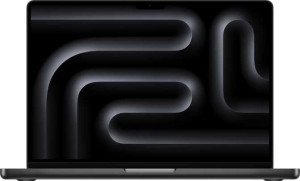
Apple MacBook Pro (2025) 14"
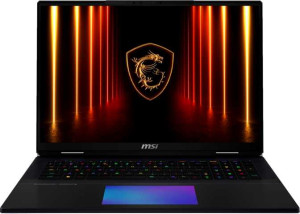
MSI Titan 18 HX AI A2XW (2025) 18" (Ultra 9 285HX / RTX 5080 Laptop / 64GB RAM / 4TB)

Apple MacBook Pro (2025) 14" MSI Titan 18 HX AI A2XW (2025) 18" (Ultra 9 285HX / RTX 5080 Laptop / 64GB RAM / 4TB)

Overview

Welcome to our in-depth spec comparison between the Apple MacBook Pro (2025) 14″ and the MSI Titan 18 HX AI A2XW (2025) 18″ (Ultra 9 285HX / RTX 5080 Laptop / 64GB RAM / 4TB). These two laptops represent very different philosophies: one a refined productivity powerhouse built for portability, the other a hulking gaming beast engineered for raw performance. We examine key battlegrounds including display quality, processing power, connectivity, and everyday usability to help you find the right fit.

Common Features

  • Neither product uses a fanless design.
  • Both products have a backlit keyboard.
  • Neither product is weather-sealed or splashproof.
  • Neither product has a rugged build.
  • Neither product has a touch screen.
  • Both products have a 120Hz refresh rate.
  • Neither product has an anti-reflection coating.
  • Both products use flash storage.
  • Both products have 4096GB of internal storage.
  • Both products use an NVMe SSD.
  • Both products support multithreading.
  • Both products use DDR5 memory.
  • Neither product supports XeSS (XMX).
  • Both products support 64-bit processing.
  • Neither product has USB 3.2 Gen 2 ports (USB-C).
  • Neither product has USB 4 20Gbps ports.
  • Neither product has USB 3.2 Gen 1 ports (USB-C or USB-A).
  • Neither product has Thunderbolt 3 ports.
  • Both products have an HDMI output.
  • Both products have USB Type-C.
  • Both products support Wi-Fi.
  • Both products have sleep-and-charge USB ports.
  • Both products have stereo speakers.
  • Both products have a 3.5mm audio jack.
  • Neither product includes a stylus.
  • Both products have a front camera.
  • Neither product has an S/PDIF Out port.
  • Neither product has a gyroscope.
  • Neither product has GPS.
  • Neither product has an accelerometer.
  • Both products are laptops.
  • Both products have the NX bit.
  • Both products have integrated graphics.
  • Both products use big.LITTLE technology.
  • Both products have a maximum RAM speed of 6400 MHz.

Main Differences

  • The Apple MacBook Pro (2025) 14″ is categorized as a productivity laptop, while the MSI Titan 18 HX AI A2XW (2025) 18″ (Ultra 9 285HX / RTX 5080 Laptop / 64GB RAM / 4TB) is categorized as a gaming laptop.
  • Weight is 1550g on the Apple MacBook Pro (2025) 14″ and 3600g on the MSI Titan 18 HX AI A2XW (2025) 18″ (Ultra 9 285HX / RTX 5080 Laptop / 64GB RAM / 4TB).
  • Volume is 1034.28 cm³ on the Apple MacBook Pro (2025) 14″ and 2976.672 cm³ on the MSI Titan 18 HX AI A2XW (2025) 18″ (Ultra 9 285HX / RTX 5080 Laptop / 64GB RAM / 4TB).
  • Width is 312mm on the Apple MacBook Pro (2025) 14″ and 404mm on the MSI Titan 18 HX AI A2XW (2025) 18″ (Ultra 9 285HX / RTX 5080 Laptop / 64GB RAM / 4TB).
  • Height is 221mm on the Apple MacBook Pro (2025) 14″ and 307mm on the MSI Titan 18 HX AI A2XW (2025) 18″ (Ultra 9 285HX / RTX 5080 Laptop / 64GB RAM / 4TB).
  • Thickness is 15mm on the Apple MacBook Pro (2025) 14″ and 24mm on the MSI Titan 18 HX AI A2XW (2025) 18″ (Ultra 9 285HX / RTX 5080 Laptop / 64GB RAM / 4TB).
  • Screen size is 14.2″ on the Apple MacBook Pro (2025) 14″ and 18″ on the MSI Titan 18 HX AI A2XW (2025) 18″ (Ultra 9 285HX / RTX 5080 Laptop / 64GB RAM / 4TB).
  • Resolution is 3024 x 1964 px on the Apple MacBook Pro (2025) 14″ and 3840 x 2400 px on the MSI Titan 18 HX AI A2XW (2025) 18″ (Ultra 9 285HX / RTX 5080 Laptop / 64GB RAM / 4TB).
  • Pixel density is 253 ppi on the Apple MacBook Pro (2025) 14″ and 251 ppi on the MSI Titan 18 HX AI A2XW (2025) 18″ (Ultra 9 285HX / RTX 5080 Laptop / 64GB RAM / 4TB).
  • Display type is Mini-LED on the Apple MacBook Pro (2025) 14″ and LCD Mini-LED on the MSI Titan 18 HX AI A2XW (2025) 18″ (Ultra 9 285HX / RTX 5080 Laptop / 64GB RAM / 4TB).
  • The Apple MacBook Pro (2025) 14″ supports up to 2 external displays, while the MSI Titan 18 HX AI A2XW (2025) 18″ (Ultra 9 285HX / RTX 5080 Laptop / 64GB RAM / 4TB) supports up to 4.
  • RAM is 32GB on the Apple MacBook Pro (2025) 14″ and 64GB on the MSI Titan 18 HX AI A2XW (2025) 18″ (Ultra 9 285HX / RTX 5080 Laptop / 64GB RAM / 4TB).
  • CPU speed is 4 x 4.6 & 6 x 3.2 GHz on the Apple MacBook Pro (2025) 14″ and 8 x 2.8 & 16 x 2.1 GHz on the MSI Titan 18 HX AI A2XW (2025) 18″ (Ultra 9 285HX / RTX 5080 Laptop / 64GB RAM / 4TB).
  • CPU threads total 10 on the Apple MacBook Pro (2025) 14″ and 24 on the MSI Titan 18 HX AI A2XW (2025) 18″ (Ultra 9 285HX / RTX 5080 Laptop / 64GB RAM / 4TB).
  • Maximum memory amount is 64GB on the Apple MacBook Pro (2025) 14″ and 96GB on the MSI Titan 18 HX AI A2XW (2025) 18″ (Ultra 9 285HX / RTX 5080 Laptop / 64GB RAM / 4TB).
  • Semiconductor size is 3nm on the Apple MacBook Pro (2025) 14″ and 4nm on the MSI Titan 18 HX AI A2XW (2025) 18″ (Ultra 9 285HX / RTX 5080 Laptop / 64GB RAM / 4TB).
  • The MSI Titan 18 HX AI A2XW (2025) 18″ (Ultra 9 285HX / RTX 5080 Laptop / 64GB RAM / 4TB) has 3 USB 3.2 Gen 2 ports (USB-A), while the Apple MacBook Pro (2025) 14″ has none.
  • USB 4 40Gbps ports number 4 on the Apple MacBook Pro (2025) 14″ and 2 on the MSI Titan 18 HX AI A2XW (2025) 18″ (Ultra 9 285HX / RTX 5080 Laptop / 64GB RAM / 4TB).
  • Thunderbolt 4 ports number 4 on the Apple MacBook Pro (2025) 14″, while the MSI Titan 18 HX AI A2XW (2025) 18″ (Ultra 9 285HX / RTX 5080 Laptop / 64GB RAM / 4TB) has none.
  • The MSI Titan 18 HX AI A2XW (2025) 18″ (Ultra 9 285HX / RTX 5080 Laptop / 64GB RAM / 4TB) supports Wi-Fi 7 (802.11be) in addition to older standards, while the Apple MacBook Pro (2025) 14″ tops out at Wi-Fi 6E (802.11ax).
  • Bluetooth version is 5.3 on the Apple MacBook Pro (2025) 14″ and 5.4 on the MSI Titan 18 HX AI A2XW (2025) 18″ (Ultra 9 285HX / RTX 5080 Laptop / 64GB RAM / 4TB).
  • An RJ45 (ethernet) port is present on the MSI Titan 18 HX AI A2XW (2025) 18″ (Ultra 9 285HX / RTX 5080 Laptop / 64GB RAM / 4TB) but not available on the Apple MacBook Pro (2025) 14″.
  • Battery size is 72.4 Wh on the Apple MacBook Pro (2025) 14″ and 99 Wh on the MSI Titan 18 HX AI A2XW (2025) 18″ (Ultra 9 285HX / RTX 5080 Laptop / 64GB RAM / 4TB).
  • A MagSafe power adapter is included with the Apple MacBook Pro (2025) 14″ but is not available on the MSI Titan 18 HX AI A2XW (2025) 18″ (Ultra 9 285HX / RTX 5080 Laptop / 64GB RAM / 4TB).
  • Ray tracing support is present on the MSI Titan 18 HX AI A2XW (2025) 18″ (Ultra 9 285HX / RTX 5080 Laptop / 64GB RAM / 4TB) but not available on the Apple MacBook Pro (2025) 14″.
  • DLSS support is present on the MSI Titan 18 HX AI A2XW (2025) 18″ (Ultra 9 285HX / RTX 5080 Laptop / 64GB RAM / 4TB) but not available on the Apple MacBook Pro (2025) 14″.
  • Dolby Atmos support is present on the Apple MacBook Pro (2025) 14″ but not available on the MSI Titan 18 HX AI A2XW (2025) 18″ (Ultra 9 285HX / RTX 5080 Laptop / 64GB RAM / 4TB).
  • A fingerprint scanner is present on the Apple MacBook Pro (2025) 14″ but not available on the MSI Titan 18 HX AI A2XW (2025) 18″ (Ultra 9 285HX / RTX 5080 Laptop / 64GB RAM / 4TB).
  • Number of microphones is 3 on the Apple MacBook Pro (2025) 14″ and 1 on the MSI Titan 18 HX AI A2XW (2025) 18″ (Ultra 9 285HX / RTX 5080 Laptop / 64GB RAM / 4TB).
  • 3D facial recognition is present on the Apple MacBook Pro (2025) 14″ but not available on the MSI Titan 18 HX AI A2XW (2025) 18″ (Ultra 9 285HX / RTX 5080 Laptop / 64GB RAM / 4TB).
  • Voice command support is present on the Apple MacBook Pro (2025) 14″ but not available on the MSI Titan 18 HX AI A2XW (2025) 18″ (Ultra 9 285HX / RTX 5080 Laptop / 64GB RAM / 4TB).
  • Clock multiplier is 46 on the Apple MacBook Pro (2025) 14″ and 28 on the MSI Titan 18 HX AI A2XW (2025) 18″ (Ultra 9 285HX / RTX 5080 Laptop / 64GB RAM / 4TB).
  • An unlocked clock multiplier is available on the MSI Titan 18 HX AI A2XW (2025) 18″ (Ultra 9 285HX / RTX 5080 Laptop / 64GB RAM / 4TB) but not on the Apple MacBook Pro (2025) 14″.
  • L2 cache is 16MB on the Apple MacBook Pro (2025) 14″ and 40MB on the MSI Titan 18 HX AI A2XW (2025) 18″ (Ultra 9 285HX / RTX 5080 Laptop / 64GB RAM / 4TB).
  • ECC memory support is present on the MSI Titan 18 HX AI A2XW (2025) 18″ (Ultra 9 285HX / RTX 5080 Laptop / 64GB RAM / 4TB) but not available on the Apple MacBook Pro (2025) 14″.
  • Maximum memory bandwidth is 153 GB/s on the Apple MacBook Pro (2025) 14″ and 811.5 GB/s on the MSI Titan 18 HX AI A2XW (2025) 18″ (Ultra 9 285HX / RTX 5080 Laptop / 64GB RAM / 4TB).
Specs Comparison
Apple MacBook Pro (2025) 14"

Apple MacBook Pro (2025) 14"

MSI Titan 18 HX AI A2XW (2025) 18" (Ultra 9 285HX / RTX 5080 Laptop / 64GB RAM / 4TB)

MSI Titan 18 HX AI A2XW (2025) 18" (Ultra 9 285HX / RTX 5080 Laptop / 64GB RAM / 4TB)

Design:
Type Productivity Gaming
weight 1550 g 3600 g
Uses a fanless design
Has a backlit keyboard
volume 1034.28 cm³ 2976.672 cm³
width 312 mm 404 mm
height 221 mm 307 mm
thickness 15 mm 24 mm
is weather-sealed (splashproof)
has a rugged build

The most defining design difference between these two machines is sheer physical presence. The Apple MacBook Pro 14″ weighs just 1,550 g and occupies roughly 1,034 cm³ of space, while the MSI Titan 18 HX AI tips the scales at 3,600 g — more than double — and displaces nearly 2,977 cm³. In practice, this means the MacBook Pro can comfortably live in a slim backpack and be carried all day without fatigue, whereas the Titan is better described as a portable workstation that moves between desks rather than a true on-the-go companion.

The dimensional gap reinforces this contrast. The MacBook Pro's 15 mm thickness against the Titan's 24 mm is immediately felt when placing either machine in a bag, and the Titan's footprint of 404 × 307 mm versus the MacBook's 312 × 221 mm means it demands meaningfully more desk space. Both laptops share a backlit keyboard and active cooling (neither uses a fanless design), and neither is weather-sealed or ruggedized, so those criteria are a wash.

For design, the MacBook Pro 14″ has a clear and decisive advantage in portability and compactness — a direct consequence of its productivity-focused form factor. The MSI Titan's bulk is an intentional engineering trade-off to accommodate high-end gaming hardware, but if physical footprint and carry weight matter at all to the buyer, the MacBook Pro wins this category outright.

Display:
screen size 14.2" 18"
resolution 3024 x 1964 px 3840 x 2400 px
pixel density 253 ppi 251 ppi
Display type Mini-LED LCD, Mini-LED
has a touch screen
refresh rate 120Hz 120Hz
has anti-reflection coating
supported displays 2 4

On paper, both screens are remarkably close in pixel density — 253 ppi for the MacBook Pro 14″ versus 251 ppi for the MSI Titan 18″ — which means sharpness per inch is essentially identical despite the Titan's significantly larger 3840 × 2400 resolution. That higher resolution on the Titan is really a function of its bigger canvas rather than a meaningful clarity advantage, and in everyday use neither screen will look noticeably sharper than the other at normal viewing distances.

Where the two diverge more meaningfully is in multi-display support and panel labeling. The MacBook Pro supports up to 2 external displays, while the Titan accommodates up to 4 — a significant edge for users who need an expansive multi-monitor desktop setup. Both panels are Mini-LED-based and share a 120Hz refresh rate, and neither offers a touchscreen or anti-reflection coating, making those attributes a complete tie.

Overall, the MSI Titan holds a practical edge in this group, primarily due to its larger screen real estate and superior external display support — advantages that matter most to power users who treat the laptop as a desktop replacement hub. The MacBook Pro's display is no less technically refined, but its more limited connectivity puts it at a disadvantage for multi-screen workflows.

Performance:
RAM 32GB 64GB
Uses flash storage
internal storage 4096GB 4096GB
CPU speed 4 x 4.6 & 6 x 3.2 GHz 8 x 2.8 & 16 x 2.1 GHz
CPU threads 10 threads 24 threads
Is an NVMe SSD
uses multithreading
maximum memory amount 64GB 96GB
DDR memory version 5 5
semiconductor size 3 nm 4 nm
has XeSS (XMX)
Supports 64-bit

Thread count and clock architecture tell very different stories here. The MacBook Pro 14″ runs a 10-thread CPU with high peak clocks — up to 4.6 GHz on its performance cores — built on a leading-edge 3 nm process. The MSI Titan counters with a 24-thread CPU, nearly two and a half times more threads, though its cores operate at more modest clock speeds topping out at 2.8 GHz. In practice, the MacBook Pro's architecture favors single-threaded and lightly-threaded tasks where raw clock speed dominates, while the Titan's broader core count gives it a structural advantage in heavily parallelized workloads such as video encoding, 3D rendering, and large compilation jobs.

Memory is another area where the Titan pulls ahead. It ships with 64GB of RAM — double the MacBook's 32GB — and can be expanded to 96GB versus the MacBook's ceiling of 64GB. Both platforms use DDR5 memory and NVMe flash storage, and storage capacity is identical at 4TB, so those specs are a wash. The Titan's higher RAM ceiling is relevant for users running memory-intensive workloads like large datasets, virtual machines, or complex simulation environments.

On semiconductor process, the MacBook Pro's 3 nm chip has a fabrication edge over the Titan's 4 nm, which generally translates to better power efficiency per transistor — though real-world efficiency depends heavily on overall system design. Taken together, the MSI Titan holds the broader performance advantage in this group for throughput-heavy and memory-demanding tasks, thanks to its superior thread count and higher RAM capacity. The MacBook Pro's faster clocks keep it competitive in single-threaded scenarios, but the Titan's raw specification headroom is wider.

Connectivity:
USB 3.2 Gen 2 ports (USB-C) 0 0
USB 3.2 Gen 2 ports (USB-A) 0 3
USB 4 20Gbps ports 0 0
USB 4 40Gbps ports 4 2
Thunderbolt 4 ports 4 0
USB 3.2 Gen 1 ports (USB-C) 0 0
USB 3.2 Gen 1 ports (USB-A) 0 0
Thunderbolt 3 ports 0 0
has an HDMI output
Has USB Type-C
supports Wi-Fi
Wi-Fi version Wi-Fi 6E (802.11ax), Wi-Fi 6 (802.11ax), Wi-Fi 5 (802.11ac), Wi-Fi 4 (802.11n) Wi-Fi 7 (802.11be), Wi-Fi 6E (802.11ax), Wi-Fi 6 (802.11ax), Wi-Fi 5 (802.11ac), Wi-Fi 4 (802.11n)
has an external memory slot
Bluetooth version 5.3 5.4
RJ45 ports 0 1
HDMI ports 1 1
DisplayPort outputs 0 0
has AirPlay
mini DisplayPort outputs 0 0
has a VGA connector

The port philosophy of these two machines reflects their intended audiences sharply. The MacBook Pro 14″ goes all-in on high-speed unified ports, offering 4 Thunderbolt 4 connections — each capable of 40 Gbps data transfer, display output, and power delivery simultaneously. The MSI Titan matches that bandwidth tier with 2 USB4 40Gbps ports but adds something the MacBook entirely lacks: 3 USB-A 3.2 Gen 2 ports and a dedicated RJ45 ethernet jack. For users with existing USB-A peripherals or a need for reliable wired networking, the Titan requires no dongles or adapters — a meaningful convenience the MacBook cannot offer out of the box.

Wireless connectivity tilts clearly in the Titan's favor. It supports Wi-Fi 7 (802.11be), the latest standard offering lower latency and higher throughput in congested environments, while the MacBook tops out at Wi-Fi 6E. The Titan also edges ahead on Bluetooth 5.4 versus the MacBook's 5.3, though the practical difference between those two versions is minimal for most users. Both share HDMI output, an external memory slot, and AirPlay support.

Connectivity here is a genuine split rather than a clean win for either side. The MacBook Pro holds the advantage in port quality and versatility — four Thunderbolt 4 ports is an exceptional concentration of bandwidth and functionality. But the MSI Titan wins on breadth: wired ethernet, legacy USB-A compatibility, and the latest Wi-Fi 7 standard make it the more self-sufficient machine for varied real-world environments, especially in fixed desk setups or competitive gaming contexts where a direct network connection matters.

Battery:
battery size 72.4 Wh 99 Wh
Has sleep-and-charge USB ports
Has a MagSafe power adapter

Raw capacity favors the MSI Titan, which packs a 99 Wh battery against the MacBook Pro 14″'s 72.4 Wh cell — a 37% larger reservoir on paper. However, battery capacity alone is a poor predictor of runtime; what matters is how efficiently the system draws from it. A high-powered gaming laptop with a discrete GPU and a large display will drain a 99 Wh pack considerably faster under load than a compact productivity machine consumes a smaller one, so the raw Wh advantage the Titan holds may not translate into longer real-world unplugged time.

Both laptops support sleep-and-charge USB ports, meaning they can top up external devices even when the lid is closed — a useful shared convenience. The meaningful differentiator here is the MacBook Pro's MagSafe power adapter, which the Titan lacks. MagSafe provides a dedicated magnetic charging port that keeps the laptop's USB-C ports free while charging, and its breakaway design protects against accidental cable yanks — a practical daily-use advantage that adds up over time.

This group is effectively a trade-off rather than a clear overall win. The Titan holds the edge in battery capacity, but the MacBook Pro counters with MagSafe — a charging experience feature the Titan simply cannot match. Buyers prioritizing raw energy storage will note the Titan's larger cell, while those who value charging convenience and port preservation will find the MacBook Pro's approach more refined.

Features:
release date October 2025 February 2025
has stereo speakers
has a socket for a 3.5 mm audio jack
supports ray tracing
supports DLSS
has Dolby Atmos
Stylus included
Has a fingerprint scanner
number of microphones 3 1
Uses 3D facial recognition
has voice commands
has a front camera
Has S/PDIF Out port
has a gyroscope
has GPS
has an accelerometer
has a compass
Has an optical disc drive

Gaming-centric graphics features split these two machines cleanly. The MSI Titan supports both ray tracing and DLSS — capabilities the MacBook Pro 14″ entirely lacks. For gamers and real-time 3D artists, this is significant: ray tracing enables physically accurate lighting and reflections, while DLSS uses AI upscaling to recover frame rates lost to that rendering overhead. The MacBook Pro, absent these features, is simply not positioned for that workload based on the provided specs.

Security and biometrics tell the opposite story. The MacBook Pro offers a fingerprint scanner, 3D facial recognition, voice commands, and a 3-microphone array — a notably richer suite of authentication and input options compared to the Titan, which provides none of those features and relies on just a single microphone. For users who prioritize secure, convenient login and hands-free interaction, the MacBook Pro's feature set is meaningfully deeper. On audio, the MacBook adds Dolby Atmos support while the Titan does not, which benefits spatial audio playback through compatible content.

Both share stereo speakers, a 3.5 mm audio jack, and a front camera, so those are a draw. Overall, this group is a clear case of divergent priorities: the MSI Titan wins decisively for graphics and gaming features, while the MacBook Pro holds a strong advantage in security, biometrics, and audio. Which side matters more depends entirely on the buyer's primary use case.

Miscellaneous:
clock multiplier 46 28
Has an unlocked multiplier
L2 cache 16 MB 40 MB
Type Laptop Laptop
Supports ECC memory
maximum memory bandwidth 153 GB/s 811.5 GB/s
Has NX bit
Has integrated graphics
Uses big.LITTLE technology
RAM speed (max) 6400 MHz 6400 MHz

The single most striking figure in this group is memory bandwidth: the MSI Titan delivers a remarkable 811.5 GB/s versus the MacBook Pro 14″'s 153 GB/s — more than five times greater. Memory bandwidth governs how quickly the CPU and GPU can feed data to and from RAM, and at this scale of difference, the Titan has a structural advantage in bandwidth-hungry workloads such as large matrix operations, high-resolution texture streaming, and AI inference tasks that saturate memory pipelines. Both machines cap RAM speed at 6400 MHz, so the bandwidth gap is a product of architecture rather than clock rate alone.

Cache and overclocking tell another layered story. The Titan's 40 MB L2 cache dwarfs the MacBook's 16 MB, meaning the Titan can hold significantly more frequently-accessed data close to the CPU cores before needing to reach out to slower main memory — a tangible benefit for complex, data-intensive computations. The Titan also ships with an unlocked multiplier, giving technically inclined users the option to push clock speeds beyond factory settings, a capability the MacBook Pro does not offer. Additionally, the Titan supports ECC memory, which can detect and correct memory errors — a feature valued in workstation and data-integrity-critical environments that the MacBook Pro omits.

Shared attributes — big.LITTLE hybrid core architecture, integrated graphics, NX bit support, and laptop form factor — produce no differentiation between the two. Taken as a whole, the MSI Titan holds a commanding advantage in this group, with its vastly superior memory bandwidth, larger L2 cache, ECC support, and overclocking headroom collectively positioning it as the more capable platform for demanding, throughput-sensitive professional and enthusiast workloads.
Comparison Summary & Verdict

After reviewing every specification, it is clear that each laptop excels in its intended domain. The Apple MacBook Pro (2025) 14″ stands out for users who value portability and premium build: at just 1550g with a 3nm chip, Thunderbolt 4, MagSafe charging, 3D facial recognition, a fingerprint scanner, and Dolby Atmos audio, it is a refined daily companion for professionals on the move. The MSI Titan 18 HX AI A2XW, by contrast, dominates on sheer muscle — offering 64GB of RAM, a massive 811.5 GB/s memory bandwidth, 24 CPU threads, ray tracing, DLSS support, Wi-Fi 7, an unlocked clock multiplier, ECC memory support, and a larger 99 Wh battery, all wrapped in an 18″ high-resolution display. Choose the MacBook Pro for polished productivity; choose the MSI Titan if uncompromising gaming and computational performance is your priority.

Apple MacBook Pro (2025) 14
Buy Apple MacBook Pro (2025) 14" if...

Buy the Apple MacBook Pro (2025) 14″ if you need a lightweight, portable productivity laptop with Thunderbolt 4, MagSafe charging, 3D facial recognition, and Dolby Atmos — all in a compact 1550g chassis built on a cutting-edge 3nm chip.

MSI Titan 18 HX AI A2XW (2025) 18
Buy MSI Titan 18 HX AI A2XW (2025) 18" (Ultra 9 285HX / RTX 5080 Laptop / 64GB RAM / 4TB) if...

Buy the MSI Titan 18 HX AI A2XW (2025) 18″ (Ultra 9 285HX / RTX 5080 Laptop / 64GB RAM / 4TB) if you demand maximum gaming and creative performance, with ray tracing, DLSS, 64GB of RAM, 24 CPU threads, Wi-Fi 7, an unlocked CPU multiplier, and a stunning 18″ 4K Mini-LED display.